A PLC is the box that makes a factory machine repeat the same sequence ten thousand times without drifting. It is not a better Arduino. It is a rugged industrial computer with isolated 24 V inputs, deterministic scan logic, diagnostics that name the failed sensor, and a support ecosystem measured in decades.
If you can read a relay circuit and write a small microcontroller program, you can learn PLC programming. The hard part is not ladder logic; it is buying the right starter hardware and understanding how a scan cycle changes the way you think about a program.
What a PLC does that a microcontroller does not
| Property | PLC | Arduino or ESP32 |
|---|---|---|
| Electrical environment | 24 V isolated I/O, surge and short protection | 3.3–5 V pins, needs level shifting and protection |
| Execution | Deterministic scan cycle, watchdog, retentive memory | Free-running loop; timing depends on your code |
| Programming | Ladder, function block, structured text (IEC 61131-3) | C, C++, MicroPython |
| Diagnostics | Module and channel faults reported by name | Whatever you added yourself |
| Lifecycle | Spare parts and software supported for many years | Board revisions and library drift |
| Cost | Higher per point | Very low |
A PLC is the correct choice when a machine must keep running for a decade, when an electrician must troubleshoot it at 2 a.m., and when a fault has to stop the line safely. A microcontroller is the correct choice inside a product you design, where you control the enclosure, the power and the maintenance.
The scan cycle is the mental model
A PLC repeats three steps forever: read every input into memory, solve the program top to bottom, then write the output image to the terminals. The whole loop might take 1–20 ms. Two consequences matter to a beginner.
- Inputs are a snapshot. A pulse shorter than the scan time can be missed unless you use a high-speed input or an interrupt block.
- Order matters. A rung that sets a coil and a later rung that resets it will behave differently from the reverse order. Ladder is read like a circuit, but executed like a list.
Ladder logic in one page
Ladder looks like a relay diagram because that is what it replaced. A normally open contact passes power when its tag is true. A normally closed contact passes when its tag is false. A coil writes its rung result to a tag or an output.
The classic start-stop circuit is the first thing to build. A start pushbutton is wired in parallel with a seal-in contact from the motor output, so releasing the button does not stop the motor. A normally closed stop button sits in series. In ladder terms: start OR motor, AND NOT stop, drives motor. Every motor starter, conveyor and pump in a plant uses some version of this pattern.
After contacts and coils, learn four instructions: on-delay timer, off-delay timer, counter, and a move or compare block. With those you can build 80% of the small machines you will meet in interviews: a conveyor that runs for a set time after a sensor clears, a bottle counter that stops the line at a target, an alarm that waits three seconds to avoid nuisance trips.
Which platform to learn on in India
| Platform | Indicative cost | Why pick it |
|---|---|---|
| Siemens S7-1200 starter kit | ₹35,000–70,000 | Most common in Indian factories and process plants; TIA Portal skills are asked for in job ads |
| Delta DVP series | ₹7,000–18,000 | Cheap, widely used in packaging and small machines; free ISPSoft software |
| Mitsubishi FX5U | ₹30,000–60,000 | Common in Japanese-origin production lines; GX Works3 |
| Allen-Bradley Micro850 | ₹35,000–70,000 | Common in multinational plants; Connected Components Workbench is free |
| Codesys on a Raspberry Pi | ₹5,000–8,000 | Free runtime for learning IEC 61131-3 languages without vendor hardware |
| Simulation only | ₹0 | PLCSIM, factory I/O trials and vendor simulators; good for logic, weak for wiring |
Prices move with GST, module mix and dealer stock, so treat these as planning ranges. Second-hand PLCs are common on resale sites; a used CPU without a tested power supply and a known-good input card usually costs more in debugging time than it saves.
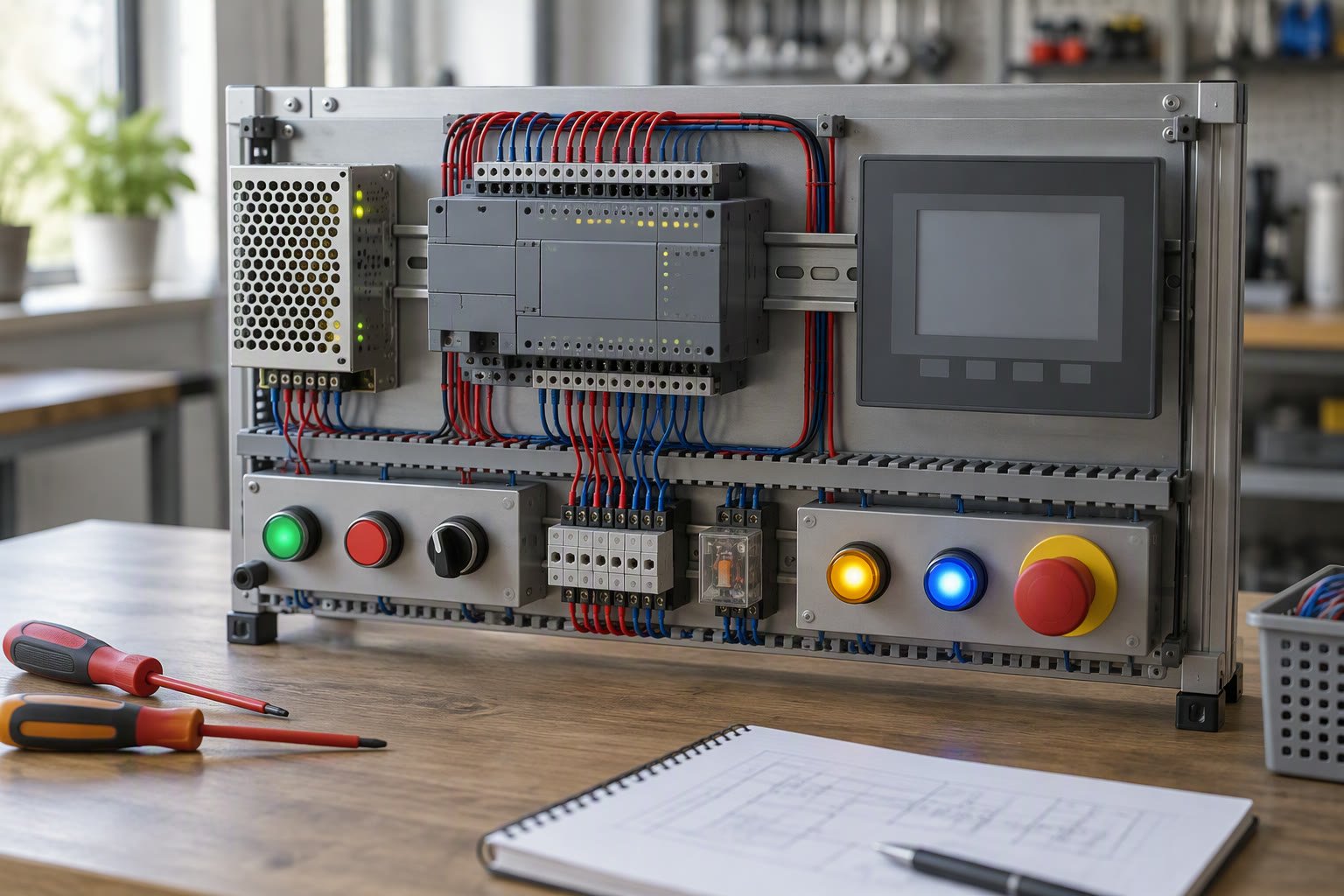
For a first purchase, a trainer kit with a CPU, digital input and output cards, a few switches, lamps and a 24 V supply is worth more than a bare CPU. You want to blow a lamp, not a factory.
Software worth learning
- TIA Portal for Siemens. The Basic version covers the S7-1200; the trial is time-limited, so plan the learning block around it.
- ISPSoft for Delta. Free download, ladder and function block, good for practice.
- GX Works3 for Mitsubishi. Licensed; often available on employer machines rather than at home.
- Connected Components Workbench for Allen-Bradley Micro800. Free and usable on a laptop.
- Codesys for the standard itself. Learning structured text here transfers across vendors.
Learn one platform deeply and the second one quickly. The concepts transfer; the menu locations do not. Interviewers can tell within five minutes whether you have actually commissioned a machine or only watched a course.
A six-step learning path
- Step 1: wire safely. Understand 24 V DC circuits, sink versus source inputs, relay versus transistor outputs, and why an emergency stop is hard-wired, not just a software tag.
- Step 2: blink a lamp. Build the start-stop seal-in, then a flasher with two timers. This teaches scan order better than any lecture.
- Step 3: count and sequence. Use a sensor input to count parts and stop a conveyor at a target. Add a reset and a jam timer.
- Step 4: add an HMI. Put start, stop, count and alarm on a small touch panel over Modbus or the vendor’s own protocol. This is where most junior automation jobs begin.
- Step 5: talk to a drive. Control a VFD over Modbus RTU: start, stop, speed setpoint, fault read. Almost every real machine does this.
- Step 6: document. Produce an I/O list, a wiring drawing, a rung comment set and a test procedure. Employers value this more than clever logic.
Beginner mistakes that cause real damage
| Mistake | What happens | Fix |
|---|---|---|
| Software-only emergency stop | Machine keeps moving when the program hangs | Hard-wire the E-stop to remove power from outputs |
| No input debounce | One press counts ten times | Use a timer or the input filter setting |
| Assuming one scan equals one millisecond | Timing logic drifts with program size | Use timers, not loop counts |
| Forgetting retentive memory | Counts reset after a power cut | Mark the tag retentive and test a power cycle |
| No I/O list | Wiring and program disagree at commissioning | Write the list first and label every wire |
| Testing with the machine loaded | Damage or injury during first run | Dry-run with outputs disconnected, then no load, then load |
What the skills are worth
PLC skills lead into automation engineer, controls engineer, commissioning engineer and maintenance roles. Freshers with a credible trainer project and an I/O list they can explain typically start in the ₹2.5–4.5 lakh range; engineers who can commission a machine, tune a drive and troubleshoot a network move up faster than those who only write logic. Plant experience and travel willingness matter more in this field than a certificate.
Do not claim a platform you have not touched. A hiring manager will ask what CPU you used, which software version, and what happened when an output card failed. Honest answers about a small trainer build beat a long list of logos.
Related: industrial robot programming, industrial robot cost in India, robotics in manufacturing, embedded systems career, robotics engineer salary.
What is the difference between a PLC and a microcontroller?
A PLC is built for factory environments with isolated 24 V I/O, a deterministic scan cycle, fault diagnostics and long vendor support. A microcontroller is cheaper and more flexible but needs protection circuitry and custom diagnostics.
Which PLC should a beginner learn in India?
Siemens S7-1200 with TIA Portal is the safest first choice because Indian factories and job ads ask for it. Delta is a cheaper way to practise the same concepts if budget is tight.
Do I need hardware to learn PLC programming?
You can learn logic with simulators, but wiring, sinking versus sourcing inputs and fault finding need real hardware. A trainer kit with switches and lamps is enough to start.
How long does it take to learn PLC programming?
Basic ladder logic and a small sequence take a few weeks of regular practice. Commissioning confidence, drive control and network troubleshooting usually take six to twelve months of real machine work.
Is PLC programming a good career in India?
Yes for people who like troubleshooting on the factory floor. Automation and controls roles are steady, pay reasonably, and reward commissioning experience more than certificates.
A robot cell usually has both a PLC and a robot controller; see who does what in the cell.
Work through ladder logic examples once you know the basics.
Fieldbus basics come next, in industrial Ethernet for robots.
Before writing ladder for a drive, get the Modbus register map and wiring right.
Where that skill leads in practice is covered in the automation engineer career guide.
Once the basics make sense, the next question is who owns what in a cell, which our PLC, HMI and SCADA guide answers.
What the job pays at each stage is covered in the PLC programmer salary guide, including what the CTC figure hides.
Sources and further reading
- IEC 61131-3 — the standard that defines ladder, function block, structured text and the other PLC languages.
- Siemens S7-1200 — controller family, modules and engineering software.
- Delta PLCs — DVP series documentation and ISPSoft downloads.
- Rockwell Micro800 — Micro850 controllers and the free Connected Components Workbench.
- CODESYS — IEC 61131-3 runtime and development environment.