Warehouse robotics in India is no longer an experiment, but it is also not a default purchase. An AMR fleet can double picking throughput in the right fulfilment centre and lose money in the wrong one. The difference is almost never the robot; it is the slotting, the order profile and whether the software can actually talk to the warehouse management system. Warehouse robotics India operators consider comes down to four systems, and this page shows when each one pays back.
The four systems you will be quoted
| System | What it does | Best fit | Indicative cost |
|---|---|---|---|
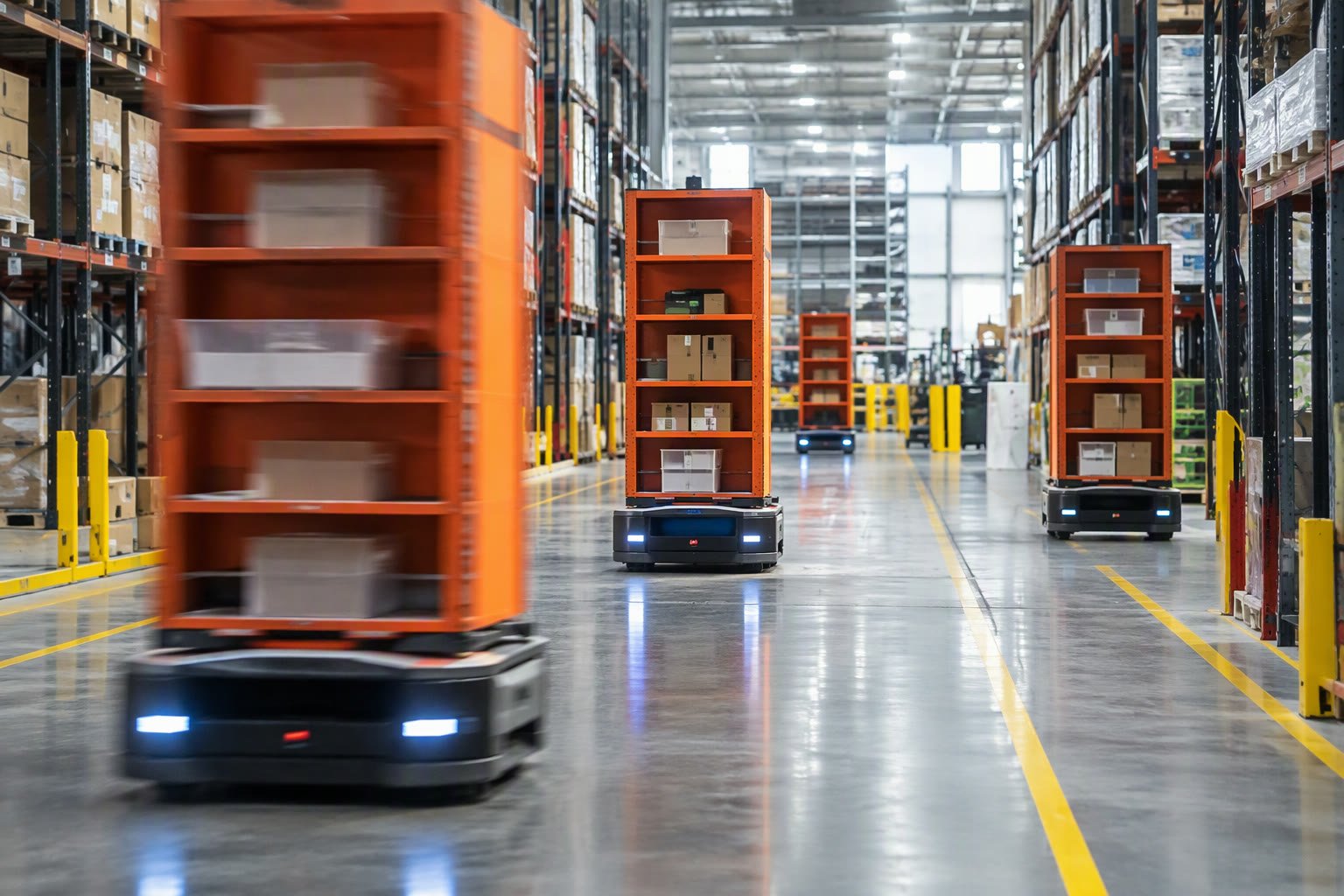
| AMR (autonomous mobile robot) | Carries shelves, totes or carts between zones | E-commerce picking, 3PL, high SKU count | ₹8–30 lakh per robot, plus software |
| AGV (automated guided vehicle) | Follows fixed tape or wire paths | Repeatable point-to-point moves in stable layouts | ₹6–20 lakh per vehicle |
| Goods-to-person (G2P) system | Robots or shuttles bring inventory to a station | High-volume fulfilment, dark stores | ₹1–5 crore for a small installation |
| AS/RS (shuttle or crane) | Automated storage and retrieval in racks | Dense storage, pharma, spare parts, cold chain | ₹50 lakh to ₹10 crore depending on height and bays |
| Sortation conveyor | Automated sorting by destination | Parcel hubs, courier and e-commerce dispatch | ₹20 lakh to ₹2 crore by throughput |
Those ranges are planning figures, not quotations. A single AMR list price looks manageable; the project cost includes the fleet manager software, Wi-Fi upgrades, charging stations, floor marking, integration with the WMS, spare batteries and training. Integration commonly adds 30–60% to the hardware number.
What changed in warehouse robotics India
Three pressures pushed warehouse automation from pilot to production:
- Order profiles got smaller and faster. Quick commerce and same-day delivery mean more picks per order and shorter promise windows. A picker walking aisles cannot keep up at peak.
- Warehouse labour became harder to retain. Night shifts, peak-season surges and high attrition make a trained picking workforce expensive to maintain.
- Real estate got denser. Urban fulfilment centres pay for floor area, and an AS/RS or G2P system stores more per square metre than manual racking.
Indian vendors now supply a meaningful share of this equipment. Addverb, backed by Reliance, builds AMRs and AS/RS in India; GreyOrange, founded in India and now headquartered abroad, sells fleet orchestration software and robots; Ati Motors, Locus and Unbox Robotics serve niche segments. Global vendors such as Geek+ and Hai Robotics also compete in the goods-to-person segment. For a buyer, local service and spare parts matter more than the brand on the robot.
When an AMR fleet pays back
Run the numbers on picks per hour, not on robot price. A simple model: Warehouse robotics India projects only pay back when the slotting, order profile and software integration are right.
saving per month =
  (picks per shift × shifts × days × labour cost per pick × efficiency gain)
  − (robot lease or depreciation + software + maintenance + charging power)

payback months = project cost / monthly saving
If a site picks 20,000 units a day across three shifts, and G2P cuts walking time enough to raise output per picker by 30%, the saving is large. If the same site picks 3,000 units a day with a stable team, the robot fleet will sit idle between waves and the payback stretches past the equipment life. The honest test is whether the site has a throughput problem, a labour problem, a space problem, or none of the three.
| Signal | Automation makes sense | Automation is premature |
|---|---|---|
| Orders per day | High and growing | Volatile or declining |
| SKU count | Thousands, stable locations | Constantly changing assortment |
| Labour | Hard to hire, high attrition | Stable team, low cost |
| Space | Expensive and constrained | Cheap, expandable |
| Process | Documented and repeatable | Still being invented weekly |
| IT | WMS with an API | Spreadsheets and manual entry |
The integration work nobody budgets for
- WMS or WES integration: the fleet manager must receive orders, report locations and handle exceptions. If the WMS has no usable API, the project stalls.
- Wi-Fi coverage: robots drop off in dead zones. A site survey and additional access points are part of the project, not an afterthought.
- Floor quality: cracks, ramps and expansion joints upset navigation. Some AMRs handle them; cheap ones do not.
- Charging strategy: opportunity charging during idle windows keeps the fleet small. Without it, you buy robots to cover battery swaps.
- Safety: mixed traffic of robots, forklifts and people needs rules, markings, speed zones and training.
- Spares and service: a robot down for three weeks waiting for an imported part is worse than a manual picker.
Robots or conveyors?
For a fixed route with constant volume, a conveyor or a shuttle is usually cheaper and simpler than a fleet of mobile robots. Robots win when the layout changes, the volume fluctuates, or the route is too long to justify fixed infrastructure. A common mistake is buying AMRs to solve a problem a well-designed conveyor and a better slotting plan would have solved for a third of the cost.
A procurement checklist
- Measure current picks per hour, lines per order and walk distance per shift before talking to vendors.
- Ask for a paid pilot on your own SKUs, not a demo in a vendor showroom.
- Require the integration scope in writing, including who owns WMS changes.
- Ask for local spare parts stock and a response-time commitment.
- Model three years of software, maintenance and battery replacement, not just the capex.
- Check the safety documentation and the training plan for floor staff.
- Visit a live Indian installation of the same system before signing.
The career side of this market is growing too: the robotics jobs guide covers warehouse automation roles, and the skills roadmap explains what to learn for AMR deployment work. For the factory equivalent, see robotics in manufacturing.
Common questions
How much does an AMR cost in India?
A single AMR is roughly ₹8–30 lakh depending on payload, lift height and navigation. The project also needs fleet software, Wi-Fi, charging and WMS integration, which commonly adds 30–60% to the hardware cost.
What is the difference between an AGV and an AMR?
An AGV follows a fixed path such as tape or wire. An AMR maps the site and navigates dynamically, so it can route around obstacles and handle layout changes. AMRs are more flexible and usually more expensive.
Do Indian warehouses use robots?
Yes, mainly in e-commerce fulfilment, quick commerce, pharma and large 3PL operations. Adoption is concentrated in high-volume sites where labour and space costs justify the integration work.
Is warehouse automation worth it for a small business?
Usually not for a full AMR fleet. A small warehouse is better served by better slotting, barcode scanning, conveyors and a WMS before considering mobile robots.
What skills are needed to work in warehouse robotics?
PLC and WMS integration basics, Wi-Fi and network troubleshooting, robot fleet software, safety procedures and data analysis. Mechanical and electrical maintenance skills are also in demand.
Related: robotics in manufacturing, robotics jobs for freshers, robotics skills roadmap, what is robotics.
For the commercial side, industrial robot cost in India and AGV vs AMR cover the two main purchase decisions.
Fleet size depends on charge time; the robot charging and docking guide shows the uptime maths.
End-of-line palletizing often decides warehouse automation payback; see palletizing robot costs in India.
Warehouse robot business cases often overcount labour savings; see robot ROI and payback.
Aisle behaviour depends on footprint and inflation settings.
Not every warehouse robot skids; some follow fixed lanes with steered front wheels.
Robots are one cost line among several, which our warehouse automation cost breakdown sets out layer by layer.
Storage density is often a bigger constraint than picking speed, which is where ASRS systems come in.
Robots are only part of a warehouse installation; the fleet layer is what connects them to the WMS.
Sources and further reading
- A3 Robotics — AMR, AGV and goods-to-person application notes.
- IFR World Robotics — service robot and logistics automation data.
- Geek+ — examples of goods-to-person system architecture.
Last reviewed: October 2026. Cost ranges are indicative planning figures for Indian projects, not quotations; vendor and integrator pricing varies widely with scope. Not bench-tested by this site.