The gearbox decides whether your motor’s torque reaches the wheel cleanly or turns into noise, backlash and heat. For most Indian robot builds the real choice is spur, planetary or harmonic.
This guide compares the three on torque density, backlash, efficiency and cost, then shows where each one belongs on a robot.
How the three types differ
| Spur | Planetary | Harmonic | |
|---|---|---|---|
| Layout | Offset shafts | Coaxial, sun and planets | Coaxial, flexspline |
| Torque density | Low | High | Very high |
| Backlash | 0.5–2° typical | 3–15 arcmin typical | Near zero |
| Efficiency per stage | ~95% | ~95% | ~70–85% |
| Ratio per stage | 2:1 to 5:1 | 3:1 to 10:1 | 30:1 to 160:1 |
| Noise | Higher | Moderate | Low |
| Cost in India | Lowest | Moderate | Highest |
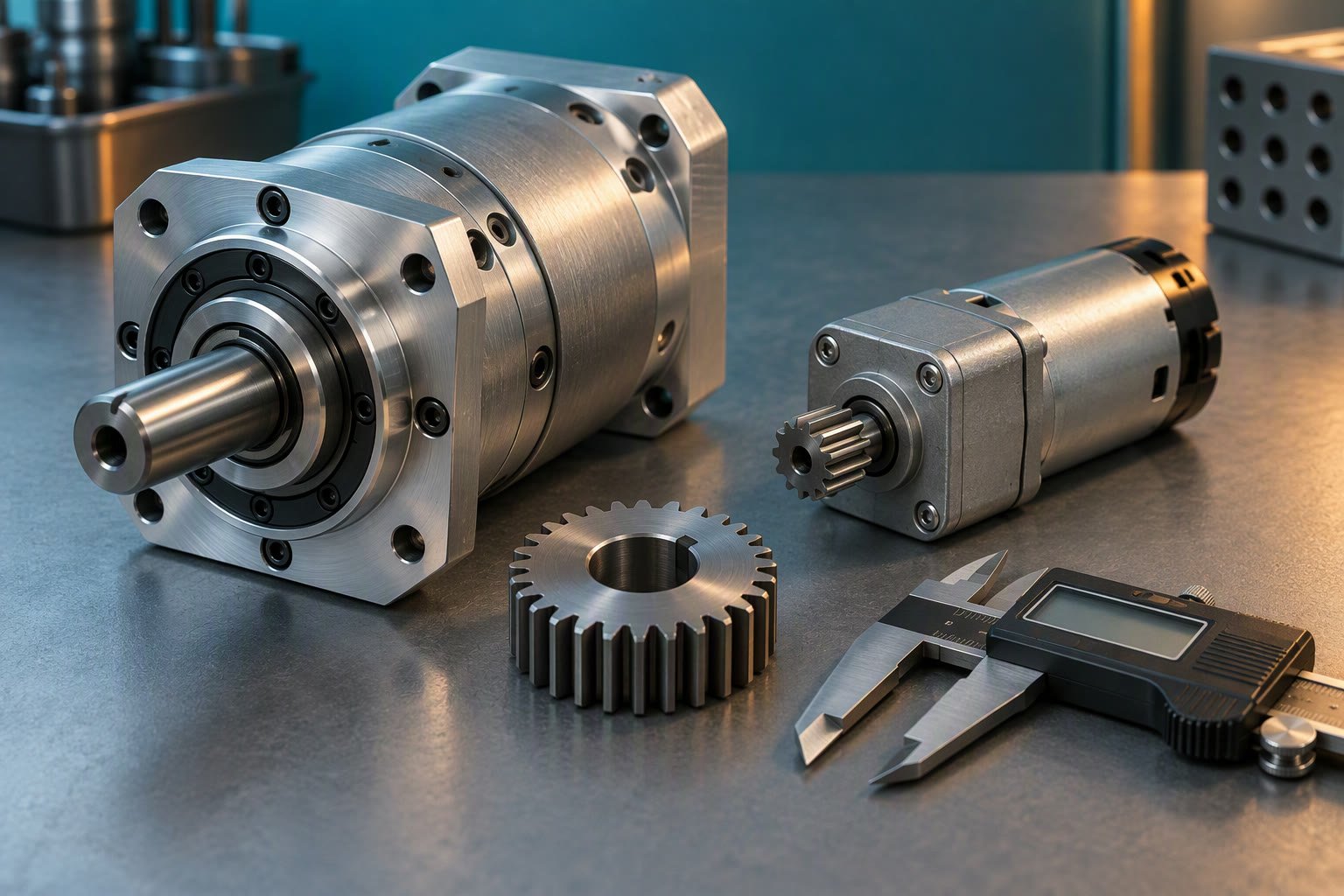
Spur gearboxes are cheap, simple and easy to replace. Planetary gearboxes put more torque in the same envelope and keep the shafts inline, which is why most robot joints use them. Harmonic drives remove backlash almost entirely, at a price and efficiency cost.
What backlash does to a robot
Backlash is the free movement before the output starts turning after the input reverses. On a wheeled robot it shows up as a dead zone when changing direction. On an arm it shows up as a position error that flips sign, and as vibration when a controller tries to correct it.
- Under 5 arcmin: fine for most arm joints and camera pointing.
- 5–15 arcmin: acceptable for pick-and-place with vision correction.
- 15–30 arcmin: fine for wheels and conveyors, poor for precise arm joints.
- Above 30 arcmin: visible slop, controller hunting, poor repeatability.
If your application quotes repeatability in tenths of a millimetre, backlash is the first thing to measure. A cheap gearbox with 1° of backlash will not hold that number no matter how good the encoder is.
Torque, speed and the motor you actually need
| Joint | Typical ratio | Gearbox type | Why |
|---|---|---|---|
| Robot arm shoulder | 50:1–160:1 | Planetary or harmonic | High torque, compact |
| Robot arm elbow | 30:1–100:1 | Planetary | Torque with some cost control |
| Robot arm wrist | 20:1–80:1 | Planetary or harmonic | Backlash matters most here |
| Differential drive wheel | 10:1–50:1 | Spur or planetary | Torque, cost, simple service |
| Conveyor | 5:1–20:1 | Spur or worm | Cheap, continuous duty |
| Pan-tilt head | 10:1–50:1 | Planetary | Compact and quiet |
Work backwards from the load. Required output torque divided by the ratio gives the motor torque, then add a margin for friction and acceleration. A gearbox chosen only by ratio and frame size usually ends up under-torqued at the joint.
Indicative prices in India
| Item | Indicative price | Notes |
|---|---|---|
| Spur gear motor, 12 V, 10–30 rpm | ₹250–₹900 | Hobby robots, high backlash |
| Planetary gearbox for NEMA 17 | ₹1,200–₹3,500 | Ratio and backlash dependent |
| Planetary gearbox for NEMA 23 | ₹3,000–₹9,000 | Higher torque, better bearings |
| Precision planetary, low backlash | ₹8,000–₹25,000 | Imported, <5 arcmin |
| Harmonic drive unit | ₹35,000–₹1.5 lakh | Robot joint grade |
| Worm gearbox | ₹800–₹4,000 | Self-locking, lower efficiency |
These move with brand, duty rating and import duty. Treat them as planning ranges and get quotes for the exact ratio and backlash class you need.
Efficiency and heat
Every stage loses some torque to friction. A single planetary stage at roughly 95% efficiency sounds good until you stack three of them and lose about 14% of the input torque as heat. Harmonic drives lose more per stage but are usually used in one stage at high ratio.
On a continuously running joint, that heat has to leave the gearbox. Small planetary units in a sealed 3D printed housing cook themselves. Give the motor and gearbox airflow, and size the duty cycle honestly.
Where each type belongs
- Spur: hobby drive bases, conveyors, anything where cost dominates and precision does not.
- Planetary: default choice for robot joints, wheel drives, pan-tilt heads and linear actuators.
- Harmonic: arm joints where backlash must be near zero, humanoid joints and precision positioning.
- Worm: lifts and holds where self-locking matters more than efficiency.
- Belt and pulley: when you need low cost and some compliance, not high torque.
Mistakes that show up on the bench
- Choosing ratio by frame size instead of required output torque.
- Ignoring backlash until the arm cannot repeat a pick.
- Stacking cheap planetary stages and losing torque to heat.
- Using a spur gear motor on an arm joint and blaming the controller for vibration.
- Buying a harmonic drive and mounting it with a flexible coupling that adds its own compliance.
- Forgetting that the gearbox needs a bearing to take radial load; the motor shaft is not a wheel axle.
Related: motor selection for robots, servo vs DC vs stepper, robot arm kinematics, linear actuators, BLDC motors and ESCs.
Planetary or spur gearbox for a robot?
Planetary for almost any robot joint or wheel drive: more torque in the same space, coaxial shafts and lower backlash. Spur is fine for cheap drive bases and conveyors where precision does not matter.
What backlash is acceptable for a robot arm?
Under 5 arcmin for precise joints, 5–15 arcmin for pick-and-place with vision correction. Above 30 arcmin the arm will visibly hunt and repeatability suffers.
How much does a planetary gearbox cost in India?
Roughly ₹1,200–₹3,500 for a NEMA 17 unit and ₹3,000–₹9,000 for NEMA 23, with precision low-backlash units at ₹8,000–₹25,000. Harmonic drives start far higher.
Why does my gearbox get hot?
Efficiency losses turn into heat, and stacking stages multiplies the loss. Three planetary stages at about 95% each lose roughly 14% of input torque, so airflow and honest duty-cycle sizing matter.
Can I use a spur gear motor for a robot arm?
For a toy or a very light arm, yes. For anything that must repeat a position, the backlash and vibration will show up as error, and a planetary gearbox is the better choice.
For high-ratio joints, the next step up is a harmonic or cycloidal drive.
Reach and torque set the gear ratio, covered in the small robot arm design guide.
A gearbox shifts the whole curve rather than lifting its top end, which the torque curve guide explains with numbers.
On a gantry, backlash appears directly at the tool, which the gantry robot guide treats as a design constraint.
Sources and further reading
- maxon — gearbox selection guidance and efficiency data.
- Oriental Motor — gear motor sizing and technical references.
- Harmonic Drive — strain wave gearing principles and ratings.
- Nidec — gearbox and motor application notes.