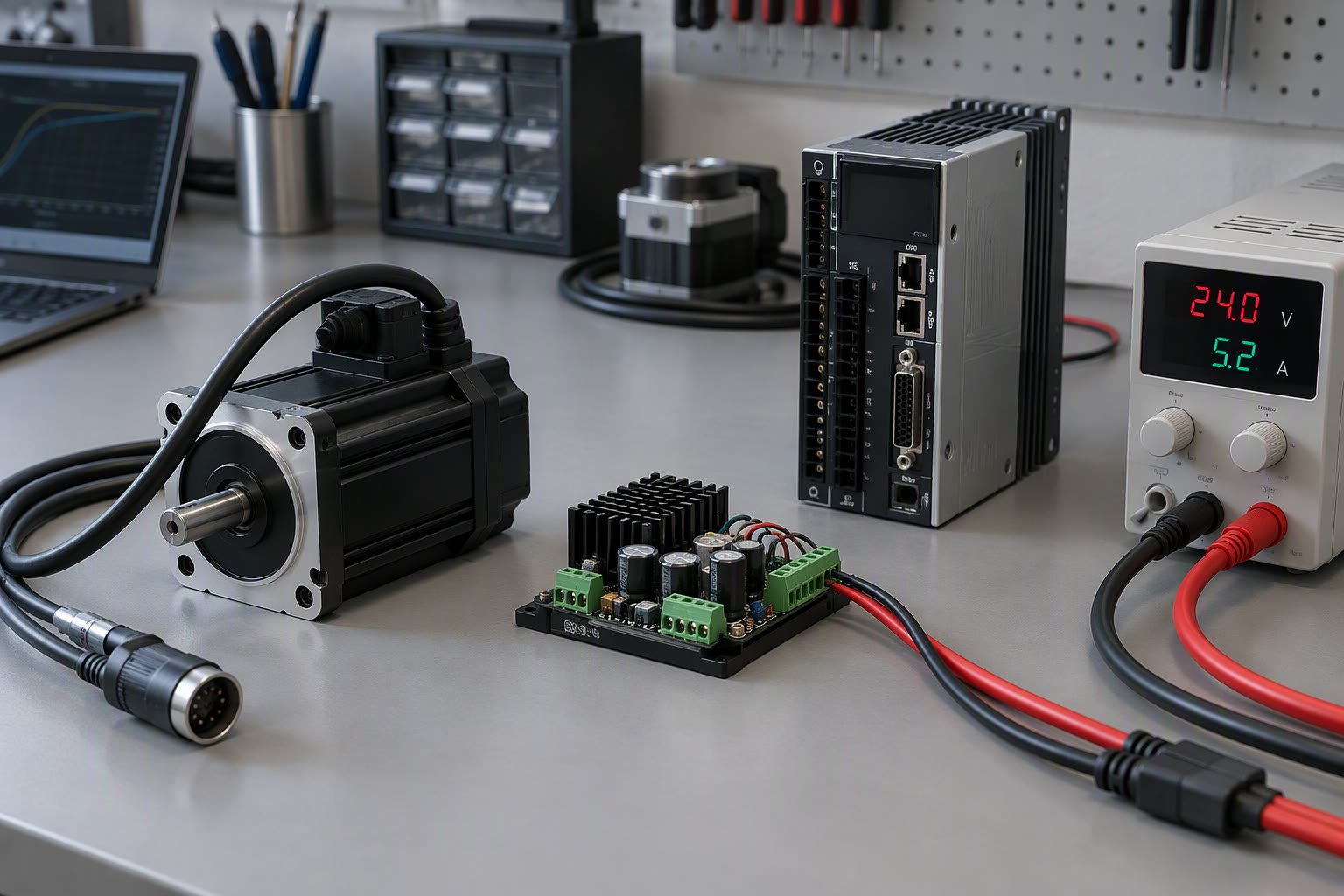
A servo motor without a matched drive is a paperweight with a shaft. The drive closes the loop, limits the current and turns a position command into torque; choosing the wrong one wastes money or destroys motors.
This guide compares the drive families available in India, explains the specifications that decide compatibility, covers power supply and braking, and lists the commissioning checks that prevent a first power-up from ending in smoke. It is written for robot builders choosing between hobby controllers, integrated servo motors and industrial drives.
What a servo drive actually does
A drive takes a command, reads feedback from an encoder or resolver, and switches current through the motor phases to follow that command. It runs three nested loops: current, velocity and position. The current loop is fastest, and it is what protects the motor from overload.
- Commutation: decides which winding is energised for the measured rotor angle.
- Current control: limits torque and prevents demagnetisation or driver failure.
- Velocity and position loops: follow the command and reject disturbance.
- Protection: over-current, over-voltage, over-temperature and following error.
Hobby ESCs do commutation and current limiting only. A genuine servo drive adds closed-loop position control and the feedback interface, which is why the price gap is large.
The four families you will compare
| Family | Typical feedback | Control interface | Best for |
|---|---|---|---|
| Hobby ESC plus DC motor | None or hall | PWM or UART | Wheels on a budget, no position control |
| FOC BLDC board | Encoder or hall | Step and direction, UART, CAN | Robot joints, gimbals, research platforms |
| Integrated servo motor | Built-in encoder | CAN, RS485, EtherCAT | Compact arms and mobile robots |
| Industrial AC servo drive | Absolute encoder or resolver | Pulse, analog, EtherCAT, CANopen | Machine tools, production cells |
The mistake is buying an industrial drive for a battery robot because it looks robust. Industrial drives expect a three-phase supply, a cabinet and a motor with an absolute encoder, and they are awkward on a 24 V mobile platform.
Specifications that decide compatibility
| Specification | Why it matters | How to check |
|---|---|---|
| Continuous current | Sets usable torque | Compare with motor rated current, not peak |
| Peak current and time | Acceleration headroom | Confirm the peak duration covers your move |
| Bus voltage range | Matches supply and motor | Motor rated voltage must sit inside the range |
| Feedback type | Drive must read your encoder | Encoder output type and counts per rev |
| Motor pole pairs | Commutation correctness | Set in configuration, not left at default |
| Control interface | Matches your controller | Step and direction, CAN, EtherCAT, analog |
| Braking method | Handles regenerated energy | Braking resistor or regenerative option |
Continuous current is the number that matters for a robot joint that holds a pose for minutes. A drive rated at 40 A peak but 10 A continuous will overheat on a lift that needs 15 A steadily, even though the datasheet looks generous.
Power supply and regeneration
When a motor decelerates a load, energy flows back into the supply. On a battery this is usually absorbed, which is one reason battery robots are forgiving. On a bench power supply, the voltage rises and the supply may trip or the drive may shut down on over-voltage.
- Add bulk capacitance close to the drive, sized from the drive manual.
- Use a braking resistor if the supply cannot absorb regeneration.
- Set the over-voltage threshold according to the actual supply, not the maximum the drive allows.
- Fuse the DC bus and add a precharge path for large capacitor banks.
- Keep the power supply cable short and thick; voltage droop during acceleration causes false faults.
Matching drive and motor
Four parameters must agree: pole pairs, encoder resolution, rated current and inductance. Pole pairs and encoder counts are configuration values, and leaving them at defaults produces a motor that vibrates instead of turning.
# example check before buying
motor_rated_current = 8.0      # A
drive_continuous_current = 10.0  # A  -> ok
drive_peak_current = 30.0      # A, for 2 s
required_accel_current = 18.0  # A for 0.8 s -> ok

# encoder
encoder_cpr = 4096
gear_ratio = 10
counts_per_output_rev = encoder_cpr * gear_ratio * 4  # quadrature
Do this arithmetic before ordering. A drive that is adequate in continuous current but marginal in peak current will fault during every fast move, and the fault looks like a tuning problem.
Control interfaces and your controller
- Step and direction. Simple and widely supported, but you lose torque limit control and the controller must generate pulses.
- Analog torque or velocity. Fine for simple servos, sensitive to noise, needs careful grounding.
- CAN with a vendor protocol. Good for multi-axis robots, but each vendor has its own command set.
- CANopen with CiA 402. Standardised state machine, well documented, common on industrial drives.
- EtherCAT. Deterministic and fast, needs a master stack and adds cost and complexity.
Match the interface to the controller you actually have. A drive with EtherCAT only is the wrong purchase if your controller has no master stack, and adding one is a project in itself.
Buying in India
Servo drives are imported and often stocked in small quantities. Price depends on the interface, current rating and whether the vendor provides configuration software. Ask three questions before paying.
- Is the configuration software available and does it run on your operating system?
- Is there local stock of spares, or does a failure mean a six-week wait?
- Does the vendor provide the motor parameters for the exact motor you are pairing?
Clones exist for the popular open designs, and the difference is usually in protection circuitry and firmware quality rather than the headline specification. For a research platform, an open design with a community is often a better buy than an unknown clone with a higher current rating.
Commissioning checks
- Power up with the motor disconnected and confirm the bus voltage and no faults.
- Set pole pairs, encoder counts and current limits before enabling the output.
- Spin the motor slowly in open loop or torque mode and confirm direction and smoothness.
- Verify the encoder sign matches the commanded direction; a reversed sign makes position control run away.
- Tune the current loop first, then velocity, then position.
- Set following error limits so a jam stops the drive instead of the gearbox.
- Test the emergency stop under load, not at standstill.
Most first power-ups fail at the encoder sign or the pole pair count. Both are configuration values, and both are quicker to check than to diagnose from a violent oscillation.
Cost bands to expect
Hobby ESCs are the cheapest option and give no position control. Open FOC boards sit in the middle and offer a lot of capability per rupee. Integrated servo motors cost more but remove cabling and cabinet work. Industrial AC servo systems are the most expensive and make sense only when the machine needs their reliability and support.
Price a complete axis, not just the drive: motor, encoder, cables, power supply, braking resistor and the time to commission it. The drive is often the smallest line item.
Related: BLDC motors and ESCs, motor selection for robots, servo, DC and stepper motors compared, stepper motor guide, payload calculation, how to power a robot.
Can I run a servo motor with a hobby ESC?
Only if the motor has hall sensors and the ESC supports sensored commutation, and even then you get velocity control rather than position control. A positioning joint needs a real servo drive with encoder feedback.
What is the difference between peak and continuous current?
Continuous current is what the drive can deliver indefinitely without overheating. Peak current is available briefly for acceleration. Size the continuous rating against the motor rated current and check the peak duration against your fastest move.
Why does my drive fault on deceleration?
Regenerated energy is raising the bus voltage. Add a braking resistor, increase bus capacitance, or slow the deceleration profile until the supply can absorb the energy.
Does encoder resolution affect accuracy?
It sets the resolution limit, but mechanical backlash, compliance and control tuning usually dominate. A high count encoder on a loose gearbox still gives a loose axis.
Do I need EtherCAT for a robot arm?
Only if you need deterministic multi-axis synchronisation at high rates. CANopen or a vendor CAN protocol is enough for most small arms and is far simpler to bring up.
Drives with CAN or CANopen interfaces are common; the CAN bus guide explains what the bus needs to work.
Drives generate heat inside a sealed cabinet; this enclosure guide shows how to size the cooling.
Gantry axes size differently from robot joints, and the gantry robot guide shows why frame stiffness comes before servo choice.
Sources and further reading
- ODrive documentation — open FOC drive configuration and tuning.
- CiA CANopen — CiA 402 drive profile reference.
- ST motor drivers — driver stage and protection references.