Pneumatics give a robot a lot of force for very little money, as long as the cylinder is sized from the numbers and not from what was in the drawer. A cylinder that is too small stalls under load; one that is too large wastes air, money and cycle time.
This guide covers the force equation, bore selection at typical workshop pressures, air consumption and compressor sizing, speed control, and the sizing checks that catch most failed builds. The examples use double acting cylinders at four to six bar, which is what a small Indian workshop compressor actually delivers.
The force equation
A pneumatic cylinder produces force equal to pressure times effective piston area. Extending uses the full bore area; retracting uses the bore area minus the rod cross section, so the return stroke is always weaker.
# pressure in bar, area in cm2, force in newtons
F_extend  = pressure * 10 * (pi / 4) * bore_cm ** 2
F_retract = pressure * 10 * ((pi / 4) * bore_cm ** 2 - (pi / 4) * rod_cm ** 2)| Bore (mm) | Piston area (cm2) | Extend force at 6 bar (N) | Typical use |
|---|---|---|---|
| 12 | 1.13 | 68 | Light gripper jaws, small diverters |
| 16 | 2.01 | 121 | Small pick and place |
| 20 | 3.14 | 188 | General light duty |
| 25 | 4.91 | 294 | Grippers, clamping |
| 32 | 8.04 | 482 | Lifting, pressing |
| 40 | 12.57 | 754 | Heavier lift, stamping |
| 50 | 19.63 | 1178 | Machine tending, large clamps |
| 63 | 31.17 | 1870 | Industrial pushing and lift |
Do not design against the catalogue figure at the maximum rated pressure. A workshop compressor with a long hose and a clogged filter may deliver four bar at the cylinder, which is a third less force than the six bar used in the table.
Sizing for a lift, with margin
For a vertical lift, the cylinder must overcome weight plus friction, with margin for acceleration and for pressure droop. A factor of two on the static load is a sensible starting point for a workshop machine.
# 12 kg load, 2x margin, 5 bar available, extend stroke lifts
required = 12 * 9.81 * 2          # 235 N
area_cm2 = required / (5 * 10)     # 4.71 cm2
# nearest standard bore: 25 mm (4.91 cm2)
If the load is lifted on the retract stroke, use the annulus area instead, and check that the rod is not so large that the retract force becomes marginal. A 25 mm bore with a 10 mm rod loses sixteen percent of its area to the rod.
Air consumption and compressor reality
Air is not free. Every cycle consumes free air equal to the swept volume multiplied by absolute pressure, and a compressor that cannot keep up will drop the receiver pressure until the cylinder slows and the gripper drops parts.
# 32 mm bore, 100 mm stroke, 6 bar, 1 cycle per second
extend  = 8.04 * 10 / 1000 * 7      # litres of free air
retract = 6.91 * 10 / 1000 * 7
per_cycle = extend + retract         # about 1.05 L
flow = per_cycle * 60                # about 63 L/min at 1 Hz
A small single-phase compressor rated around 100 litres per minute of free air delivery can just about sustain that, with nothing else running. Add a second cylinder, a blow-off nozzle and a leak, and the machine becomes intermittent. Size the compressor for total consumption at the worst simultaneous moment, not the average.
| Symptom | Likely cause | Fix |
|---|---|---|
| Slow stroke only when several cylinders move | Insufficient compressor flow | Larger receiver, sequenced motion, bigger compressor |
| Pressure gauge drops during cycle | Restriction in hose or filter | Bigger tubing, service the FRL unit |
| Cylinder speed varies day to day | Water in the line or a worn seal | Drain the receiver, fit a dryer, replace seals |
| Jerky end of stroke | No cushioning, too much speed | Use cushioned cylinder, meter-out control |
Speed control and cushioning
Control speed on the exhaust side, not the supply side. A meter-out flow control valve holds back escaping air, which keeps the piston loaded and gives steady motion. Meter-in control fights the load and produces jerky travel when the load changes.
- Fit a flow control valve on each port, adjusted with the machine running under real load.
- Use cushioned cylinders above roughly 100 mm per second, or add external shock absorbers.
- Keep tubing short and bore generous; a long thin hose is a speed limiter.
- Set the regulator for the lowest pressure that does the job, which saves air and reduces impact.
Gripper force, not cylinder force
A two-jaw gripper converts cylinder force into grip force through a linkage, so the number that matters is at the jaw. Required grip force depends on part weight, friction and the number of contact faces.
# part held by two jaws, friction grip
F_required_per_jaw = mass * 9.81 * safety / (2 * mu)

# 1 kg part, safety 2, mu 0.4 with rubber pads
# F = 1 * 9.81 * 2 / (2 * 0.4) = 24.5 N per jaw
A 20 mm bore cylinder at four bar delivers about 125 N, which is five times the requirement for that part. That is fine, and it is also why a regulator matters: running the gripper at two bar reduces impact on the part and cuts air use by half, while still leaving margin.
Remember that friction coefficient falls with oil, coolant and dust. Rubber pads on a dry aluminium part may reach 0.6, and the same pads on an oily steel part may drop below 0.2. Design for the worst surface you will actually handle.
Side load and rod buckling
A standard cylinder is designed for axial load. Any side load goes into the rod seal and the rod bearing, which wears quickly and eventually scores the rod. Long strokes with small bores can also buckle under compression.
- Use a guided cylinder or add an external linear guide for any side load.
- Keep stroke length reasonable; beyond about twenty times the rod diameter, check buckling.
- Mount so the load is supported, not hanging from the rod.
- Use a clevis or floating joint where alignment cannot be guaranteed.
Valves, sensing and control
A double acting cylinder needs a five-port two-position valve, usually 5/2, with a spring return or double solenoid. Add magnetic reed switches on the barrel if the controller needs to know the end positions, which is far more reliable than timing the stroke.
const int VALVE_PIN = 7;
const int SENSOR_EXTENDED = 2;

void extendAndWait() {
  digitalWrite(VALVE_PIN, HIGH);
  unsigned long start = millis();
  while (digitalRead(SENSOR_EXTENDED) == LOW) {
    if (millis() - start > 2000) {   // timeout, do not hang forever
      digitalWrite(VALVE_PIN, LOW);
      return;
    }
  }
}
Always include a timeout. A cylinder that does not reach its sensor is telling you about low pressure, a jammed part or a dead valve, and a controller that waits forever hides the fault until something else breaks.
Air preparation in an Indian workshop
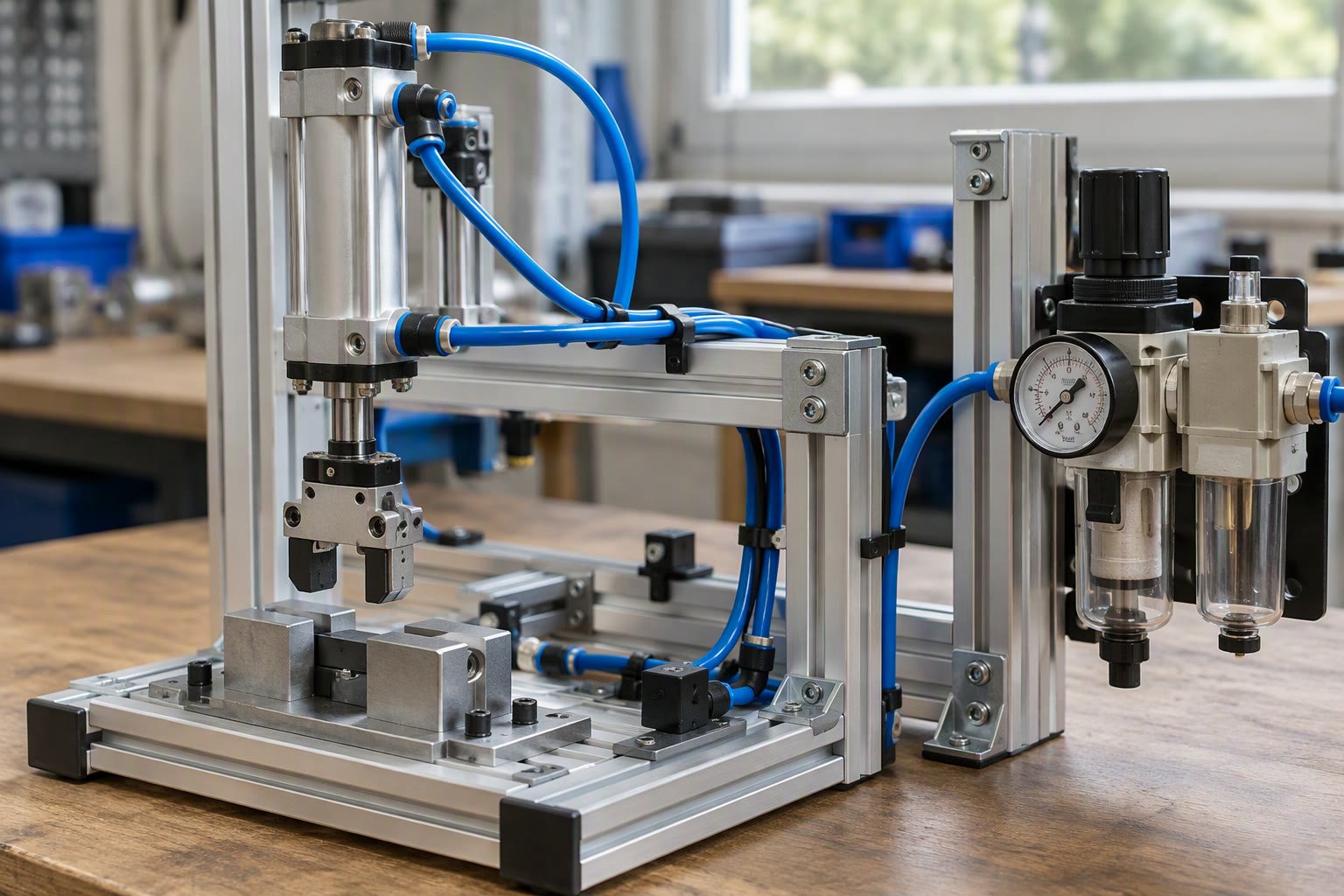
Compressed air in a typical workshop carries moisture and oil aerosol, more so during monsoon. Fit a filter regulator lubricator unit at the machine, drain the receiver weekly, and use an auto drain if the compressor runs daily. Water in a cylinder washes out the grease, and the first symptom is sluggish retract speed rather than a leak.
Keep the filter element clean. A clogged element looks like a weak compressor and is a fraction of the cost to fix.
Related: vacuum gripper design, hydraulic, pneumatic and electric actuators, gripper design basics, end effector types, pick and place arm project.
What pressure should I run a robot cylinder at?
The lowest pressure that produces the required force with margin, typically three to five bar in a small workshop. Lower pressure saves air, reduces impact and makes the machine quieter.
Why is the retract stroke weaker than extend?
The rod occupies part of the piston area, so the effective area on the retract side is smaller. The difference is the rod cross section, which can be ten to twenty percent of the bore area.
How do I know if my compressor is big enough?
Add the free air consumption of every actuator that can move at the same time, multiply by the cycles per minute, and compare with the compressor free air delivery. Keep a receiver and margin, because a compressor rated at its peak is not a continuous rating.
Can I control cylinder speed with a needle valve on the supply?
It works poorly. Meter-out control on the exhaust gives steady motion under changing load, while supply-side restriction makes the cylinder jerky and sensitive to pressure changes.
Why does my gripper drop parts occasionally?
Usually pressure droop when other actuators move, worn pads that reduced friction, or a regulator set too low. Check the gauge during the cycle and check pad condition before changing the air circuit.
Sources and further reading
- SMC pneumatic cylinders — bore sizes, force tables and accessory ranges.
- Festo — cylinder selection guidance and air preparation documentation.
- Arduino language reference — timing and digital I/O used in the control example.