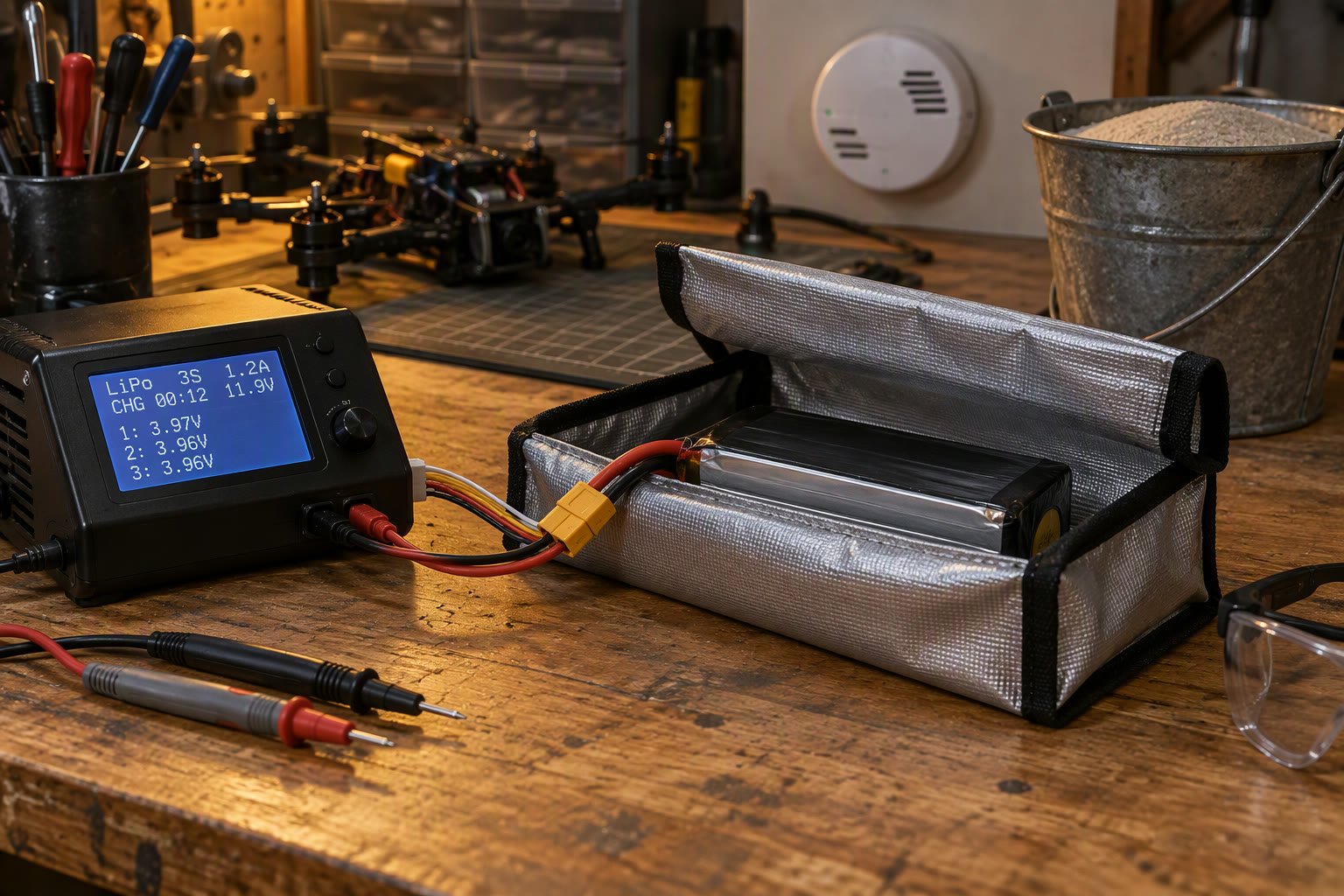
A lithium polymer pack stores enough energy to weld a wrench to its terminals. Treat it as a fuel tank with wires, not as a battery you can abuse like a AA cell. LiPo battery safety starts with treating the pack as a fuel tank with wires, not as a battery you can abuse.
LiPo packs are the default choice for mobile robots because they deliver high current from a light package. They also fail violently when overcharged, over-discharged, punctured or charged cold. This guide covers the numbers you need, the charging routine that keeps a lab safe, the wiring that prevents shorts and the warning signs that mean a pack should be retired.
The four numbers that matter
| Term | Meaning | Rule of thumb |
|---|---|---|
| Nominal voltage | 3.7 V per cell | A 3S pack is 11.1 V nominal |
| Full charge | 4.2 V per cell | 12.6 V for a 3S pack |
| Storage voltage | About 3.8 V per cell | Best state for a pack sitting idle |
| Cut-off | 3.0 to 3.3 V per cell | Stop the robot before this, under load |
| Capacity | mAh | 2200 mAh delivers 2.2 A for one hour |
| C rating | Discharge multiple | 2200 mAh at 20C is 44 A continuous claim |
C ratings from hobby suppliers are optimistic. Use half the printed figure for continuous load and check temperature after a run. A pack that is hot to the touch after normal driving is being asked for more current than it can give comfortably.
Charging routine that does not burn the lab
- Use a balance charger, never a dumb power supply, and connect the balance lead every time.
- Charge at 1C or less. A 2200 mAh pack charges at 2.2 A maximum, and slower is kinder.
- Charge on a non-flammable surface, away from paper, solvent and the robot.
- Never charge unattended, and never charge overnight.
- Charge at room temperature. A pack that came in from a hot vehicle should cool first.
- Check cell voltages before charging. A pack with one cell far below the others should not be charged until you understand why.
A balance charger brings every cell to the same voltage, which is what keeps the pack healthy. A pack charged without balancing drifts over time, and the weakest cell goes below the cut-off first while the total voltage still looks fine. LiPo battery safety depends on a fixed charging routine, so follow the same one every time.
Discharge limits and the cut-off trap
Running a pack flat damages it permanently. Cells that sit below about 3.0 V per cell lose capacity and can develop internal shorts. The trap is measuring voltage under load: a pack at 3.3 V per cell under load may recover to 3.6 V when the robot stops, so design the cut-off for the loaded voltage, not the resting voltage.
// voltage divider on an Arduino, 3S pack example
const float R1 = 100000.0;
const float R2 = 22000.0;
const float CELLS = 3.0;

float packVoltage() {
  int raw = analogRead(A0);
  float v = raw * (5.0 / 1023.0);
  return v * ((R1 + R2) / R2);
}

bool batteryLow() {
  return (packVoltage() / CELLS) < 3.35;   // loaded threshold
}
Calibrate the divider against a multimeter before trusting it. Resistor tolerance of one percent plus the ADC reference error can easily be a few hundred millivolts on a 3S pack, which is the difference between a safe cut-off and a damaged cell.
Wiring that prevents a dead short
- Fuse the main positive lead close to the pack. A 30 A blade fuse costs little and saves the harness.
- Use connectors rated for the current, and never run a pack through a breadboard.
- Keep the balance lead capped and never let it touch the main terminals.
- Add a precharge resistor before big capacitor banks, or the connector will spark and pit.
- Route the pack so a crash cannot crush the cells against a sharp chassis edge.
- Fit an emergency stop that cuts motor power, not just the logic supply.
Most robot fires start with a short across the main leads, not with a charger fault. A fused lead and a strain-relieved connector solve a large share of the risk.
Single cell, protected pack, or BMS
| Option | Protection | Where it fits |
|---|---|---|
| Bare LiPo pack | None in the pack | Robots with a balance charger and cut-off in firmware |
| Protected 18650 pack | Per-cell board, over-current and over-discharge | Simple robots, low current |
| BMS with 3S or 4S board | Cell balancing, cut-off, sometimes temperature | Custom packs, ebike style builds |
| Tool battery with adapter | Built-in BMS and charger | Quick prototypes, heavier robots |
A BMS protects the pack but does not replace a balance charger. Many cheap BMS boards only cut off and never balance, which is why packs with them still drift out of balance over months.
Storage, heat and monsoon humidity
Store packs at about 3.8 V per cell in a cool dry place, inside a fire-resistant bag, away from sunlight. In Indian summer, a closed car or a metal workshop shelf in direct sun can exceed the safe storage temperature, and heat accelerates the chemical ageing that leads to swelling.
- Check storage voltage every two to three months and top up to 3.8 V per cell.
- Do not store a fully charged pack for weeks; it ages faster at 4.2 V.
- Keep packs out of humid cabinets where condensation forms on the tabs.
- Never store a pack that is swollen, even if it still works.
LiPo battery safety warning signs and retirement
| Sign | What it means | Action |
|---|---|---|
| Puffed or soft pack | Gas from cell damage | Retire, discharge safely, do not charge |
| One cell much lower | Weak or damaged cell | Investigate, likely retire |
| Hot during gentle use | High internal resistance | Retire, it is near end of life |
| Charger terminates early | Cell imbalance or charger fault | Check per-cell voltages |
| Sweet or solvent smell | Electrolyte venting | Move to open air, do not charge |
Retire packs by discharging them slowly to about 1 V per cell with a resistive load in a safe place, then take them to an e-waste collection point. Do not puncture a pack to discharge it, and do not put a lithium pack in household waste.
If a pack starts smoking
Move away and let it burn in a safe place if it is already venting. A small LiPo fire produces dense smoke and hydrogen fluoride, so do not breathe the fumes and do not handle the pack with bare hands. A fire-resistant bag or a bucket of dry sand is the practical response in a workshop without a lithium fire extinguisher.
Water is not the right answer for a live pack, and neither is a standard CO2 extinguisher, which cools but does not stop the reaction. Prevention, spacing and a bag are worth more than any extinguisher in a small lab.
Related: robot battery guide, battery management systems, how to power a robot, buck converters for robots, mobile robot docking.
Can I charge a LiPo with a normal 12 V adapter?
No. A LiPo needs a charger that limits current, stops at 4.2 V per cell and balances the cells. A fixed adapter will overcharge the pack and can start a fire.
What voltage should I stop the robot at?
Around 3.3 to 3.5 V per cell measured under load, which protects the pack from deep discharge. Check the loaded voltage, because the pack recovers several tenths of a volt when the motors stop.
Is a swollen LiPo still usable?
No. Swelling means gas has formed inside the cell, which is a sign of damage. Retire the pack, discharge it slowly in a safe place and take it to e-waste collection.
Do I need a BMS if I use a balance charger?
Not for charging, but a BMS adds over-discharge and short-circuit protection for the robot. Many cheap boards do not balance, so keep using the balance charger either way.
How do I store packs between projects?
At about 3.8 V per cell, in a cool dry place inside a fire-resistant bag. Check the voltage every few months and never store a fully charged or swollen pack.
Charge rate and storage voltage affect usable capacity, covered alongside the pack sizing maths.
Sources and further reading
- Battery University — lithium cell chemistry, charging and ageing behaviour.
- OSHA — battery handling and fire safety guidance for workplaces.
- Arduino analogRead reference — ADC behaviour used in the voltage divider example.