Most robot actuators are chosen by habit, not by calculation. A plant that already has compressed air uses pneumatics; a plant with hydraulics stays hydraulic; a new machine builder defaults to electric. All three can be right, and all three can be wrong by a factor of five on cost or precision.
This guide compares the three families on force, speed, precision, efficiency, maintenance and 2026 India costs, with the sizing maths that decides most real applications.
The comparison that matters
| Property | Hydraulic | Pneumatic | Electric |
|---|---|---|---|
| Force density | Very high | Moderate | Moderate to high with gearing |
| Position control | Good with servo valves | Poor without extra hardware | Excellent |
| Speed | Moderate | Very fast | Application dependent |
| Efficiency | 70–80% | 20–30% | 80–90% |
| Cleanliness | Oil leak risk | Air exhaust, moisture | Clean |
| Maintenance | Oil, filters, seals, leaks | Moisture, lubrication, leaks | Bearings, belts, electronics |
| Cost at low force | High | Low | Moderate |
| Cost at high force | Moderate | High (large bore, air cost) | Very high |
Hydraulics: force in a small package
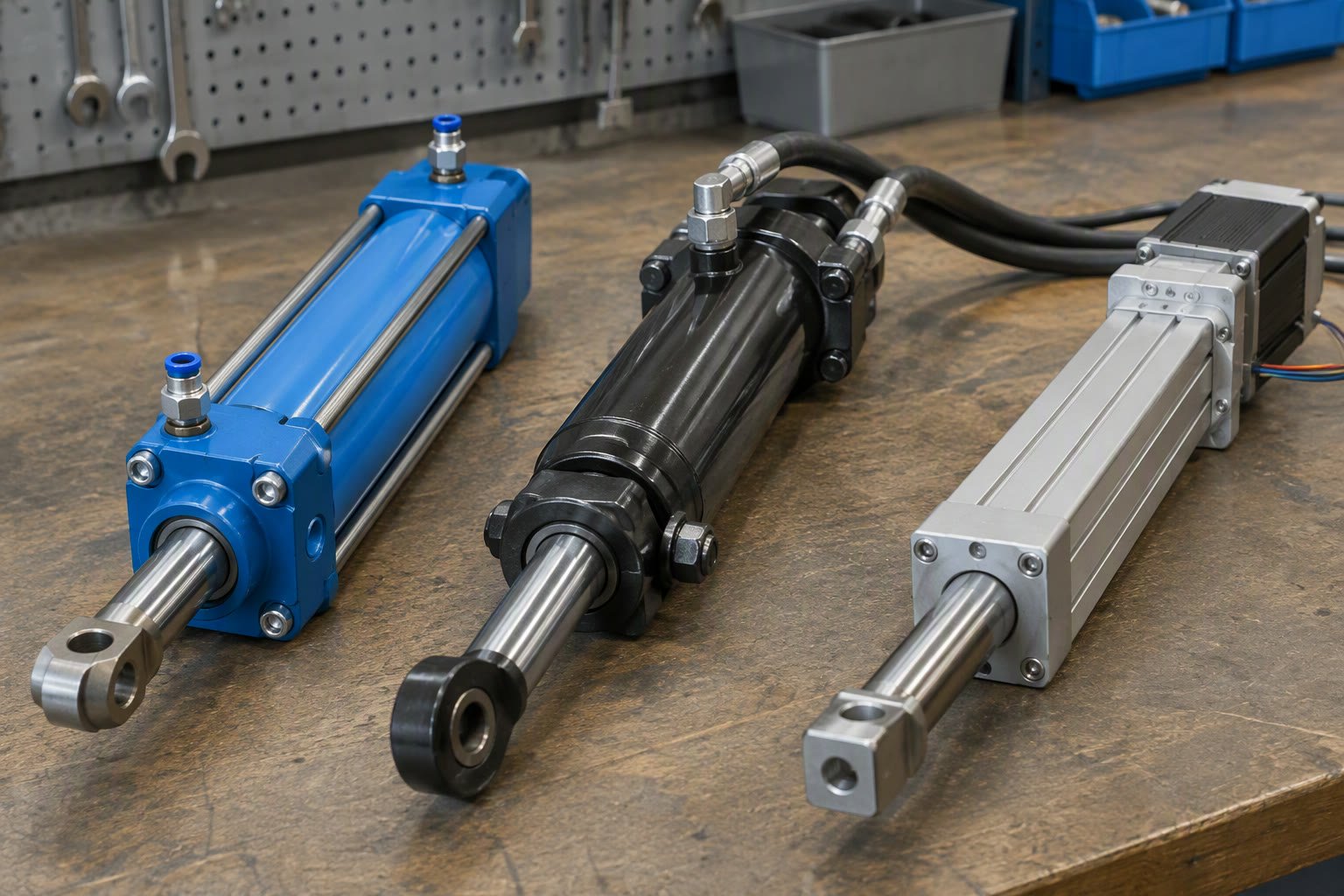
Hydraulics win when the force is large and the space is small. A 50 mm bore cylinder at 150 bar produces about 29 kN — roughly three tonnes of force — from a package that fits in your hand. Excavators, presses, injection moulding machines and heavy lifting all rely on this.
The price is infrastructure: a power pack, valves, filters, hoses, oil and a plan for leaks. A hydraulic system that is not maintained contaminates its oil and destroys pumps and valves. In a clean assembly cell, the risk of an oil leak on product is often the deciding factor against hydraulics, not the cost.
Pneumatics: fast, cheap and imprecise
A pneumatic cylinder at 6 bar with a 50 mm bore produces about 1.2 kN. That is enough for clamping, ejecting, pick-and-place and packaging, which is why pneumatics dominates those applications. It is fast, simple and the components are cheap and widely available in India.
The catch is control. Air is compressible, so stopping at an intermediate position needs extra hardware: a rod lock, a servo-pneumatic valve or an external stop. Repeatability at end positions is fine; mid-stroke positioning is not. Compressed air is also expensive per unit of energy — often the most expensive utility in a small plant — and leaks silently waste it.
Electric: precise, efficient and easy to monitor
Electric actuators — a motor driving a screw, belt or rack — give position, speed and force control in one package. They are clean, quiet and efficient, and they report their own position and current, which makes fault detection easier. That is why machine tools, robots, packaging lines and medical equipment have moved toward electric actuation.
The limits are force density and cost at high force. A ball screw and servo that produce 20 kN is a large, expensive assembly compared with a hydraulic cylinder. Electric also adds electronics, tuning and a new set of failure modes: encoder faults, drive alarms, cable noise.
Sizing maths you can do on paper
Pneumatic force is pressure times piston area. For a 50 mm bore, area is about 1,963 mm². At 0.6 N/mm² (6 bar), the theoretical force is about 1,180 N. Subtract friction and allow for the rod side of the piston, and plan on 70–80% of that.
Hydraulic force uses the same formula with a much higher pressure. At 15 N/mm² (150 bar), the same 50 mm bore gives about 29 kN. The cylinder is small; the power pack is not.
Electric force comes through the screw or belt. For a ball screw, force is roughly torque times 2π times efficiency divided by lead. A 5 mm lead screw with 1 Nm of torque and 90% efficiency gives about 1,130 N. Increase the lead for speed and you reduce the force for the same torque.
Costs in India
| Item | Indicative range | Comment |
|---|---|---|
| Pneumatic cylinder, 32–50 mm bore | ₹2,000–8,000 | Standard ISO cylinder, stroke dependent |
| Solenoid valve and FRL unit | ₹3,000–12,000 | One valve per cylinder, plus filtration |
| Air compressor, 1–3 HP | ₹25,000–1,00,000 | Plus piping, dryer and running cost |
| Hydraulic cylinder, 50 mm bore | ₹6,000–40,000 | Stroke and mounting dependent |
| Hydraulic power pack | ₹50,000–3,00,000 | Pump, motor, tank, valves, filtration |
| Electric linear actuator, 1–5 kN | ₹8,000–60,000 | Belt or screw, with or without controller |
| Servo motor and ball screw, 5–20 kN | ₹40,000–2,00,000 | Precision, speed and feedback included |
These are planning ranges before GST. The cheapest cylinder is rarely the cheapest system: compressors, dryers, piping, oil, filtration and energy often cost more over five years than the actuators themselves.
How to choose
- Choose pneumatic for fast, simple, end-to-end motion at low force, where precise mid-stroke position is not needed and compressed air already exists.
- Choose hydraulic for very high force in a small space, especially where the machine already has a hydraulic system and leak control is manageable.
- Choose electric for programmable position, speed and force, for clean environments, for energy efficiency and for machines that must report their own state.
- Choose a hybrid when one axis needs high force and another needs precision: a hydraulic clamp with an electric slide is common and sensible.
Mistakes that cost the most
| Mistake | Result | Better |
|---|---|---|
| Sizing a pneumatic cylinder at theoretical force | It stalls under load | Use 70–80% and include friction |
| Ignoring air consumption | Compressor runs constantly, pressure sags | Calculate litres per cycle and size the supply |
| Choosing hydraulics for a clean cell | Oil contamination and product rejects | Electric or pneumatic with a leak plan |
| Choosing electric for 30 kN at low cost | Budget shock and a large package | Hydraulic, or redesign the mechanism |
| No filtration on air or oil | Valve and cylinder failure | FRL and return filters as specified |
| No position feedback on pneumatic | Missed picks and jammed fixtures | Add sensors or use a servo axis |
Related: linear actuators for robots, motor selection, robot gripper design, BLDC motors and ESCs, how to power a robot.
Which is better: hydraulic, pneumatic or electric?
None is universally better. Hydraulics gives the highest force in the smallest space, pneumatics is fast and cheap at low force, and electric gives the best position control and efficiency.
Why is compressed air considered expensive?
Most of the energy used to compress air becomes heat, and only 20–30% does useful work at the cylinder. Leaks and poor maintenance waste more, so the running cost is often higher than the cylinder price suggests.
Can pneumatic cylinders hold a position mid-stroke?
Not reliably without extra hardware. Air is compressible, so a standard cylinder stops at its end positions. Use a rod lock, servo-pneumatic control or an electric axis for intermediate positions.
How do I size a hydraulic cylinder?
Force equals pressure times piston area. Choose the bore for the required force at the system pressure, then check rod buckling, stroke, speed and oil flow.
Are electric actuators replacing hydraulics?
In many precision and clean applications, yes. Hydraulics remains dominant where very high force density is required, such as presses, excavators and heavy lifting.
Pneumatic ejectors are one actuator option, and vacuum generator choice decides cycle time on porous parts.
If you chose a pneumatic actuator, size it properly with this cylinder sizing method.