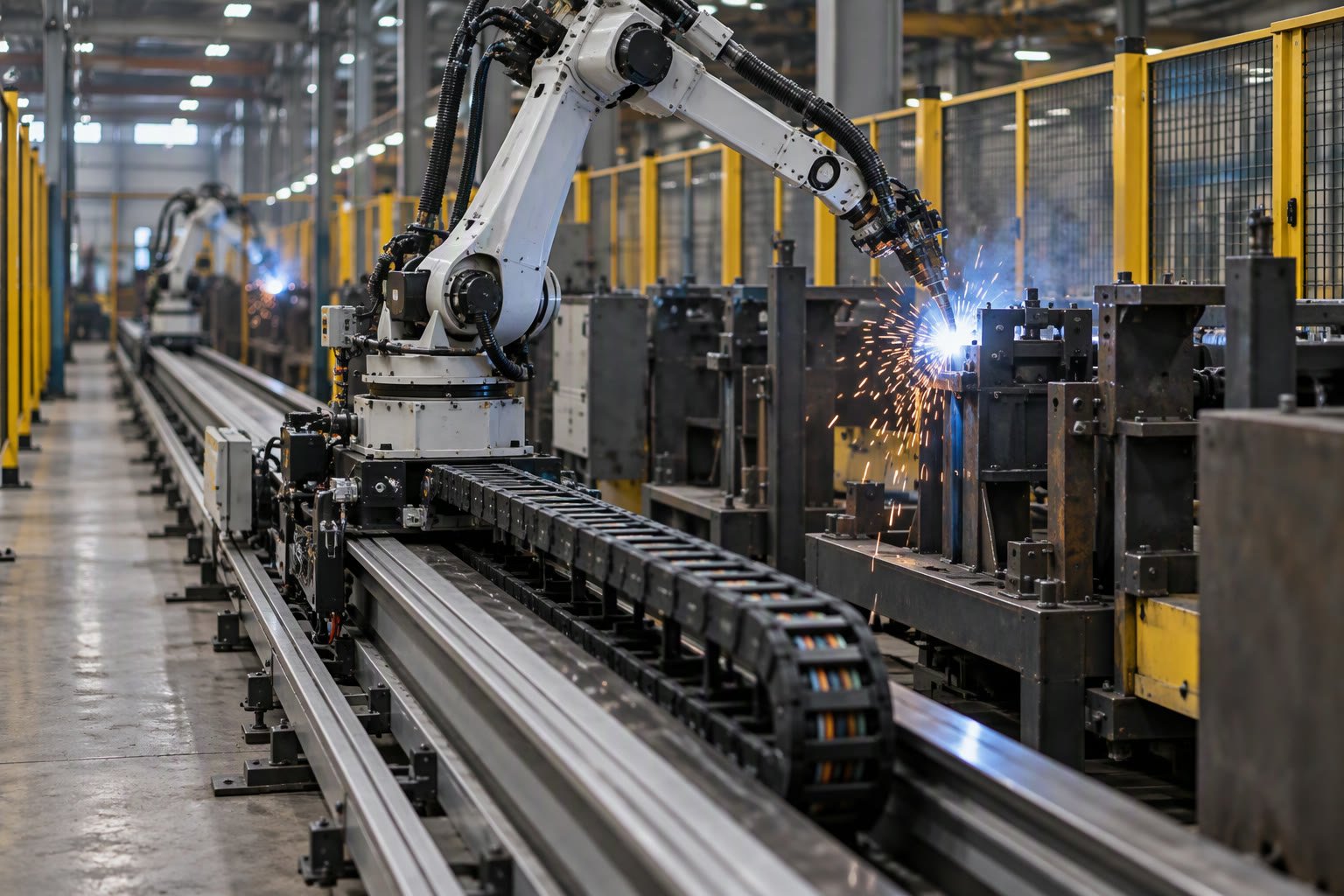
A seventh axis turns one robot into a machine that can work along a 20-metre line. It also turns a simple cell into a coordinated motion problem, and that is where most track projects lose time.
This guide covers track types, how to size travel and speed, the coordination issues between robot and track, costs in India, and the safety questions a moving robot on a rail raises.
Why add a track instead of another robot
Two robots working along a line spend part of every cycle idle while the other serves the shared station. One robot on a track serves several stations in sequence, and the track costs a fraction of a second robot. For long parts with many weld stations, or for machine tending across a row of CNC machines, that arithmetic usually wins.
The counter-argument is cycle time. A track adds travel time between stations, and if stations are far apart the robot spends its life commuting. The break-even is roughly this: if the sum of station process times is much larger than the travel time between them, a track wins. If travel dominates, two robots win.
Track types
| Type | How it moves | Best for |
|---|---|---|
| Floor-mounted linear track | Robot base on a carriage, rack and pinion | Welding lines, machine rows, long parts |
| Inverted track | Robot hangs from an overhead rail | Keeping the floor clear, reaching down into machines |
| Wall-mounted track | Horizontal rail on a wall or column | Space-constrained cells |
| Rotating base (turntable) | Robot on a powered rotary table | Two-station alternation, not long travel |
| Mobile base | Robot on an AMR | Visiting several cells, low duty cycle |
Sizing travel, speed and payload
Travel must cover every station plus a parking position plus the distance needed to clear guards. Add 300 to 500 mm at each end for limit switches and buffers; a track that just fits will be a maintenance problem.
Speed is usually 0.8 to 2 m/s for welding and machine tending. Faster tracks exist but the acceleration needed to reach the speed and stop accurately becomes the limiting factor, and the structure has to be much stiffer. A 2 m/s track with 0.5 g acceleration needs roughly 0.4 m to accelerate and the same to stop.
Travel time between two stations

Distance  = 4.0 m
v max     = 1.5 m/s
a         = 0.5 g = 4.9 m/s2

Time to reach v max = 1.5 / 4.9 = 0.31 s
Distance in accel    = 0.5 x 4.9 x 0.31^2 = 0.23 m
Same for decel       = 0.23 m
Cruise distance      = 4.0 - 0.46 = 3.54 m
Cruise time          = 3.54 / 1.5 = 2.36 s

Total travel time     = 0.31 + 2.36 + 0.31 = 2.98 s
Add 0.4 s for positioning and settling = 3.4 s
That 3.4 seconds per move is the price of the track. If each station takes 20 seconds of process time, the track is cheap. If each station takes 4 seconds, the track is the bottleneck and the layout is wrong.
Coordination: the hard part
When the track is integrated as an external axis in the robot controller, the robot and carriage can move simultaneously. This is what makes a track useful: the robot can start reaching toward the next station while the carriage is still moving, which cuts travel time by 30 to 50 percent compared with sequential motion.
To get that, three things must be right. The track must be configured as a coordinated axis, not a simple positioner. The robot program must be written in a frame that accounts for the moving base. And the controller must have a kinematic model of the track that the manufacturer supports.
Mixing brands is where projects stall. A robot from one maker on a track from another can work through a PLC handshake, but coordinated motion usually needs the robot maker’s own external axis package. Ask before purchase, not after.
Costs in India
| Item | Indicative cost | Notes |
|---|---|---|
| Track, 3 m, 500 kg carriage | ₹6–14 lakh | Rack and pinion, servo, cable chain |
| Track, 10 m, 1,000 kg carriage | ₹18–40 lakh | Fabricated base, twin pinion, covers |
| Track, 20 m heavy duty | ₹40–85 lakh | Foundation, alignment, cable management |
| External axis software and commissioning | ₹2–8 lakh | Robot maker package; varies by brand |
| Cable chain and dress pack | ₹1.5–7 lakh | Scales with travel and services carried |
Cable management and wear
A travelling robot drags every cable that serves it. A badly specified cable chain is the most common source of downtime on track systems: cables fatigue, connectors work loose, and welding cables fail at the bend radius.
Specify a chain rated for the travel, speed and acceleration, with a bend radius above the cable manufacturer’s minimum. Separate power and signal cables into different compartments. Leave 10 to 15 percent spare capacity in the chain for future additions, because adding a cable later is far harder than allowing for it now.
The principles mirror those in the dress pack guide, scaled up for a moving base.
Safety on a moving base
A robot on a track has a hazard that a fixed robot does not: the whole machine travels. The safeguarded space must cover the full travel, including the parking position, and the risk assessment must treat the carriage as a powered axis.
Practical measures: interlocked gates at every station, a light curtain or scanner along the open side, hard stops at both ends, and a controlled stop on every guard opening. Do not rely on the robot’s own safety zone configuration alone if the track is driven by a separate drive; the track drive needs its own safe torque off function.
The framework is in the robot safety standards guide, and for long open sides a safety laser scanner is often the practical solution.
When not to buy a track
- Travel is under 1.5 m and the cycle is tight: a bigger robot or a repositioned fixture is cheaper.
- Stations are far apart and process times short: two robots beat one travelling robot.
- The layout is temporary: a track is foundation work, and moving it is a project.
- Floor quality is poor: alignment tolerance on a 20 m track is strict, and a slab that is not flat enough will need remedial work.
What is a 7th axis on a robot?
A seventh axis is an external linear track that moves the robot base along a rail, extending its reach in one direction. It lets one robot serve several stations along a line instead of installing a robot at each station.
How much does a robot linear track cost in India?
Indicative ranges: 3 m track ₹6–14 lakh, 10 m track ₹18–40 lakh, 20 m heavy-duty track ₹40–85 lakh, plus ₹2–8 lakh for external axis software and commissioning and ₹1.5–7 lakh for cable chain.
When should I use a track instead of a second robot?
When the sum of station process times is much larger than the travel time between stations. If travel dominates the cycle, two robots are faster. Calculate travel time from distance, speed and acceleration before deciding.
Why is coordinated motion hard on a track?
Coordinated motion requires the track to be configured as an external axis in the robot controller with a supported kinematic model. Mixing robot and track brands often limits you to sequential PLC handshakes, which loses 30–50% of the travel saving.
What safety measures does a robot track need?
Safeguarding over the full travel including parking, interlocked gates at each station, a light curtain or scanner along open sides, hard stops at both ends, and a safe torque off function on the track drive itself.
Sources and further reading
- ISO 10218-1 — safety requirements for industrial robots.
- A3 Association for Advancing Automation — integration resources.
- KUKA India — linear unit and external axis documentation.
- igus India — cable chain selection and bend radius data.