Most robot welding problems blamed on the robot are fit-up problems. Seam tracking is the technology that absorbs them, and it only works if the joint, the sensing method and the fixture are designed together.
This guide covers the tracking methods used in Indian fabrication shops, what each one can and cannot correct, how to specify it, and how to avoid the classic mistake of buying tracking to compensate for a fixture that should have been fixed.
What seam tracking actually corrects
Tracking corrects the position of the seam relative to where the program expects it. It compensates for part-to-part variation, fixture wear, thermal distortion during a long weld, and small errors in the taught path.
It does not correct a gap that is too wide, a part that is the wrong shape, or a joint that has been tacked with the two plates offset in height. Those are fit-up problems, and no sensor can weld a joint that is not there. The distinction matters because tracking is often proposed as a fix for exactly those problems.
The four methods
| Method | How it senses | Best for | Limitation |
|---|---|---|---|
| Touch sensing (through-arc or wire touch) | Wire touches the part, controller calculates offset | Simple joints, low cost, thick plate | Point-by-point, slow, needs clean surface |
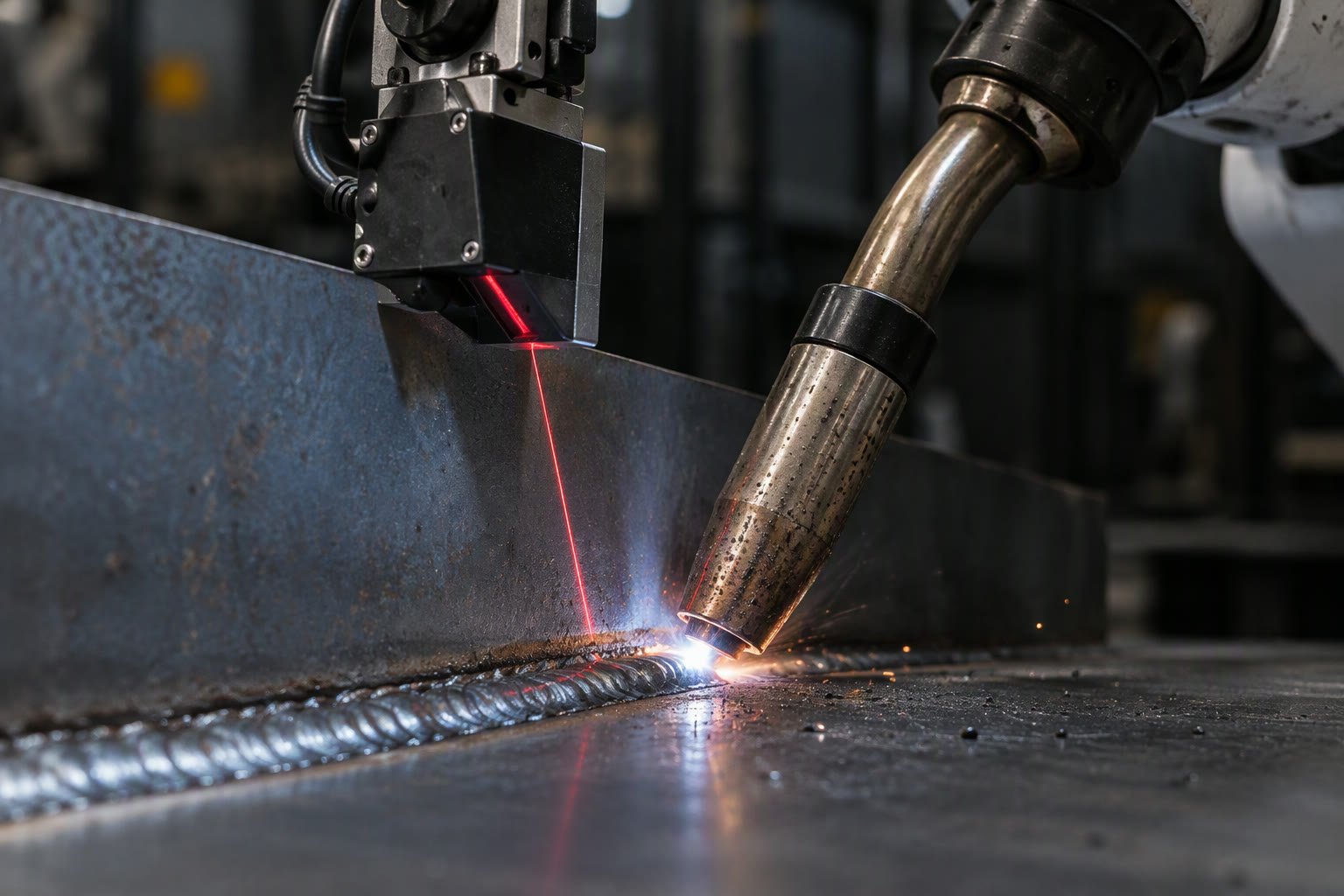
| Laser seam tracking | Laser line and camera measure the joint profile ahead of the torch | Long welds, thin sheet, high speed | Needs line of sight, sensitive to spatter and smoke |
| Through-arc sensing | Monitors current/voltage variation as the torch weaves | V-groove welds, no extra hardware | Needs weaving, works only on some joint types |
| Vision-based seam finding | Camera locates the joint before welding starts | Complex parts, one-off jobs | Finding rather than continuous tracking |
Touch sensing: cheap and underrated
Touch sensing uses the welding wire itself as a probe. The robot moves to a taught point, the wire touches the part, the controller detects contact through the welding circuit, and calculates the offset from the expected position. Three touches are enough to define a plane and a line.
It costs almost nothing beyond software, and on thick plate with consistent joints it solves 80 percent of the variation problem. The limits are speed and surface condition: mill scale, rust and paint interfere with contact detection, and each touch adds a second or two to the cycle.
For a job shop welding 8 to 20 mm plate, touch sensing is usually the right first purchase. For thin sheet at speed, it is too slow.
Laser tracking: what the specification should say
A laser tracker projects a line onto the joint and a camera reads the profile. The controller uses the profile to correct the path in real time. The useful specifications are not the marketing numbers.
- Stand-off and lead distance. The sensor must see the joint ahead of the torch without being blocked by the torch, the gas cup or the fixture.
- Measurement range and resolution. The tracker must cover the expected variation, typically 5 to 15 mm, with resolution better than 0.1 mm.
- Tracking speed. The controller must keep up at the welding speed you actually use, not at a demonstration speed.
- Spatter protection. A replaceable window or air knife is essential; a dirty lens is the most common failure.
- Joint types supported. Butt, lap, fillet and corner need different algorithms. Confirm yours is in the list.
Ask for a demonstration on your joint, at your speed, with your material. A tracker that works on clean mild steel may struggle on galvanised sheet or on aluminium with a reflective surface.
The fixture is still the foundation
Tracking corrects the path, not the gap. If the root gap varies from 0 to 3 mm along a seam, the weld will look acceptable at one end and burn through at the other, and the tracker will follow the seam faithfully the whole way.
Design the fixture to hold the gap within the process window, then use tracking to absorb the remaining variation. A fixture that repeats within 0.5 mm allows a simple tracker and a stable procedure. A fixture that repeats within 3 mm forces a sophisticated tracker and still produces inconsistent welds.
The fixture design principles are in the robot welding fixture guide, and the cost of getting this wrong is covered in the welding cost guide.
Costs in India
| Option | Indicative cost | Notes |
|---|---|---|
| Touch sensing software option | ₹40,000–1.5 lakh | Per robot; may need a torch with sensing capability |
| Through-arc sensing | Included in many welding packages | Requires weaving; no extra hardware |
| Laser seam tracker, sensor and controller | ₹8–22 lakh | Includes mounting, cabling and integration |
| Vision seam finding system | ₹10–28 lakh | Camera, lighting, software, integration |
| Retrofit to an existing cell | Add 20–35% | Mounting, safety review, reprogramming |
Programming and validation
Tracking changes how a program is written. Instead of teaching exact points, the programmer teaches the nominal path and defines search and tracking parameters. That is a different skill, and it is where many installations underperform.
Validate with a deliberate variation test: weld three parts with the seam offset by 1 mm, 2 mm and 3 mm from nominal, and confirm the weld quality holds. If it does not, the tracking parameters are wrong, or the joint cannot be tracked at all.
Record the results. When a new operator adjusts parameters six months later, the original validation is the only evidence of what the system was capable of.
A sensible progression
Start with good fixtures and touch sensing. If the parts are thin, the volumes high and the variation real, add laser tracking. Do not begin with the most expensive sensor, because the cell will still be limited by the fixture, the torch angle and the welding procedure.
Track the result in the same way as any process improvement: measure rework rate and arc-on time before and after. Tracking that reduces rework from 8 percent to 2 percent pays for itself quickly. Tracking that leaves rework unchanged is an expensive camera on a robot.
What is robot welding seam tracking?
Seam tracking senses where the joint actually is and corrects the robot path in real time. It compensates for part variation, fixture wear and thermal distortion, but it cannot fix a gap that is out of specification.
What are the main seam tracking methods?
Touch sensing using the welding wire as a probe, through-arc sensing that reads current variation during weaving, laser seam tracking with a camera that reads the joint profile, and vision-based seam finding before welding starts.
How much does laser seam tracking cost in India?
Indicative ₹8–22 lakh for sensor, controller, mounting and integration, plus 20–35% for a retrofit. Touch sensing software costs ₹40,000–1.5 lakh and is often enough for thick plate work.
Does seam tracking fix poor fit-up?
No. Tracking follows the seam; it does not close a gap. If the root gap varies beyond the welding procedure's window, the weld will still be inconsistent. Improve the fixture first, then use tracking for residual variation.
Which tracking method should a small Indian fabricator buy?
Start with touch sensing on good fixtures. It is cheap, needs no extra sensor and solves most variation on thick plate. Add laser tracking only for thin sheet, high volume and genuinely variable joints.
Tracking holds the torch on the joint; a positioner puts the joint where it can be welded properly in the first place.
Sources and further reading
- American Welding Society — welding procedure and qualification standards.
- ISO 3834 — quality requirements for fusion welding.
- A3 Association for Advancing Automation — robotic welding resources.
- The Fabricator — practical welding automation articles.