Most college robotics labs are bought, not designed. A vendor supplies a list, the equipment arrives, and within a year half of it is unused because there are no spares, no trained staff and no projects that need it. A lab that produces good engineers is built around a small number of repeatable activities: build, measure, debug, document. This guide gives three realistic budget tiers, the room requirements people forget, and procurement rules that keep a lab alive after the warranty ends.
Prices are indicative 2026 ranges before tax. Indian academic pricing, bulk deals and state schemes move them significantly, so use these numbers to size a proposal, not to place an order.
Three lab tiers
| Tier | Budget | What it supports | Typical use |
|---|---|---|---|
| Starter | ₹3–6 lakh | 30 students, microcontroller projects, basic sensors and motors, one 3D printer | Diploma and first-year labs |
| Working | ₹8–20 lakh | 60 students, ROS 2 and SLAM, robot arms, soldering and measurement stations, two printers | Degree projects and competitions |
| Advanced | ₹25–60 lakh | Research groups, vision, mobile manipulators, drones, dedicated compute | M.Tech, PhD and industry projects |
Do not buy the advanced tier in year one. Buy the working tier, run it for two semesters, and let the equipment list for the next phase come from actual project bottlenecks.
The equipment list that earns its space
| Category | Items | Planning range | Notes |
|---|---|---|---|
| Workbenches and power | 8–12 benches, fused power strips, UPS, earth leakage protection | ₹1.5–4 lakh | Sockets at bench level, not on the floor |
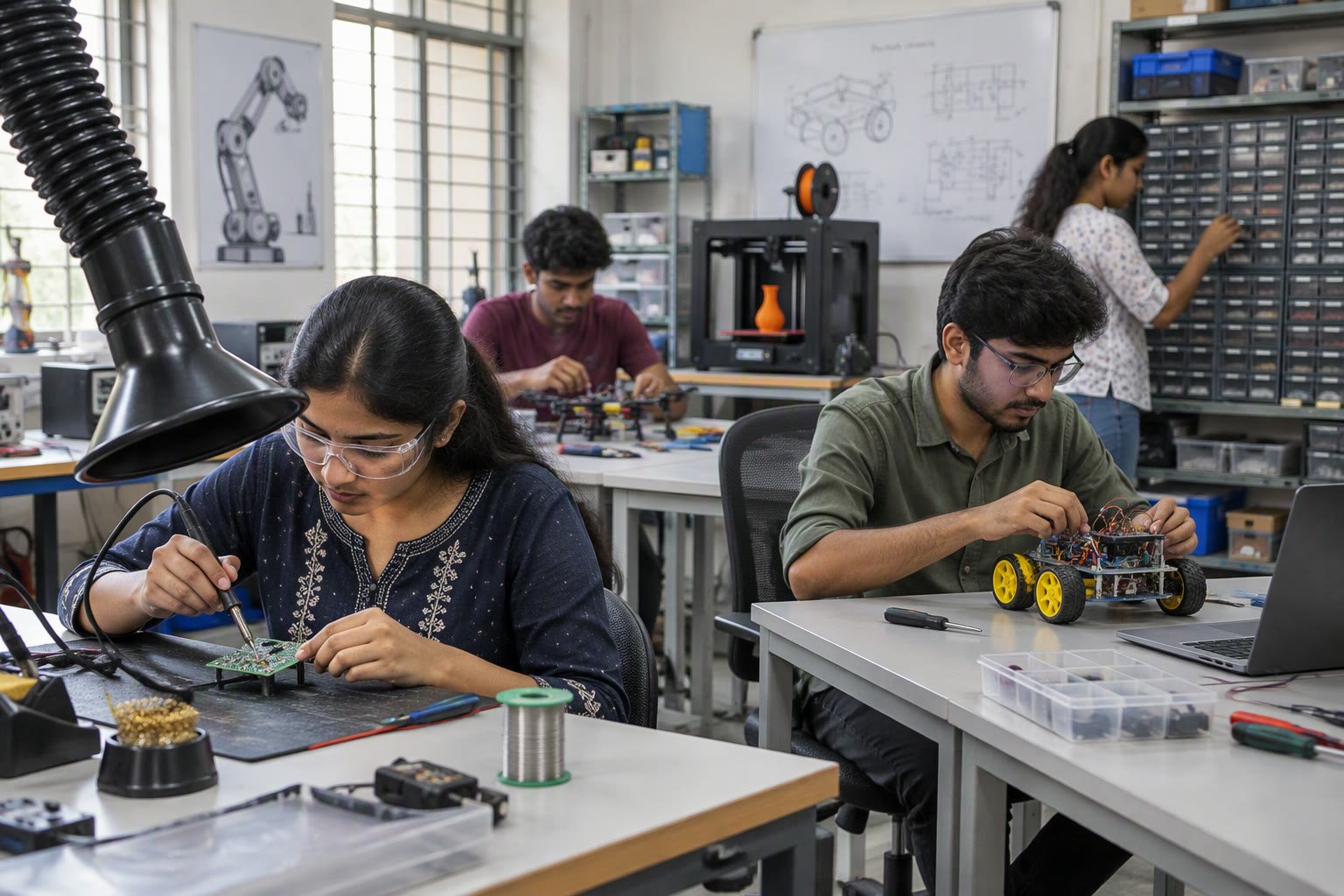
| Soldering and rework | 8–12 stations, fume extraction, hot air rework, helping hands | ₹60,000–2 lakh | Fume extraction is a health requirement, not a luxury |
| Measurement | Digital multimeters, one 100 MHz oscilloscope, bench power supplies, logic analyser | ₹1.5–4 lakh | One good scope beats five cheap ones |
| Controllers | Arduino, ESP32, Raspberry Pi, Pico, motor drivers, sensors | ₹1–3 lakh | Standardise on two families to simplify teaching |
| Motion | DC gear motors, steppers, servos, drivers, wheels, encoders | ₹1–3 lakh | Buy spares of every driver and sensor |
| Fabrication | 3D printer, hand tools, drill, rotary tool, laser cutting outsourced | ₹1–4 lakh | Outsource laser and CNC until demand is proven |
| Robots and arms | Educational 4–6 axis arm, mobile robot kits, one lidar | ₹2–10 lakh | Choose equipment students can open and repair |
| Storage | Component cabinets, labelled bins, project lockers | ₹50,000–1.5 lakh | Untracked components disappear within a month |
| Safety | Fire extinguisher, first aid, eye wash, gloves, goggles, isolation switch | ₹30,000–80,000 | Required before the first soldering session |
The room requirements people forget
- Floor area. 500–800 sq ft comfortably supports 30 students at benches with a test track. Below 400 sq ft, project storage becomes the constraint.
- Power. Separate circuits for soldering and motor testing, one emergency stop for the test area, and a UPS for computers and the 3D printer.
- Ventilation. Solder fume and 3D printer emissions need extraction or strong general ventilation. A closed room with the door shut is not acceptable.
- Network. Wired access points, because Wi-Fi is congested when 30 boards connect at once.
- Flooring and layout. A hard, level test area with tape marks for line-following and a clear safety zone around arms and drones.
- Storage. Lockable cabinets plus open bins. Students need somewhere to leave a half-built robot without it being cannibalised.
Consumables are the budget line that gets cut
A lab without consumables is a museum. Budget per student per semester for wire, solder, headers, resistors, sensors that get damaged, 3D filament, batteries and broken motor drivers. A practical planning figure is ₹1,500–3,000 per student per semester, plus a 15% annual maintenance reserve on the capital equipment.
Example, working lab for 60 students
Capital equipment          = Rs 14,00,000
Annual maintenance (15%)   = Rs 2,10,000
Consumables (Rs 2,000 x 60)= Rs 1,20,000
Spares and replacements    = Rs 80,000
Training for two staff     = Rs 60,000
Year-one running cost      = Rs 4,70,000
Present this number with the capital budget. A lab approved without a running budget fails in year two, usually because nobody planned for the first set of dead batteries and burnt drivers.
Staffing and training
One lab instructor who can debug hardware is worth more than another robot kit. Plan for one technician per 30 students during open hours, and train at least two faculty members on the specific equipment so the lab does not depend on one person. Vendor training at installation is rarely enough; schedule a second session after a semester of real use, when staff know what to ask.
Procurement rules that protect the lab
- Buy open, repairable hardware. Prefer equipment with published schematics, standard connectors and available spares over sealed boxes with proprietary cables.
- Standardise. One or two controller families, one motor driver family, one sensor set. This simplifies teaching and spares.
- Require an Indian service contact. Ask for the local service engineer, response time and spare lead time in writing.
- Reject demo-only equipment. If students cannot open it, modify it or repair it, it belongs in a showcase, not a teaching lab.
- Buy the software stack that industry uses. ROS 2, Python, C++ and standard CAD. Avoid closed teaching platforms that only work with one vendor’s kit.
- Keep a spares ratio. At least one spare motor driver, sensor and controller for every ten units in use.
Funding routes
Most labs are funded through a mix of institutional budget, state technical education schemes, research grants and CSR. AICTE runs modernisation and innovation-lab schemes; UGC and state departments have their own equipment programmes; companies fund education projects under CSR. Each has its own proposal format and timeline, so start with the institution’s finance office and ask which scheme is currently open rather than working from an old circular.
A stronger proposal ties equipment to outcomes: number of students trained, projects completed, competitions entered, industry problems solved. Reviewers fund outcomes, not shopping lists.
Safety and housekeeping
- Never run motor tests with loose wires on a shared bench; use a marked test zone.
- Lithium batteries need a fire-resistant charging bag and a rule against unattended charging.
- 3D printers run hot; place them on a non-flammable surface with clearance.
- Keep a first-aid kit and eye wash accessible, and record every incident, however small.
- Label every power supply with its voltage and current limit. Most student damage comes from the wrong adapter.
Related: robotics starter kits, where to buy parts in India, robotics competitions, 3D printers for robotics, SLAM for beginners.
How much does it cost to set up a robotics lab in an Indian college?
A starter lab for 30 students costs roughly ₹3–6 lakh in equipment. A working lab for 60 students with ROS 2, robot arms and fabrication typically costs ₹8–20 lakh. Add about 15% of capital cost per year for maintenance and consumables.
How much space does a robotics lab need?
Around 500–800 sq ft supports 30 students at benches with a test track. Below 400 sq ft, storage and safe testing become the limiting factors rather than equipment.
What equipment should be bought first?
Benches, power, soldering with fume extraction, multimeters, one oscilloscope, controllers, sensors, motors and a 3D printer. Add robot arms, lidar and advanced compute only after the basics are in daily use.
Can a robotics lab be funded through government schemes?
Yes. AICTE, UGC and state technical education departments run equipment and innovation-lab schemes, and companies fund education through CSR. Confirm current schemes with your institution's finance office before preparing a proposal.
How do I keep a lab from becoming unused?
Tie every purchase to a course activity or project, fund consumables annually, train two staff members, keep spares, and choose repairable open hardware that students can modify.
A robotics lab budget has to cover simulators and hardware; see Isaac Sim vs Gazebo for the workstation cost.
The assessment students must follow is in the cobot risk assessment guide.
Sources and further reading
- AICTE — technical education schemes, model curriculum and lab guidelines.
- University Grants Commission — higher education funding and scheme information.
- Ministry of Corporate Affairs — CSR rules under the Companies Act.
- Startup India — innovation lab and incubator context for institutions.