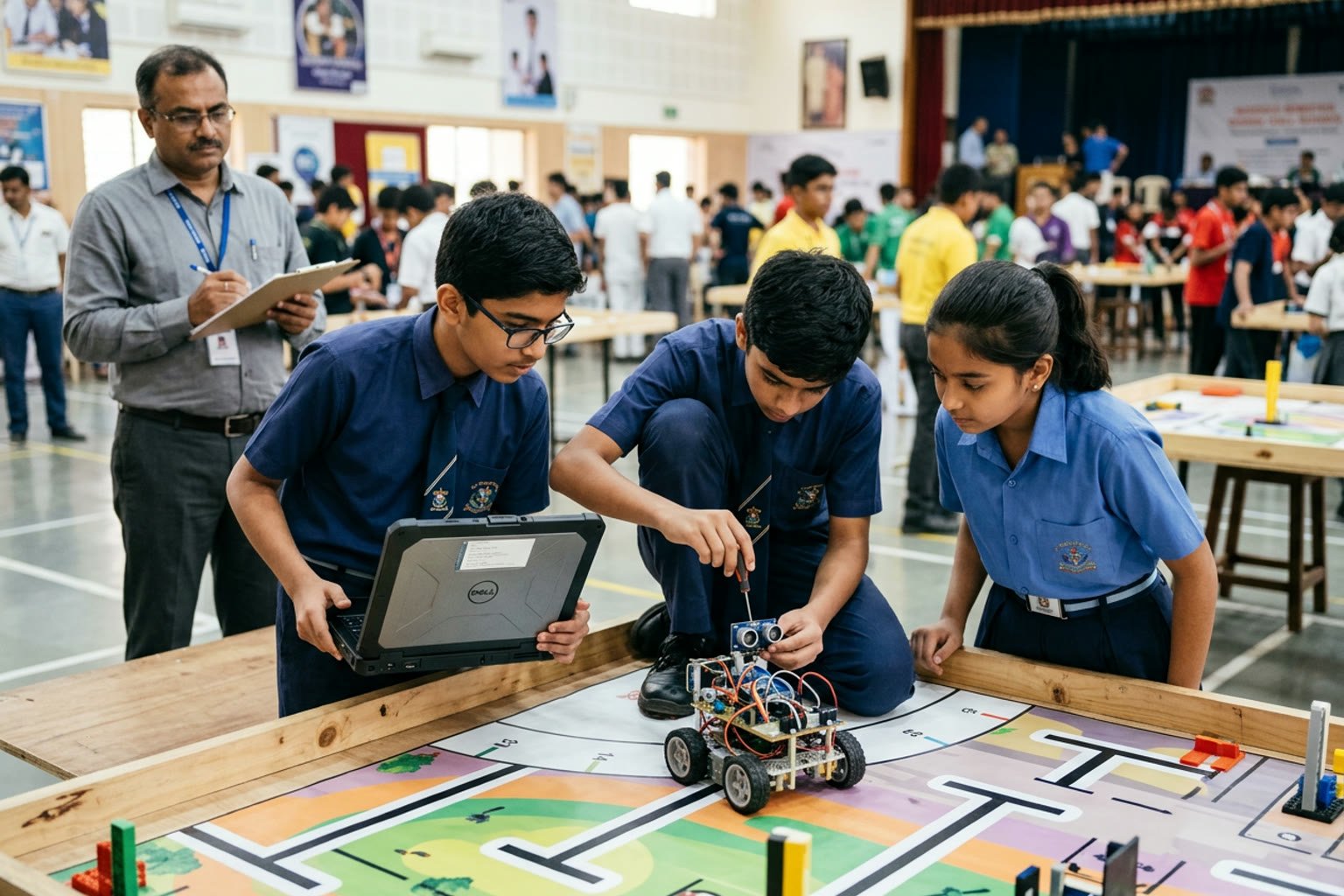
A robotics competition is the cheapest portfolio you can build. It gives you a deadline, a scoring rulebook, a judge who does not care about your marks, and a robot that has to survive a real match. For a student in India, one season of competition teaches more than three semesters of watching videos. This guide maps the competitions worth entering, what they cost, and how to prepare without wasting a year. Robotics competitions in India give students a deadline, a rulebook and a judge who ignores marks, which is why I rate them highly.
Dates, age bands and fees change every season. Always confirm on the organiser’s official page before you plan around a date. What does not change is the shape of a good entry: a simple robot that finishes every match beats an ambitious robot that works once.
The competitions Indian students can actually enter
These are the long-running, nationally recognised routes. Each has a different age group, team size and scoring style.
| Competition | Who it is for | What you build | Why it is worth it |
|---|---|---|---|
| World Robot Olympiad (WRO) India | School students, split into age groups | Autonomous LEGO or controller-based robots on a fixed field | The most structured entry point; strong design-process judging |
| FIRST LEGO League and FIRST Tech Challenge | School and early college | Team robot plus a research or engineering notebook | Teaches documentation and teamwork, not just building |
| DD Robocon | Engineering colleges | A large custom robot for a themed task | India’s toughest college-level build; strong industry visibility |
| Techfest, IIT Bombay | College students | Event-specific robotics challenges | Good first college competition, high footfall and networking |
| Shaastra, IIT Madras | College students | Robotics and autonomous challenges | Technical depth, often judged by student robotics clubs |
| State and college tech fests | Diploma and degree students | Line follower, sumo, maze, pick and place | Low entry cost, useful practice before national events |
There is also a school-level route through Atal Tinkering Labs, which fund robotics and electronics equipment in schools. If your school has one, that is where a first team usually starts.
Pick the competition that matches your level
Students lose seasons by entering something two levels above their current skill. Use this progression instead.
- Never built a moving robot: start with a college or school line follower or sumo event. The rulebook is short and the robot is cheap.
- Built two or three kits: enter a WRO or FIRST category, or a maze solver. You will learn autonomous navigation and sensor calibration.
- Comfortable with code and sensors: attempt a college-level challenge with a custom chassis, encoders and a proper power system.
- Led a team before: DD Robocon or an international-qualifier route. This is a project-management test as much as a technical one.
What a season actually costs
Costs vary widely, so treat these as planning bands for a team of three to five students, excluding travel to the venue.
| Item | School-level event | College-level event | National final |
|---|---|---|---|
| Registration and kit | ₹5,000–25,000 | ₹15,000–60,000 | Often included after qualifying |
| Custom parts, motors, drivers | ₹3,000–10,000 | ₹15,000–80,000 | ₹40,000–2,00,000 |
| Spares and a second set of critical parts | ₹2,000–5,000 | ₹5,000–20,000 | ₹10,000–40,000 |
| 3D printing, laser cutting, machining | ₹1,000–5,000 | ₹5,000–25,000 | ₹10,000–50,000 |
| Travel, stay, transport of the robot | Local | ₹5,000–20,000 | ₹15,000–50,000 |
Two habits keep this number down. First, buy one spare of every part that can fail in a match: motor driver, sensor, wheel hub, battery connector. Second, design the robot around parts you can buy again this week in India, not parts that arrive in six weeks.
An eight-week preparation plan
Most teams start too late and spend the last week debugging instead of practising. This schedule works backwards from match day.
- Weeks 1–2: read the rulebook twice, list every scoring action, and score the top three teams from last season’s videos. Decide what your robot will do, and write down what it will not do.
- Week 3: build the simplest drivebase that can complete the course. No mechanisms yet. Get it moving reliably on the actual field dimensions.
- Week 4: add the first scoring mechanism and test it without the drivebase moving. Mechanisms fail more often than code.
- Week 5: integrate, then measure cycle time with a stopwatch. If a run takes 90 seconds when the match is 120, you have no margin.
- Week 6: break it on purpose. Swap a battery mid-run, unplug a sensor, run on a dusty floor, and fix what fails.
- Week 7: full match practice, ten runs a day. Change nothing structural after day three of this week.
- Week 8: pack spares, tools, chargers, printed rulebook and a checklist. Travel, set up, and do one slow calibration run.
What judges score in robotics competitions in India
In WRO and FIRST-style events, the robot game is only part of the score. Judges look for evidence that you can explain decisions: why this gear ratio, why this sensor, what failed and what you changed. A team with an average robot and a clear engineering notebook routinely beats a team with a clever robot and no record of how it was built.
Keep the notebook as you work, not after. Photograph every version, note the date, the change and the result. Two lines per entry is enough. This is also the document you will reuse in college applications and internship interviews.
Kit or custom build
Use the kit the competition expects for school-level events. It removes mechanical uncertainty and lets the team focus on strategy and programming. For college events, a custom build gives you an advantage in speed and payload, but only if someone on the team can design, machine and wire it.
| Factor | Kit robot | Custom robot |
|---|---|---|
| Time to first working version | Days | Weeks |
| Repair speed at venue | Fast, parts are standard | Depends on what you brought |
| Performance ceiling | Limited by the kit | As high as your design |
| Skills learned | Programming, strategy | Design, fabrication, integration |
| Best for | First two seasons | Teams with a workshop and a mentor |
Mistakes that cost teams a season
The mistakes below can cost a team an entire season of robotics competitions in India.
- Designing for the maximum score. A reliable 60% score wins more matches than an unreliable 100% attempt.
- No spare motor driver. It is the single most common match-day failure and costs under ₹500.
- Testing on a different surface. Field mats, lighting and reflections change sensor behaviour. Practise on the real material.
- Batteries charged the morning of the event. Charge, discharge and recharge at least twice before travelling so you know the real runtime.
- One person owns all the code. If they are absent, the team is out. Two people must be able to upload a working build.
- Ignoring the rulebook update. Organisers publish clarifications during the season; these override the original PDF.
Turning a competition into a career asset
Recruiters and admission panels cannot evaluate a robot they never saw. They can evaluate a two-page build report, a short video and a clear explanation of one hard problem you solved. After each event, write down three things: the constraint that shaped your design, the failure that cost you the most points, and the fix you would ship next season. That paragraph is worth more in an interview than the trophy.
Related: final-year robotics projects, robotics skills roadmap, what to buy in a starter kit, project report format, how to become a robotics engineer.
What age can a student enter robotics competitions in India?
Most school-level events group students from roughly 8 to 19 into age bands, while college events are open to diploma and degree students. Exact bands are set by each organiser every season, so check the current rulebook before registering.
Do I need an expensive kit to compete?
No. School-level events are usually designed around a standard kit. College events reward a well-built custom robot, but a simple reliable design beats an expensive one that fails under match pressure.
How many students should be on a team?
Most competitions allow two to five students per team. Three is a practical size: one for mechanical, one for code, one for strategy and driving, with everyone able to cover another role.
Can I enter without a school or college team?
Some events allow private or club teams, but most school-level competitions require an institutional registration. Check the organiser's rules, and consider starting a robotics club if your institution does not have one.
What should a beginner build first?
A line follower or a simple sumo robot. Both teach motor control, sensor calibration and power wiring with a short rulebook and a parts cost under a few thousand rupees.
Drone events reward a machine you built and can repair; start with the build guide.
Competitions give a club its deadlines, and the club guide explains how to build the team before entering one.
Drone racing and FPV events sit alongside the other competitions Indian students enter.
Sources and further reading
- World Robot Olympiad Association — official categories, age groups and season rules.
- FIRST — FIRST LEGO League and FIRST Tech Challenge programme details.
- Techfest, IIT Bombay — competition calendar and rules.
- Shaastra, IIT Madras — annual technical festival and robotics events.
- Atal Innovation Mission — Atal Tinkering Labs and school-level innovation support.