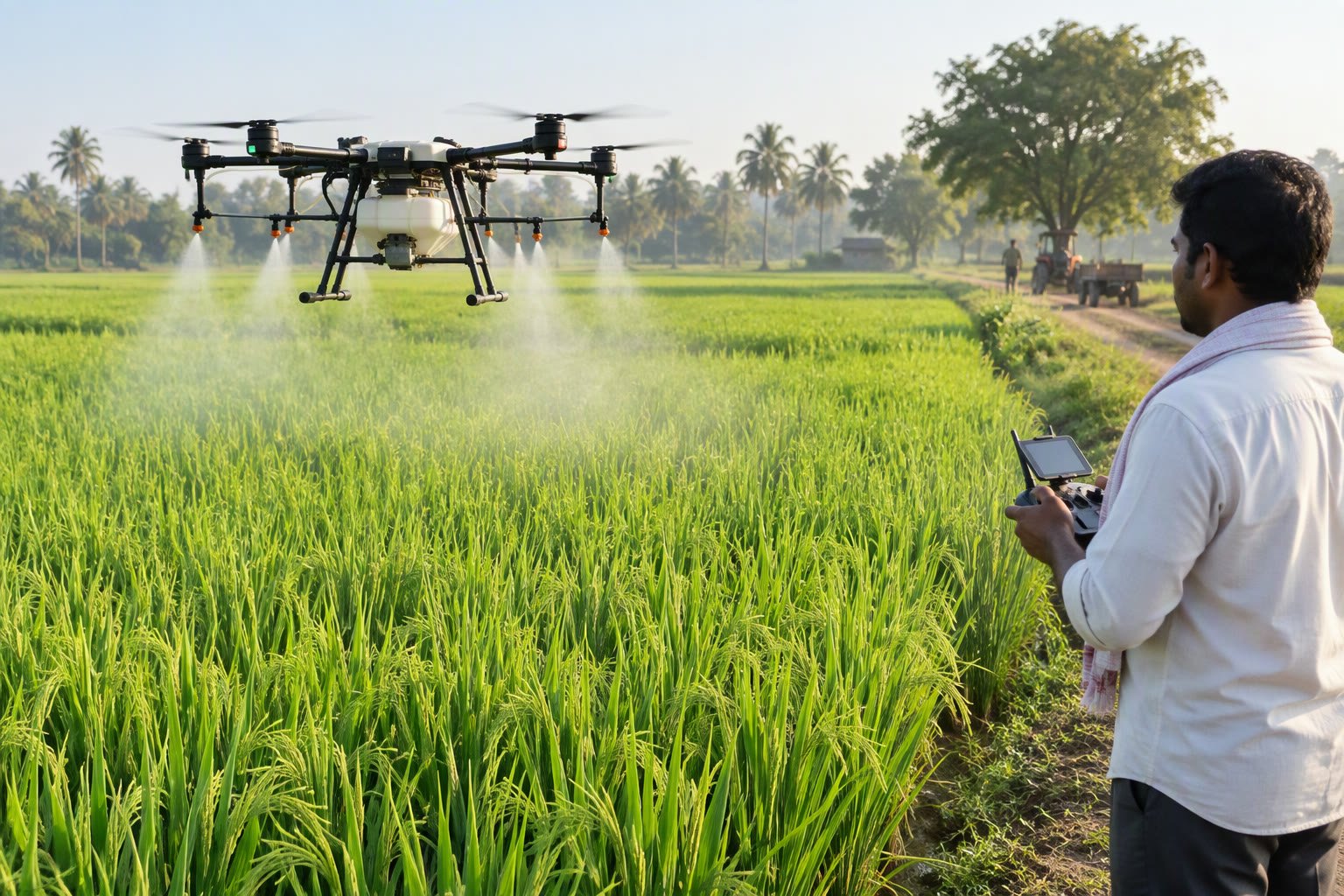
Drone spraying looks like an easy business from the outside: buy a drone, charge per acre, finish before lunch. The operators who make money treat it as a service business with tight logistics, not as a gadget. Battery swaps, water for mixing, transport between fields and the spraying season decide whether the machine pays for itself. This guide covers the rules, the real costs, and a payback model you can stress-test before you spend ten lakh rupees.
Figures here are indicative planning ranges for 2026 and vary by state, crop, drone class and vendor. Confirm current rules with the DGCA and current subsidy terms with your state agriculture department before committing money.
The rules you must satisfy first
Agricultural spraying is regulated. The Drone Rules, 2021 created a single framework administered by the DGCA, and several requirements sit on the operator rather than the seller.
- Type-certified drone. Agricultural drones used commercially should be type-certified and carry a Unique Identification Number. Ask the vendor for the certificate, not a brochure claim.
- Remote Pilot Certificate. The person flying needs an RPC from a DGCA-approved Remote Pilot Training Organisation. A hobby certificate is not enough for commercial spraying.
- Registration and permissions. Operations in controlled airspace need permission through the Digital Sky platform. Green zones have simpler rules, but you still operate a registered aircraft.
- No Permission No Takeoff. Compliant drones enforce NPNT. If the firmware lets you fly anywhere with no check, that is a warning sign about certification.
- Insurance. Third-party liability cover is a practical necessity and often a customer requirement.
Rules and state subsidy schemes change. Treat any figure you see online, including on this page, as a starting point for verification.
What the equipment actually costs
| Item | Planning range | Notes |
|---|---|---|
| Spray drone, 10 litre class | ₹5–12 lakh | Includes controller and basic spares; price tracks tank size and certification |
| Spare batteries | ₹60,000–1.5 lakh each | You need at least three to keep working through a day |
| Battery charger and generator | ₹40,000–1.2 lakh | Field charging is the bottleneck; plan for two chargers |
| Remote pilot training | ₹30,000–60,000 | RPC course at a DGCA-approved training organisation |
| Transport | ₹0–8 lakh | A small pickup or a fitted trailer; do not improvise with a two-wheeler |
| Insurance and registration | ₹20,000–60,000 per year | Hull and third-party cover |
| Spares and maintenance | ₹40,000–1 lakh per year | Nozzles, pumps, props, arms |
A realistic entry package, including a spare battery set and training, lands between ₹7 lakh and ₹15 lakh. Anything advertised well below that usually excludes batteries, training or certification, which are the parts that make the machine usable.
How the working day actually goes
New operators overestimate acreage because they count flight time only. A spray pass is a small part of the job.
- Travel and setup: 30–60 minutes per site, longer if fields are small and scattered.
- Mixing and filling: 10–15 minutes per tank, plus water sourcing.
- Flight: a 10 litre tank covers roughly an acre in 7–10 minutes depending on crop and dosage.
- Battery swap: 3–5 minutes, but the spare must already be charged.
- Cleaning: 15–20 minutes at the end of the day, and between chemicals.
With three batteries, two chargers and a nearby water source, a two-person team can realistically spray 15–25 acres in a working day. With one battery or a distant water source, that number collapses. Logistics, not the drone, sets your ceiling.
Pricing per acre
Market rates vary by state, crop and competition, but most operators price between ₹250 and ₹600 per acre, with a minimum charge for small plots. Some charge per tank or per hour instead. Per-acre pricing is easier for farmers to compare and easier for you to defend.
| Service | Typical pricing basis | What to include |
|---|---|---|
| Pesticide spray | ₹250–500 per acre | Labour, drone, water; chemical billed separately |
| Herbicide or growth regulator | ₹300–600 per acre | Precision matters more; charge for calibration |
| Small or irregular plots | Minimum charge per site | Setup time dominates; price the visit, not the acre |
| Annual contract | Discounted per acre | Guaranteed visits, predictable revenue |
Never quote a rate that does not cover the trip. A five-acre job two hours away can lose money at a rate that works for a fifty-acre block next door.
A payback model you can stress-test
Capital cost (drone, 3 batteries, chargers, training, misc) = Rs 11,00,000
Working days per month (season average)                   = 18
Acres per working day                                     = 20
Monthly acres                                             = 360
Rate per acre                                             = Rs 350
Monthly revenue                                           = Rs 1,26,000

Pilot and helper wages        = Rs 35,000
Fuel, transport, misc         = Rs 15,000
Maintenance reserve           = Rs 8,000
Insurance (monthly share)     = Rs 4,000
Monthly costs                 = Rs 62,000

Monthly net                   = Rs 64,000
Simple payback                = 11,00,000 / 64,000 = 17 months
Now change the assumptions. At 12 acres a day, net falls to roughly ₹36,000 and payback stretches beyond two years. At ₹250 an acre, it falls further. If the season gives you only four working months a year, the annual picture changes completely. Run the model with your own district’s rates and season length before you buy.
The risks that sink new operators
- Seasonality. Spraying demand clusters around crop stages. A drone that sits idle for months still depreciates.
- Battery cost per acre. Batteries degrade. Budget replacement cycles, not just the first set.
- Chemical handling. You are applying someone else’s pesticide. Dosage errors damage crops and reputations; train the pilot on calibration, not just flying.
- Drift and neighbours. Wind carries spray. Keep buffer distances and record weather at the time of application.
- Payment collection. Farmers pay after harvest. Agree terms in writing and collect part payment on the day.
- Competition. When several operators enter a district, rates fall. Differentiate on reliability, calibration and record-keeping.
Where the demand is strongest
Drone spraying wins where labour is scarce, fields are large, and the crop needs timely application: paddy, cotton, sugarcane, soybean and horticulture. It is weaker on tiny, terraced plots where setup time dominates. Before buying, list twenty farmers you could realistically serve within a 60-minute drive and ask what they currently pay for spraying. If that list is short, the business case is short too.
Support is available. Agricultural mechanisation schemes and women-focused drone programmes have subsidised equipment and training in many states, with terms that change annually. Check the current guidelines rather than relying on a scheme description from an old news article.
Related: drone pilot licence in India, agricultural robots in India, solar panel cleaning robots, robot battery guide, robotics jobs for freshers.
Do I need a licence to spray crops with a drone in India?
Yes for commercial operations. The drone should be type-certified and registered, and the person flying needs a Remote Pilot Certificate from a DGCA-approved training organisation. Operations in controlled airspace need permission through the Digital Sky platform.
How much does an agricultural spraying drone cost in India?
A 10 litre class spray drone typically costs ₹5 lakh to ₹12 lakh. With spare batteries, chargers, training and insurance, a working setup usually lands between ₹7 lakh and ₹15 lakh.
How many acres can a drone spray in a day?
A realistic range is 15 to 25 acres per day for a two-person team with three batteries, two chargers and a nearby water source. Setup time, refills and travel reduce this sharply on small or scattered fields.
How much should I charge per acre for drone spraying?
Most Indian operators price between ₹250 and ₹600 per acre depending on state, crop and competition. Always set a minimum site charge so short trips still cover travel and setup.
Can I get a subsidy for an agricultural drone?
Several state and central agricultural mechanisation schemes include drone subsidies, and some programmes support women self-help groups. Terms change, so confirm the current rate and eligibility with your state agriculture department.
If you want to understand the machine rather than buy it, the drone build guide lists parts and costs.
Agricultural drones depend on a stable autopilot loop, which is why the flight controller choice matters commercially.
A spraying drone and an FPV quad share electronics knowledge but not much else; the differences matter before buying.
The other major services market is mapping, covered in the drone survey and mapping guide.
The people who fly for a spraying business are usually employed pilots, and the drone pilot career guide covers the salary side.
Sources and further reading
- Directorate General of Civil Aviation — Drone Rules, 2021, type certification and remote pilot requirements.
- Digital Sky — drone registration, permissions and no-permission-no-takeoff framework.
- Farm Mechanization — Sub-Mission on Agricultural Mechanization and state subsidy information.
- Press Information Bureau — official announcements on drone schemes and agricultural technology.