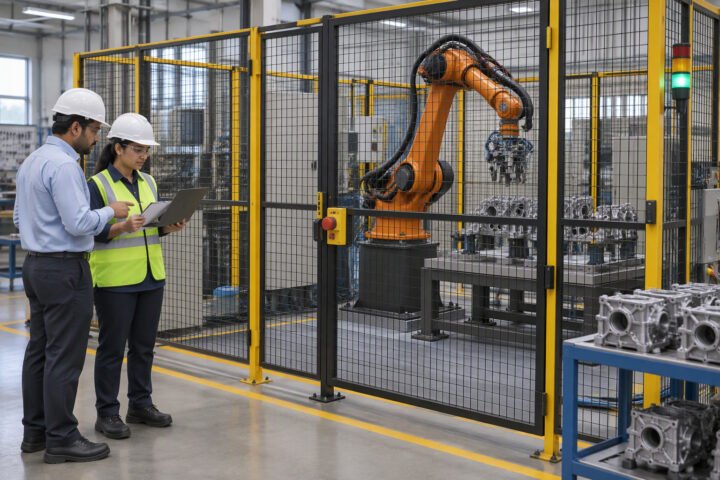
A cobot is not a safe robot. It is a robot that can be made safe for a specific task. The assessment is what earns the phrase “collaborative application”, and without it the cell has no defensible safety case.
This guide explains the four collaborative methods, what a cobot risk assessment has to cover, how force and pressure are measured, and the documentation an auditor will ask for.
Four ways a cobot can collaborate
Standards describe four collaborative methods. A real cell often uses more than one, and each has its own requirements.
| Method | How it works | Typical use |
|---|---|---|
| Safety-rated monitored stop | Robot stops when a person enters, and stays stopped | Operator loading a fixture |
| Hand guiding | Operator moves the arm through a guide handle | Teaching paths, positioning |
| Speed and separation monitoring | Robot slows or stops as a person approaches | Shared workspace with scanners |
| Power and force limiting | Contact is allowed but limited to safe force and pressure | Close work, assembly, inspection |
Power and force limiting is the method people mean when they say “cobot”, and it is also the hardest to prove. It requires measurements at the worst contact points, not a datasheet claim.
What the assessment covers
A cobot risk assessment follows the same logic as any machine risk assessment, with extra attention to contact. Identify every task the robot performs, every person who can reach it, and every body area that can be touched.
- Normal operation, including loading and unloading.
- Teaching and program verification.
- Cleaning, jam clearing and maintenance.
- Fault recovery and restart.
- Foreseeable misuse, such as reaching past the tool.
- Changes in speed, payload or tooling after commissioning.
For each hazard, record the body region involved, the contact geometry and whether the contact is quasi-static or transient. A pinch between the tool and a fixture is a different problem from a moving arm brushing a forearm.
A practical assessment sequence
- Define the task and the full workspace, including approach paths.
- Identify hazards for every task and every person.
- Choose the collaborative method for each hazard.
- Set the robot speed, payload and force limits accordingly.
- Measure force and pressure at the worst contact points.
- Compare with the limits in the current standard for that body region.
- Add safeguards where the limits cannot be met.
- Validate, record and train the operators.
Step five is where most informal assessments fail. A team sets the speed to a comfortable value, watches the robot for an hour and declares it safe. That is a demonstration, not a measurement.
Measuring force and pressure
Use a force gauge with a probe shaped like the body region being assessed, and measure at the robot’s real speed with the real payload and tool. The worst case is usually not the arm moving freely; it is a pinch point where the robot closes against a fixed object.
- Test at maximum programmed speed, not the reduced teaching speed.
- Test with the heaviest part in the gripper.
- Test every pinch point between tool, part, fixture and machine.
- Use pressure-indicating film for small contact areas.
- Repeat after any change to tooling or speed.
The acceptable values depend on the body region and on whether the contact is transient or quasi-static. The current edition of the collaborative robot standard lists these limits; use the standard text and the manufacturer’s guidance rather than numbers from a blog.
The tool is part of the robot
A cobot with a smooth arm and a sharp gripper is not safe. Sharp edges, exposed screws, pinch points on the gripper and the workpiece itself all change the contact risk. The workpiece is often the most dangerous object in the cell because it is heavy, hard and changes shape.
- Round or cover sharp tool edges.
- Check the gripper closing force and speed.
- Assess the part as held, not just the bare gripper.
- Consider what happens if the part slips.
- Keep cables and air lines out of the contact zone.
Restart and reset behaviour
How a cobot restarts after a stop is part of the safety case. If the operator can restart from inside the workspace, the stop was decorative. Decide who resets, from where, and in what state the robot must be before motion resumes.
- Reset only from outside the workspace, with a clear view.
- Require a deliberate action, not an automatic timer.
- Confirm the hazard zone is clear before motion resumes.
- Define behaviour after an e-stop, a protective stop and a fault.
- Record the reset procedure in the work instruction.
Speed and separation monitoring has an additional trap: the response time of the scanner and the stopping time of the robot both count. A robot that stops quickly but is detected late is not protected. Measure the whole chain, not each part.
Working with the integrator
Ask the integrator for the risk assessment, the force measurements and the validation record as deliverables, not as a favour after commissioning. A supplier who treats these as paperwork will also treat a change of gripper as a paperwork change. Put the obligation in the purchase order.
Where assessments commonly go wrong
| Mistake | Why it matters |
|---|---|
| Assessing only the arm | Tool and workpiece are the real contact surfaces |
| Testing at reduced speed | Limits apply at the production speed |
| Ignoring maintenance tasks | People reach into the cell with the robot powered |
| No reassessment after changes | A new gripper invalidates the old measurements |
| Assuming no fence is needed | The assessment may require guarding or a scanner |
| No validation record | Nothing proves the function works as designed |
Documentation to keep
- Task description and workspace drawing.
- Hazard identification and risk evaluation.
- Selected collaborative method per hazard.
- Force and pressure measurements with equipment details.
- Validation record and date.
- Operator training record.
- Change log for tooling, payload and speed.
In India, this file is what turns a cobot purchase into an insurable, auditable installation. Buyers who ask for it during commissioning get a better-integrated cell; suppliers who cannot produce it are a warning sign.
Related: cobot versus industrial robot, robot safety standards in India, safety light curtains, cobot buying guide, cobot welding for small business.
Is a cobot automatically safe?
No. A cobot is designed to be capable of safe collaboration, but each application needs a risk assessment, correct limits and validation before it can be called safe.
What is ISO/TS 15066?
The technical specification for collaborative robots that defines collaborative methods and provides body-region force and pressure limits for power and force limiting applications.
Do I need a fence around a cobot?
Not always, but often yes. If force and pressure limits cannot be met, or if the task involves sharp tooling or heavy parts, guarding or a safety scanner is required.
How do I measure cobot contact force?
With a force gauge and body-region probes at production speed and payload, plus pressure film for small contact areas. Test pinch points, not just free-space contact.
How often should the assessment be repeated?
After any change to tooling, payload, speed, layout or task, and at a planned interval as part of maintenance. Record each review.
Slowing or stopping on approach is one collaborative technique, and the safety laser scanner guide covers the hardware.
The risk assessment sets the required category, and the safety relay channel and reset rules turn that into wiring.
Contact detection is a risk assessment item, and force limiting is part of how a cobot application claims safety.
Dust and moisture are part of the risk picture, covered in this guide to robot enclosure ratings.
If the assessment still calls for a fence, the perimeter guarding cost guide lists what the quote should contain.
The risk assessment decides whether you need guarding, and the cobot price guide budgets for each outcome.
A cobot still needs a protective stop path, and the relay versus safety PLC question applies to that circuit as much as to a fence.
Sources and further reading
- ISO 10218 — industrial robot safety requirements.
- ISO/TS 15066 — collaborative robot safety specification.
- ISO 13849 — safety-related control system performance levels.
- A3 — collaborative robot safety resources and R15.806.