India’s average farm holding is about one hectare, so the giant autonomous tractor is the wrong mental model. The agricultural robots that are actually spreading here are spray drones, grading machines, automated sorters and small implements shared through custom hiring centres. This guide separates what is working from what is still a pilot. The agricultural robots India smallholders can realistically use are spray drones, sorters and shared implements, not giant tractors.
The Indian context that decides everything
Around 86% of Indian holdings are small or marginal, and the average size is roughly 1.08 hectares according to the Agriculture Census. A machine that costs ₹30 lakh cannot be justified on one hectare of wheat. That single fact explains why agricultural automation in India looks different from Australia, Brazil or the American Midwest: the unit of adoption is a village, an FPO or a custom hiring centre, not a single farm.
Labour is the other half of the equation. Where labour is scarce and wages are rising — paddy transplanting, sugarcane harvesting, grape and horticulture spraying — automation pays. Where labour is available and cheap, a machine has to be dramatically better, not merely equivalent.
What is actually deployed
| Category | Indian status | Typical user | Indicative price |
|---|---|---|---|
| Spray drones | Commercial, growing fast, subsidy-supported | CHCs, FPOs, drone service providers | ₹4.5–10 lakh for 10 L class |
| Autonomous tractors | Demonstrations and early commercial | Large farms, research, contractors | ₹25 lakh and above |
| Automated seeders and transplanters | Available, adoption uneven | Progressive farmers, contractors | ₹1–6 lakh |
| Weeding machines | Mechanical widely available; robotic rare | Horticulture, organic farms | ₹25,000–₹4 lakh |
| Grading and sorting | Mature in food processing | Rice, dal, spice and fruit processors | ₹5–50 lakh by capacity |
| Harvesting robots | Pilots, no broad deployment | Research, protected cultivation | Project-specific |
| Dairy automation | Large farms only | Commercial dairy | ₹15 lakh and above |
Spray drones are the real story
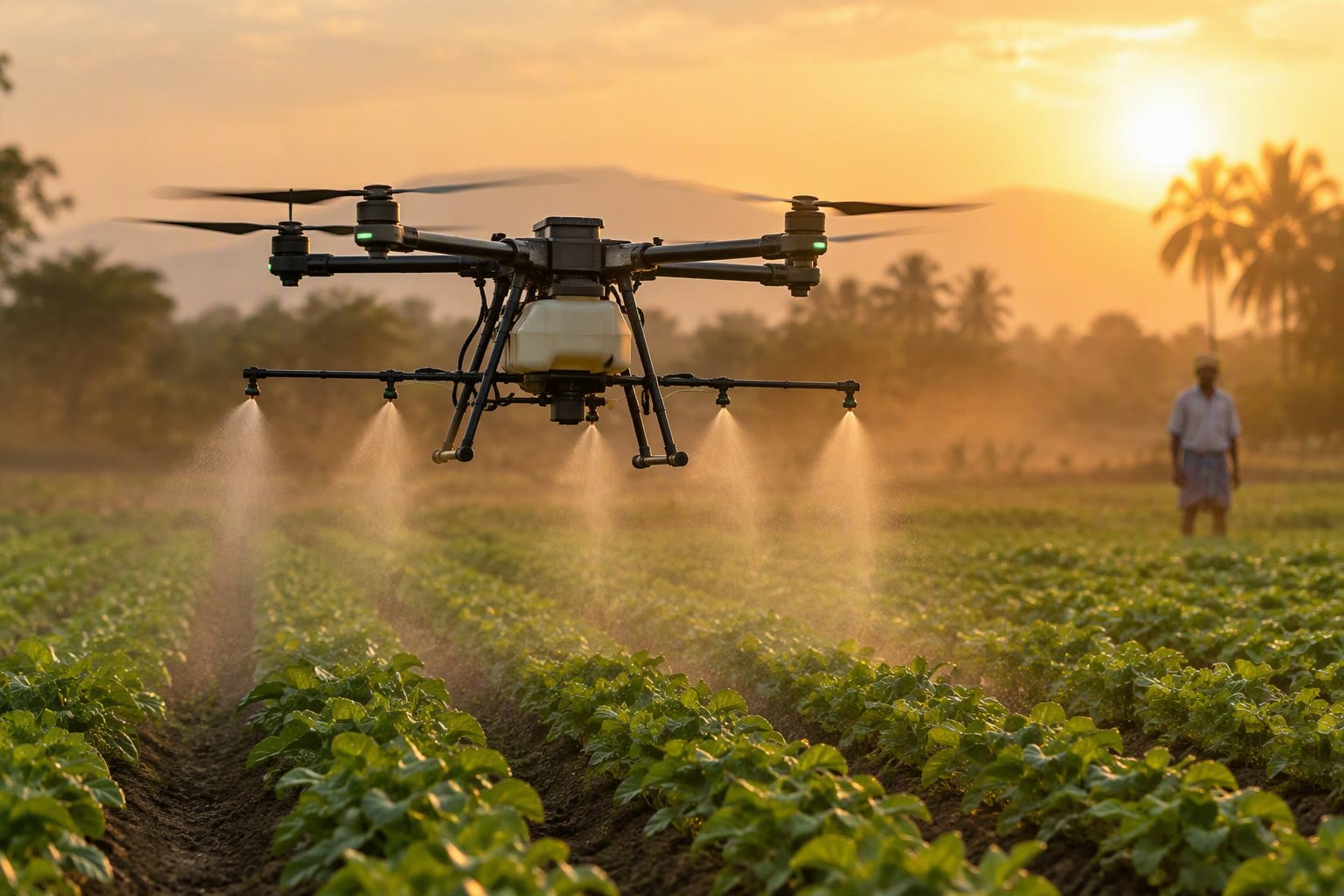
A 10-litre agricultural drone can spray roughly an acre in 7–10 minutes, depending on speed, spray width and wind. That is several times faster than a knapsack sprayer, and it removes the operator from direct contact with the pesticide — the strongest argument in a country where manual spraying causes regular poisoning cases. Among agricultural robots India farmers can access, spray drones are the real story.
The regulatory side is settled enough to be workable. The DGCA Drone Rules 2021 created a digital permission framework, and agricultural drones require a type-certified model, a remote pilot certificate from a DGCA-approved training school, and compliance with no-permission-no-takeoff requirements. Several central and state schemes subsidise purchase, and the Drone Didi programme supplies drones to women’s self-help groups for rental spraying. Subsidy percentages and caps vary by scheme and state, so the numbers must be checked locally before any purchase decision.
| Item | Indicative figure |
|---|---|
| 10 L drone, type-certified | ₹4.5–8 lakh |
| 16 L drone | ₹8–15 lakh |
| Extra battery set | ₹35,000–₹80,000 |
| Remote pilot training | ₹25,000–₹60,000 |
| Service charge to farmers | ₹300–₹600 per acre |
| Coverage per battery set | Roughly 1–2 acres before swap |
The economics hinge on utilisation. A drone that sprays 20 acres a day earns its keep; one that sprays two acres a week does not. That is why the service model, not the ownership model, is spreading.
Grading and sorting: the quiet success
Optical sorters are the most mature agricultural robots in India, even though most people do not call them robots. Rice, dal, spices, coffee and fruit processors use colour sorters with cameras and air jets to reject discoloured grain at tonnes per hour. The machine sees, decides and actuates — the definition of a robot — and it has been cost-justified for years.
For a small processor, the entry point is a 1–3 tonne per hour colour sorter at roughly ₹5–15 lakh. The payback comes from export-grade consistency and reduced manual sorting labour, not from the machine being novel.
Why harvesting robots are still pilots
Picking a tomato or a cotton boll is easy for a human and hard for a machine: the fruit varies in size, position and ripeness, the plant moves in wind, and the gripper must not bruise the produce. Research systems exist and some protected-cultivation pilots run in India, but broad field deployment is not here yet. Harvesting is where agricultural robots India farmers hear about are still pilots.
Sugarcane and paddy are different: those harvesters are mature machines, just not autonomous. The automation gap is in navigation and logistics, not in the cutting mechanism.
Small robots a student or small farm can build
Not every useful agricultural robot costs lakhs. Three builds are within reach of a college project or a small polyhouse:
- Row-following sprayer: a 2WD or 4WD chassis with two IR or ultrasonic sensors that follows a crop row and triggers a pump over a plant. Useful in polyhouses and raised beds, where rows are regular.
- Seed dibbler: a solenoid or servo-driven mechanism that drops a seed at fixed intervals as the robot moves, with an encoder or GPS for spacing.
- Soil moisture mapper: a rover that stops at marked points, reads a capacitive moisture sensor and logs the location. Less glamorous, immediately useful for irrigation decisions.
| Part | Purpose | Indicative price |
|---|---|---|
| Arduino Uno or ESP32 | Controller and logging | ₹400–₹900 |
| 4WD chassis with geared motors | Movement on soil or gravel | ₹1,200–₹3,000 |
| TB6612FNG or L298N driver | Motor control | ₹150–₹600 |
| IR or ultrasonic sensors | Row following or obstacle stop | ₹100–₹700 each |
| Capacitive soil moisture sensor | Moisture reading, corrosion-resistant | ₹150–₹400 |
| 12 V pump and nozzle | Spraying | ₹600–₹2,500 |
| 18650 pack or sealed lead-acid | Power | ₹800–₹2,500 |
// Row following with two IR sensors: left sensor sees soil, right sees plant
const int LEFT_IR = 4;
const int RIGHT_IR = 5;

void loop() {
  bool left = digitalRead(LEFT_IR);
  bool right = digitalRead(RIGHT_IR);

  if (left && !right) {
    steer(-120, 160);      // drift right
  } else if (!left && right) {
    steer(160, -120);      // drift left
  } else {
    steer(150, 150);       // both see the row: go straight
  }
}
Field conditions break naive row followers: mud, dust, low sun and uneven ground. Mount the sensors close to the ground, shield them from sunlight, and add a physical bumper that cuts motor power on contact. A robot that stops when it hits something is worth more than one that drives further.
What to check before buying any agricultural robot in India
- Local service: a machine that cannot be repaired within a week is useless during a spray window.
- Spare batteries and nozzles: the consumables decide daily throughput, not the tank size.
- Certification and pilot licence: for drones, confirm the model is type-certified and the operator is certified.
- Subsidy paperwork: confirm the scheme, the eligible model list and the claim process before paying.
- Utilisation plan: who else will use it, at what rate, and for how many days a year?
- Weather limits: wind speed and rain limits are real; spraying in 15 km/h wind drifts chemical onto the wrong field.
Common questions
Are agricultural robots used in India?
Yes, but mainly spray drones, optical sorters, automated graders and mechanised seeders. Autonomous tractors and harvesting robots are still pilots or niche deployments rather than mainstream farm equipment.
How much does an agricultural drone cost in India?
A 10-litre class type-certified spray drone is roughly ₹4.5–10 lakh depending on battery count and accessories. Subsidy schemes can reduce the effective cost, but eligibility and caps vary by state.
Do I need a licence to fly an agricultural drone?
Yes. The drone must be type-certified and the operator needs a remote pilot certificate from a DGCA-approved training school, along with compliance with no-permission-no-takeoff requirements.
Is a robotic harvester practical for a small farm?
Not yet. Harvesting robots are expensive, slow and still mostly in pilots. For small holdings, mechanised implements and custom hiring are far more practical.
What is the simplest agricultural robot to build?
A row-following sprayer or a soil moisture mapping rover. Both use an Arduino or ESP32, a 4WD chassis, a motor driver and cheap sensors, and can be built for roughly ₹5,000–₹10,000.
Related: robotics in manufacturing, PID line following, HC-SR04 sensor, robot power guide.
For aerial work, the drone pilot licence guide for India covers DGCA categories, training costs and the jobs that follow.
For the commercial side of spraying drones — equipment cost, per-acre pricing and payback — see the separate business guide.
Field robots need to follow crop rows without scrubbing, which is one reason Ackermann steering appears on agricultural platforms.
Construction is not the only sector with hard automation problems; the construction robotics guide covers what actually works on site.
For the services side of farm technology, the drone survey business guide covers mapping and volumetric work.
Sources and further reading
- DGCA — Drone Rules 2021, type certification and remote pilot requirements.
- Agriculture Census of India — holding size distribution.
- FAOSTAT — crop area and production context.
- ICAR — farm mechanisation research and advisories.
Last reviewed: October 2026. Prices, subsidy amounts and drone rules change; confirm with the current scheme guidelines and DGCA before purchase. Not bench-tested by this site.