In pharmaceutical manufacturing the robot is rarely the hard part. The validation file, the cleaning procedure and the change-control record are. Budgets that treat those as paperwork rather than engineering are the ones that stall.
This guide covers where robots genuinely pay in Indian pharma plants, what cleanroom and GMP requirements change about the equipment, how validation actually runs, and what a realistic budget and timeline look like.
Where robots earn their place
| Application | Why automate | Difficulty |
|---|---|---|
| Vial and ampoule handling in aseptic areas | Removes operators from grade A/B zones | High |
| Blister and carton packing | Speed, repeatability, less human contact | Medium |
| Case packing and palletising | Labour, ergonomics, 24-hour output | Low |
| Lab automation and sample handling | Traceability, chain of custody, throughput | Medium |
| Medical device assembly | Precision, cleanliness, documentation | Medium |
| Tablet and capsule inspection handling | Consistent presentation to vision | Medium |
The strongest financial case is usually not labour saving. It is the cost of an environmental monitoring excursion, a media fill failure, or a batch rejection caused by operator technique. Removing people from a critical zone changes the contamination risk profile, and that is a quality argument that survives audit far better than a payback calculation.
Cleanroom grades change the robot specification
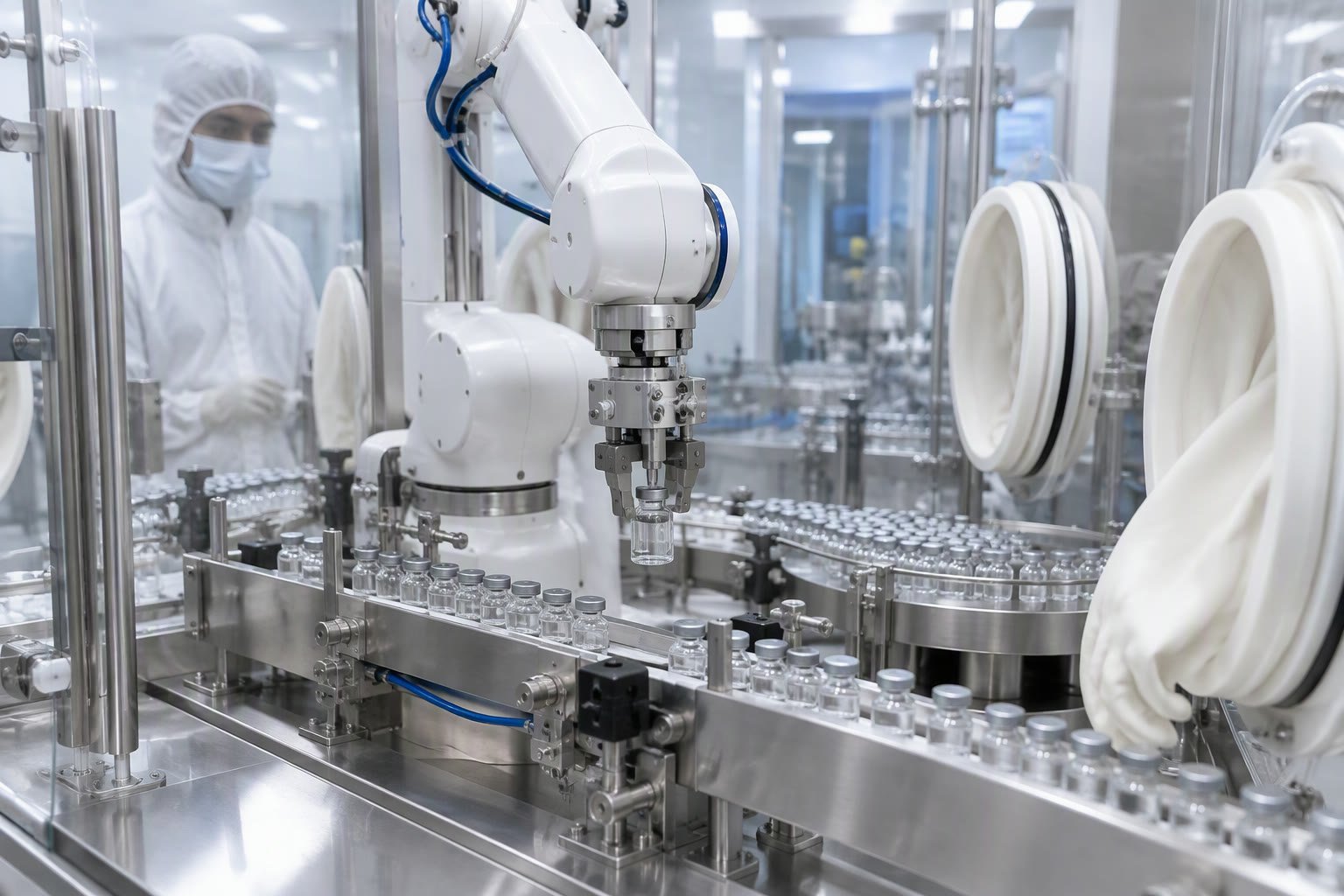
A standard industrial robot is not cleanroom equipment. It has painted castings, external cabling, grease reservoirs and cooling fans, all of which shed particles and resist cleaning. In a grade C or D area a modified robot can work. In grade A or B it usually has to live inside an isolator or a barrier, with the arm either excluded or specially specified.
- Surface finish. Smooth, non-shedding coatings; stainless or epoxy finishes that survive IPA and sporicidal agents without degrading.
- Lubricants. Food-grade or pharma-grade grease, with documentation, and a defined re-lubrication interval that does not contaminate the product.
- Airflow. Fan-cooled motors can disturb unidirectional airflow; cleanroom variants use sealed or low-particulate cooling.
- Routing. Cables and dress packs must be cleanable, with no fabric braid and no crevices that trap residue.
- Ingress protection. IP65 minimum for washdown areas; the ratings and their limits are set out in the IP rating guide.
- Documentation. Material certificates, lubricant certificates and a particle-shedding statement are part of the purchase, not an afterthought.
Ask the robot maker for a cleanroom variant and the supporting documentation before you design the cell. Retrofitting cleanroom compliance to a general-purpose arm is expensive and often unconvincing to an auditor.
Validation: the real project plan
Pharmaceutical equipment is validated through a documented sequence, and the robot cell is treated as a system, not a machine. The sequence is familiar but frequently underestimated in scheduling.
- URS. User requirement specification: what the cell must do, in what environment, with what accuracy, cleaning and documentation.
- DQ. Design qualification: evidence that the proposed design meets the URS.
- IQ. Installation qualification: correct equipment installed, correctly, with certificates and drawings.
- OQ. Operational qualification: the cell performs across its operating range, including worst cases.
- PQ. Performance qualification: the cell makes acceptable product under production conditions, usually over several batches.
- Cleaning validation. Residue limits, sampling method, recovery studies and a written cleaning procedure with hold times.
- Computer system validation. Recipe management, audit trails, user access and data integrity for any software that records GMP data.
For a mid-size packaging cell, this sequence typically takes four to seven months after the equipment arrives, on top of the build. For an aseptic cell inside an isolator, twelve months is not unusual. Add the timeline to the business case before approval, not after the purchase order.
Data integrity and audit trails
If the cell records batch data, rejects, or operator actions, that software is in scope for data integrity expectations. The practical requirements are consistent across Indian Schedule M, WHO GMP and the expectations of regulated export markets: attributable, legible, contemporaneous, original and accurate records, with a secure audit trail that cannot be edited or deleted by users.
Robot controllers are usually not the system of record. The line’s SCADA or MES is. Decide early which system owns which data, and make sure the robot’s own logs are either captured by that system or excluded from GMP use with a documented rationale. Bolting this on after commissioning is the most common cause of a delayed PQ.
The control architecture that connects robot, PLC, SCADA and MES is described in the robot cell control guide, and the interface list you should agree before signing is in the integration checklist.
Costs in India
| Scope | Indicative cost | Notes |
|---|---|---|
| End-of-line case packing and palletising cell | ₹28–70 lakh | Standard robot, guarding, gripper, conveyor interface |
| Blister or carton handling cell | ₹40 lakh–1.2 crore | Cleanroom variant, vision, reject handling |
| Aseptic vial handling inside isolator | ₹1.2–4 crore | Isolator, grade A environment, robotics, validation support |
| Validation and documentation support | ₹4–20 lakh | Depends on scope; aseptic work costs more |
| Cleaning validation | ₹1.5–6 lakh | Residue method development and recovery studies |
Note how the last three lines behave. They are not equipment, they do not appear in the vendor’s headline price, and together they can add 20 to 50 percent to a cleanroom project. Any budget without them is not a budget.
Picking a partner
India has capable packaging machinery builders and a smaller number of integrators with genuine pharma validation experience. Ask three questions that separate them quickly.
- Show me a validation package you delivered for a comparable product, with the client’s name available for reference.
- Who writes the URS, who writes the IQ/OQ protocols, and who executes them?
- What happens to the audit trail if the cell loses power mid-batch?
An integrator who answers the first question with a redacted protocol from a real project is in a different league from one who answers with a brochure. The second question exposes whether validation is subcontracted to a consultant who will disappear after PQ.
Safety in a GMP environment
Lockout procedures, guarding and risk assessment are the same engineering task as in any plant, but the documentation burden is higher and the equipment is harder to isolate. A robot inside an isolator has to be decontaminated before maintenance access, which changes mean time to repair and therefore the spare parts strategy.
Follow the framework in the robot safety standards guide and add the site’s own permit-to-work system. Design for maintenance access from outside the critical zone wherever possible; a robot that requires a full decontamination for a grease top-up will be maintained badly.
A sensible sequence
Automate packaging and palletising first. It is lower risk, it produces a documented win, and it builds the team’s validation muscle. Move to blister and carton handling once the quality and engineering functions have run a full IQ/OQ/PQ cycle together. Consider aseptic robotics only when there is a specific contamination or capacity driver, because the cost and timeline are in a different category.
For the upstream equipment that feeds these lines, the machine tending guide covers CNC and moulding cells, and injection moulding robots covers medical-grade moulding specifically. Palletising costs are set out in the palletising robot cost guide.
Are robots used in Indian pharmaceutical manufacturing?
Yes, mainly in packaging, case packing, palletising, blister and carton handling, lab automation and medical device assembly. Aseptic vial handling is growing but remains a smaller, much more expensive segment.
What does a pharma robot cell cost in India?
Indicative ranges: end-of-line packing and palletising ₹28–70 lakh, blister or carton handling ₹40 lakh–1.2 crore, aseptic vial handling in an isolator ₹1.2–4 crore. Validation and cleaning validation add 20–50% on cleanroom projects.
How long does pharma robot validation take?
For a packaging cell, four to seven months after equipment arrival for URS, DQ, IQ, OQ, PQ and cleaning validation. Aseptic cells inside isolators can take twelve months. Plan the timeline before purchase approval.
Do robots need special cleanroom versions?
Yes. Cleanroom variants use non-shedding finishes, pharma-grade lubricants, sealed cooling and cleanable cable routing, with material and lubricant certificates. In grade A/B areas the arm usually sits inside an isolator.
What documentation is needed for a GMP robot cell?
URS, DQ, IQ, OQ and PQ protocols with executed records, cleaning validation with residue limits, material and lubricant certificates, drawings, calibration certificates, and computer system validation with audit trails for any GMP data.
Sources and further reading
- CDSCO — Central Drugs Standard Control Organisation, India.
- WHO GMP norms and standards — good manufacturing practice guidance.
- ISO 14644-1 — cleanroom classification by particle concentration.
- A3 Association for Advancing Automation — robotics integration resources.