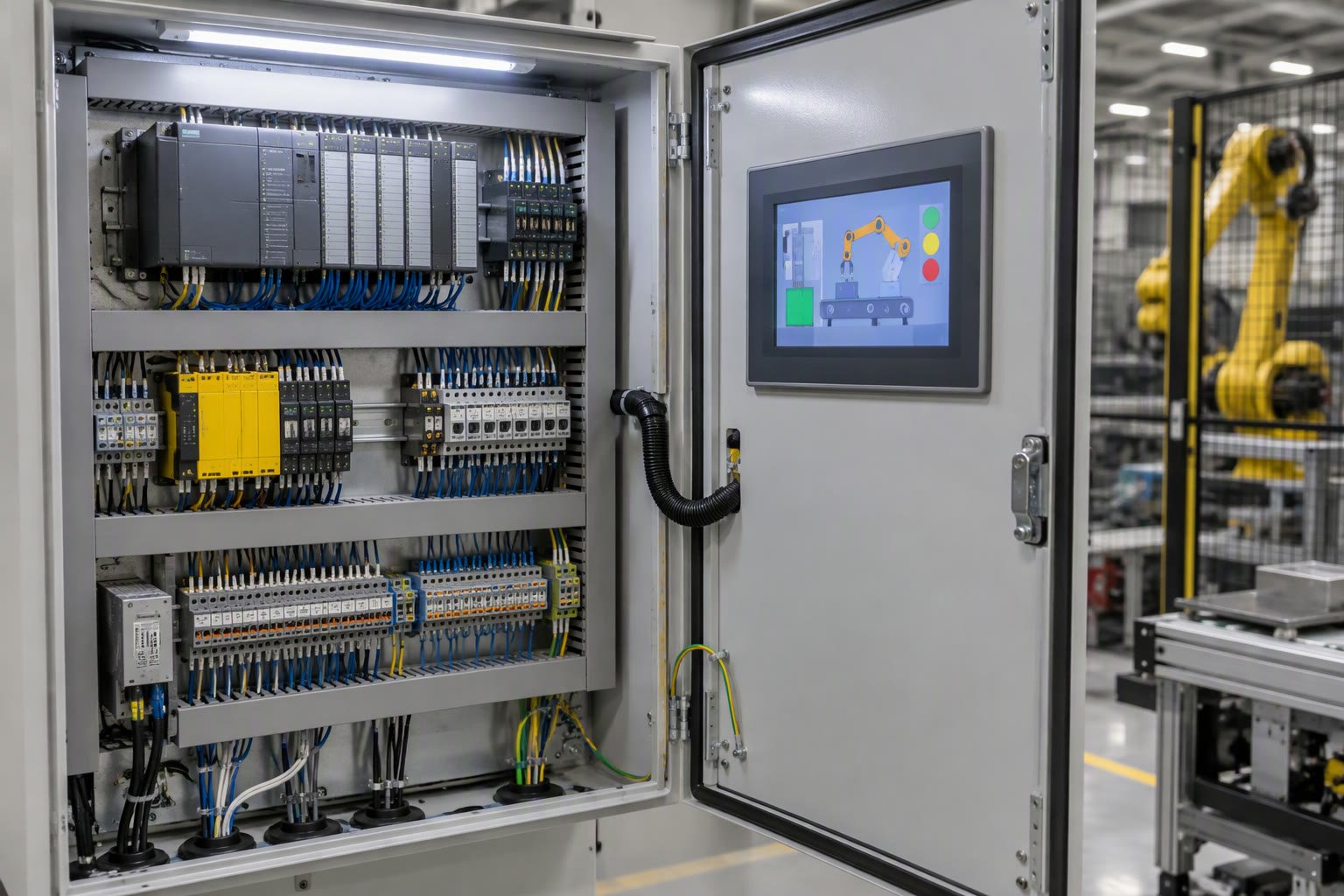
A robot cell has two brains: the robot controller that moves the arm and the PLC that owns the machine around it. Confusing the two is how cells get built twice.
This guide explains the split of responsibility, what each device should own, how the HMI and SCADA layer fits, and the communication choices that keep the cell maintainable ten years later.
Who owns what
| Device | Owns | Should not own |
|---|---|---|
| Robot controller | Arm motion, safety-rated stop, taught positions, tool logic | Conveyor sequencing, cell interlocks, production counts |
| PLC | Cell sequence, interlocks, conveyors, guards, handshakes | Joint trajectories, servo tuning |
| HMI | Operator interface, recipes, alarms, manual jog requests | Safety functions or motion commands |
| SCADA or MES | Production data, downtime reasons, traceability | Real-time control |
The robot controller is very good at moving the arm and very poor at running a plant. The PLC is the opposite. A cell designed with that split is easy to maintain because each device has one job and one set of drawings.
The handshake between PLC and robot
The PLC asks, the robot answers. Typical signals are a start request, a busy acknowledgement, a part-present confirmation and a fault flag. The exact words matter less than the discipline: every signal has one owner, and every state has a defined timeout.
PLC  → Robot   start job, station free, part present, reset
Robot → PLC    busy, at home, cycle complete, fault code
Both           safety stop, guard closed, e-stop healthy

Rule: no signal changes state without a timeout in the PLC.
Timeouts are what turn a hang into a diagnosable fault. Without them, a dropped handshake leaves the cell waiting forever and the operator restarts everything, which hides the cause. With them, the HMI shows “robot not at home within 5 s” and the technician knows where to look.
Communication options
| Link | Good for | Watch out for |
|---|---|---|
| Hard-wired 24 V signals | Simple cells, safety-critical handshakes | Many wires, hard to extend |
| PROFINET or EtherNet/IP | PLC-to-robot IO and status | Network design and switch quality |
| EtherCAT | Fast, deterministic motion networks | Needs a compatible master |
| Modbus TCP | Meters, older devices, simple data | No determinism, limited diagnostics |
| OPC UA | SCADA and MES integration | Security configuration, not real-time |
For most Indian cells, PROFINET or EtherNet/IP carries PLC-to-robot signals, and OPC UA carries data to the plant system. Safety signals stay on a certified safety bus or hard-wired circuit, separate from the standard control network.
What the HMI should show
- Current state, in words: running, waiting for part, faulted, in manual.
- The active fault with a plain-language description and the likely cause.
- Cycle count and cycle time for the shift, not just a lifetime total.
- Jog and manual functions behind a key switch or login, never on the main screen.
- A maintenance page with the last service date and the next due.
Operators trust an HMI that tells them what to do next. A screen full of tag names trains people to ignore alarms, which is the opposite of what the cell needs at 2 a.m.
SCADA and data: useful, not decorative
The value of plant-level data is downtime attribution. A cell that logs why it stopped, with a reason code the operator selects, gives a plant manager something to act on. A dashboard of green and red boxes without reasons is decoration.
Start with three numbers: availability, cycle time and scrap. Add traceability only when a customer or a regulation requires it. Each layer adds cost, and the first three pay for themselves fastest.
A reference architecture
[ HMI ]───[ PLC ]───[ Safety controller ]
             │  │
             │  └── fieldbus ──[ Robot controller ]──[ Arm ]
             │
             └── OPC UA ──[ Edge gateway ]──[ SCADA / MES ]
This layout keeps control local and data one-way upwards wherever possible. If SCADA needs to write to the PLC, restrict it to recipe values and setpoint changes that the PLC validates, never to sequence logic.
What this costs in India
- PLC with sufficient IO: ₹45,000 to ₹2.5 lakh depending on brand and IO count.
- HMI, 7 to 10 inch: ₹25,000 to ₹95,000.
- Safety controller or relay: ₹18,000 to ₹1.2 lakh.
- Programming and commissioning: ₹60,000 to ₹3 lakh for a typical cell.
- SCADA licence and configuration: ₹1.5 lakh upwards, plus a server.
Brand choice drives a large part of the range. A tier-one PLC costs more but has local support and spares in every industrial city; a low-cost PLC saves money until the first breakdown. For a plant that runs three shifts, support availability is worth more than the difference in list price.
Mistakes that show up in commissioning
- Putting sequence logic in the robot program because it was easier at the time.
- No timeout on handshake signals, so faults appear as unexplained hangs.
- Sharing an IP range with office equipment, then blaming the robot for dropouts.
- HMI alarms written as tag names instead of sentences.
- No as-built drawings, so the next engineer reverse-engineers the cell.
If the cell also has safety devices, the logic behind them deserves the same care: see our safety PLC versus relay guide. For the robot side of the split, read PLC vs robot controller, and for protocol detail, EtherCAT vs PROFINET.
What is the difference between a PLC and a robot controller?
The robot controller handles arm motion, taught positions and tool logic. The PLC handles cell sequencing, interlocks, conveyors and the handshake with the robot.
Should the robot controller sequence the whole cell?
No. It is poor at plant-level sequencing and hard to maintain. Keep sequence and interlocks in the PLC so the cell has one owner for logic and one set of drawings.
Which protocol should connect the PLC and robot?
PROFINET or EtherNet/IP for most Indian cells, with hard-wired or certified safety signals for stops. Use OPC UA for data upwards, not for real-time control.
Do I need SCADA for a single robot cell?
Not necessarily. Start with PLC and HMI, and add SCADA when you need multi-cell reporting, downtime analysis or traceability.
How much does the control system cost?
For a typical cell, PLC, HMI, safety controller and commissioning usually fall between ₹2 lakh and ₹6 lakh, with brand and IO count driving most of the variation.
Tool changes are a handshake between robot and PLC, described in the robot tool changer guide.
Sources and further reading
- PROFIBUS & PROFINET International — fieldbus standards and profiles.
- OPC Foundation — OPC UA specifications.
- ISA — automation standards including ISA-95 levels.
- ISO 10218-2 — robot cell integration safety requirements.