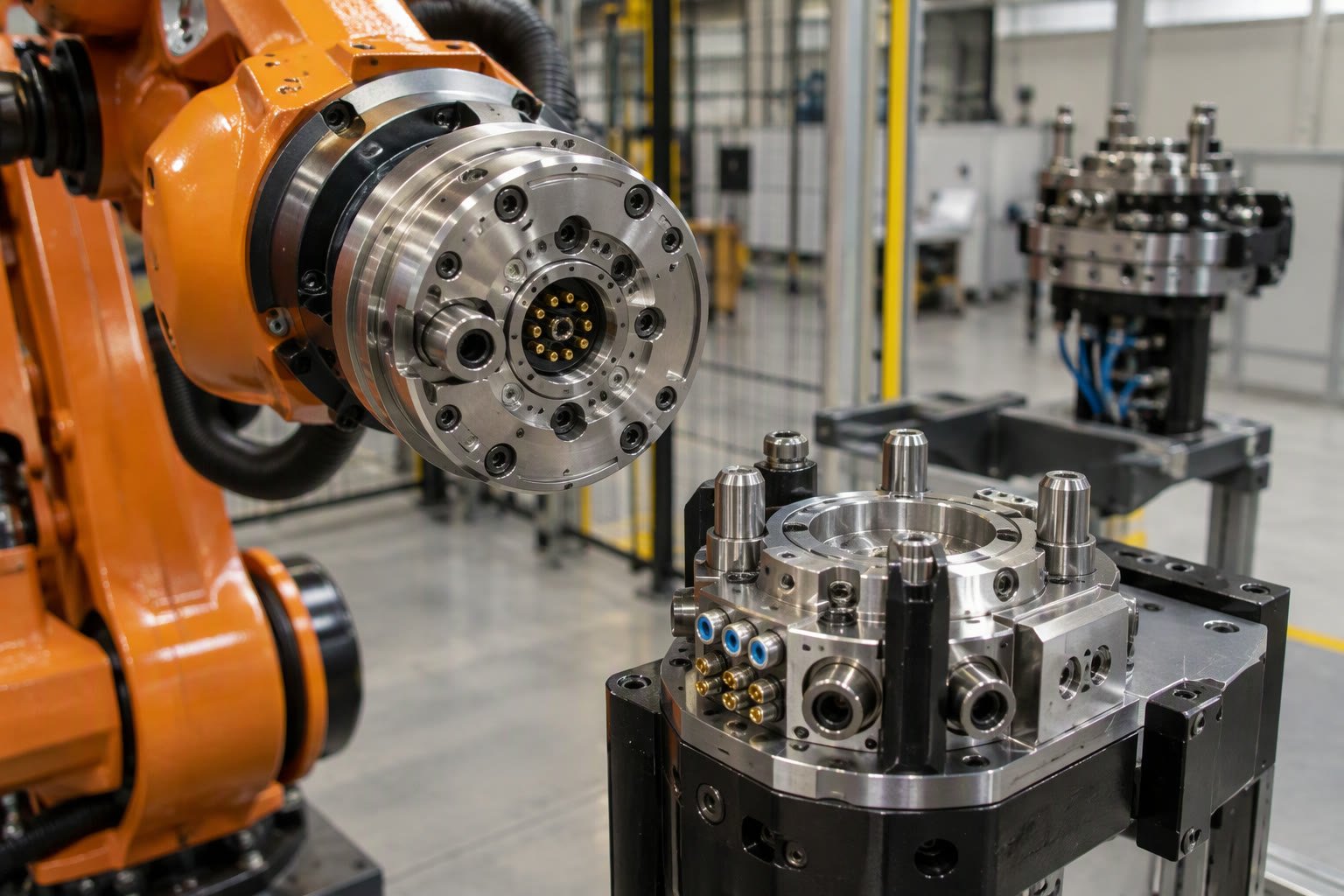
A tool changer turns one robot into many tools. It also adds the joint that decides how accurately the robot can find its tool again.
This guide covers changer types, repeatability, the utilities that must pass through the coupling, and the costs you will see in India.
Why a changer exists
Without a changer, every tool needs its own robot or a manual swap that costs minutes and risks the TCP. With a changer, the robot picks up a gripper, a welding torch, a deburring spindle or a camera, and the cell can run several operations on the same part without a second arm.
The trade is accuracy and complexity. Every coupling adds a mating interface with some repeatability error, and every additional utility line adds a failure point.
Changer types
| Type | How it works | Repeatability | Typical use |
|---|---|---|---|
| Manual changer | Operator releases a clamp and swaps the tool | Dependent on locating features | Low volume, infrequent changes |
| Pneumatic changer | Air-driven locking, spring return | ±0.02 to ±0.05 mm | General pick and place, deburring |
| Servo or motor changer | Motor-driven lock with position feedback | ±0.01 to ±0.02 mm | Welding, machining, high accuracy |
| Docking station | Tool rests in a stand, robot docks into it | Dependent on stand rigidity | Heavy tools, simple cells |
Utilities through the coupling
- Air for grippers, blow-off and venturi vacuum. Check flow, not just pressure.
- Electrical for tool sensors, cameras and lights. Spring-loaded contacts wear; specify cycle life.
- Power for spindles and high-current tools. Usually a separate high-current module.
- Coolant or welding current for welding and machining tools. These need sealed, rated couplings.
- Ethernet or fieldbus for smart tools. Adds cost and a connector that must survive the cycle count.
Every utility added to the changer adds a line to the dress pack and a potential leak or intermittent fault. Keep the tool set as simple as the process allows.
Repeatability maths that matter
A pneumatic changer with ±0.03 mm repeatability mated to a robot with ±0.05 mm repeatability can produce a tool position that varies by roughly ±0.08 mm before any thermal effects. For a pick-and-place task that is irrelevant. For a machining or welding task with a 0.1 mm tolerance, it consumes most of the budget.
Two mitigations exist. First, choose a servo changer when accuracy matters. Second, calibrate the tool after each change with a sensor or a fixed reference, which removes the coupling error from the process. The second is cheaper and works with any changer type.
Tool stands and safe parking
The tool stand is part of the changer system, not an afterthought. It must hold the tool rigidly enough to mate cleanly, position it repeatably, and protect the coupling faces from dust and spatter. A stand bolted to a vibrating floor will produce mating failures that look like changer faults.
Design the parking position so the robot approaches on a straight path with no wrist rotation during the last few millimetres. Angled approaches wear the coupling and eventually crack the locating pins.
Safety and interlocks
The changer must not release while the robot is moving or while the tool is carrying a part. That is a logic and, for heavy tools, a mechanical interlock. Add a tool-present sensor and a locked sensor to the robot’s safety input, and test the release sequence during commissioning.
For the control architecture around it, the PLC and cell control guide covers how these signals fit.
How many tools are worth having
Each additional tool costs money twice: once for the changer plate and stand, and again in lost time every time the robot changes. A pneumatic change typically takes 3 to 8 seconds including the move to and from the stand, which is small on a 60-second cycle and significant on a 12-second one.
Four to six tools is the practical range for a flexible cell. Beyond that, the stand layout grows, the robot path gets longer and the chance of a collision during a change rises. If a cell needs eight tools, it is often a sign that two cells would be simpler.
Place the stands within the robot’s reach envelope and order them by usage, so the most frequent changes are the shortest moves. Keep the heaviest tool closest to the robot base to reduce inertia on the wrist.
Costs in India
- Manual changer with locating pins: ₹25,000 to ₹80,000 per pair.
- Pneumatic changer, two ports: ₹1.2 lakh to ₹3 lakh per pair.
- Servo changer with feedback and multiple utilities: ₹4 lakh to ₹12 lakh per pair.
- Tool stand, fabricated and aligned: ₹35,000 to ₹1.2 lakh each.
- Additional tooling plate per tool: ₹15,000 to ₹60,000.
A four-tool system typically lands between ₹6 lakh and ₹20 lakh for hardware, before the tools themselves. That is often cheaper than a second robot, which is why changers are common in flexible cells.
Maintenance that prevents surprises
- Clean coupling faces weekly; dust is the main cause of mating errors.
- Check pneumatic pressure and seal condition monthly.
- Inspect electrical contacts for pitting and replace as a set, not individually.
- Verify tool position with a reference check after any changer service.
- Log the number of changes and replace wear parts on a cycle count, not on failure.
For the tool side, our end effector guide covers gripper and tool selection, and the gripper buying guide covers Indian prices. The cell layout implications are in robot cell layout design.
What repeatability does a robot tool changer have?
Pneumatic changers are typically ±0.02–0.05 mm, servo changers ±0.01–0.02 mm. That error adds to robot repeatability, so a 0.1 mm process tolerance is quickly consumed.
Do I need a tool changer or a second robot?
A changer is usually cheaper if the operations are sequential and the tools are light enough. A second robot wins when two operations must run in parallel or the tools are heavy.
Can a tool changer pass air and electrical signals?
Yes, most pneumatic and servo changers offer air ports and spring-loaded electrical contacts. Specify flow, current and cycle life for each utility.
How do I keep tool position accurate after a change?
Calibrate the tool against a fixed reference after mating, or use a servo changer and a rigid tool stand. Both remove most of the coupling error.
What does a changer cost in India?
A manual pair is ₹25,000–80,000, pneumatic ₹1.2–3 lakh, and servo with feedback ₹4–12 lakh. Tool stands and plates add ₹35,000–1.2 lakh per station.
A spot welding gun is one of the heaviest tools a robot handles, which affects changer selection and payload margin.
Sources and further reading
- ATI Industrial Automation — tool changer specifications and selection.
- SCHUNK India — gripper and changer documentation.
- ISO 10218-2 — robot cell integration safety.
- A3 Automate — robotics integration resources.