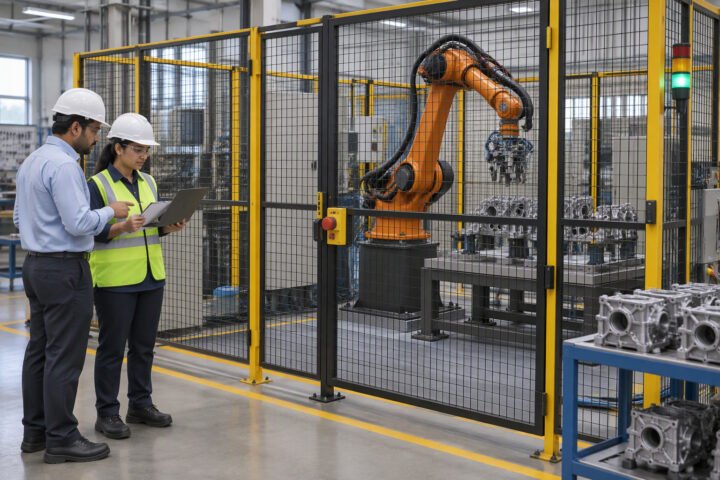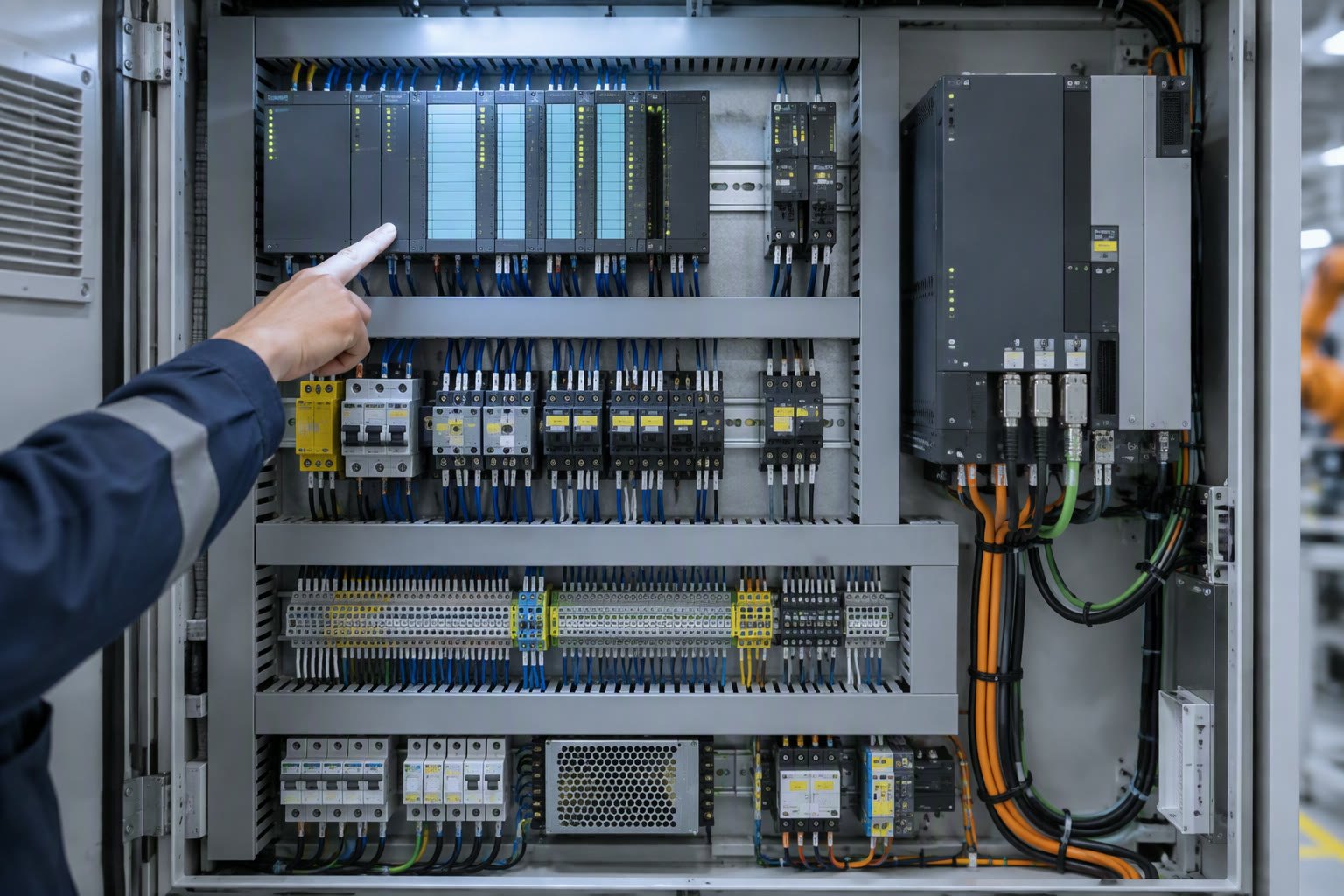
The robot controller moves the arm. The PLC decides whether it is allowed to. Confusing the two produces cells that work in manual mode and fail in production, or safety circuits that depend on a program scan.
This guide explains the division of labour, the handshake sequence between a PLC and a robot, the communication options, and the integration mistakes that cost the most commissioning time.
Two controllers, two jobs
| Controller | Owns | Typical tasks |
|---|---|---|
| Robot controller | Joint motion, kinematics, servo loop | Move to pose, follow path, manage payload, report status |
| PLC | The cell and the sequence | Conveyors, clamps, doors, safety interlocks, part tracking |
| Safety controller | People protection | E-stops, light curtains, door switches, safe speed |
| Vision system | Where the part is | Locate, inspect, send coordinates |
A robot controller can run a sequence on its own. It should not be the only thing standing between a person and a moving arm. Safety functions belong in hardware or a certified safety controller, not in the robot program.
The handshake
Most cells exchange a small set of signals. The exact names differ by vendor, but the pattern is stable.
| PLC to robot | Robot to PLC |
|---|---|
| Part present at pick position | Robot ready |
| Start cycle | Cycle running |
| Abort / hold | At pick position |
| Program number | Part gripped |
| Reset fault | Cycle complete |
| Permit to enter cell | Fault code |
Every signal needs an owner, a default state and a timeout. A “start” bit that stays on because the PLC never resets it will start the robot again the moment the fault clears.
1. PLC: part present = TRUE
2. PLC: start cycle = TRUE
3. Robot: cycle running = TRUE, start acknowledged
4. PLC: start cycle = FALSE
5. Robot: at pick, part gripped = TRUE
6. PLC: clamp open, conveyor index
7. Robot: cycle complete = TRUE
8. PLC: cycle complete acknowledged
Step 3 and step 8 are acknowledgements. Without them, the two controllers can both be waiting for each other, which looks like a dead cell with no error message.
Communication options
| Method | Best for | Limitations |
|---|---|---|
| Discrete I/O | Simple handshakes, retrofits | Cable count, limited data |
| PROFINET | Siemens cells and new machines | Vendor ecosystem |
| EtherNet/IP | Rockwell and many robot brands | Configuration detail |
| Modbus TCP | Simple data exchange, legacy devices | Weak diagnostics |
| OPC UA | MES, dashboards, cross-vendor data | More setup, not for tight control |
Discrete I/O is not obsolete. For a two-machine tending cell, eight signals over a terminal block are easier to troubleshoot than a fieldbus mapping that nobody documented.
What a PLC costs in India
Indicative 2026 ranges, before GST.
| Item | Indicative range | Notes |
|---|---|---|
| Compact PLC with 16 I/O | ₹15,000–40,000 | Delta, Siemens S7-1200 entry models |
| Mid-range PLC with fieldbus | ₹50,000–1.5 lakh | More I/O, Ethernet, motion |
| Safety PLC or safety relay | ₹25,000–2 lakh | Depends on zone count and certification |
| HMI panel | ₹20,000–1 lakh | 7–15 inch, depends on brand |
| Integration and programming | ₹50,000–3 lakh | Sequence, alarms, commissioning |
The PLC is rarely the expensive part of a cell. The engineering hours that make the sequence safe and diagnosable are.
Safety wiring is not PLC logic
An emergency stop must remove power or bring motion to a safe stop without depending on a general-purpose program scan. Use a safety relay or safety controller with dual-channel wiring, and follow the risk assessment. The robot’s own safety inputs are part of that circuit, not a substitute for it.
Where a robot and a PLC share a safety network, verify the configuration with a functional test at commissioning and record the result. A safety function that has never been tested is an assumption.
Integration mistakes
| Mistake | Symptom | Fix |
|---|---|---|
| No acknowledgement bits | Cell hangs with no fault | Handshake with ack for every command |
| Start bit left on | Robot restarts unexpectedly | Momentary command, PLC resets after ack |
| Safety in standard PLC code | Unsafe failure mode | Certified safety hardware |
| No fault codes | Operators guess | Numeric fault list on the HMI |
| Undocumented fieldbus map | Maintenance cannot diagnose | Signal table in the panel drawing |
| No manual mode | Every test needs a full cycle | Step mode and jog from the HMI |
Related: PLC programming for beginners, industrial robot programming, machine tending robots, robot safety standards, industrial robot cost.
What is the difference between a PLC and a robot controller?
A robot controller handles joint motion, kinematics and the robot's own safety inputs. A PLC sequences the whole cell: conveyors, clamps, doors, part tracking and handshakes with the robot.
Can a robot controller replace a PLC?
For a single robot doing a simple pick-and-place, sometimes. For a cell with conveyors, multiple machines and safety interlocks, a PLC gives clearer sequencing, diagnostics and maintenance.
What communication should I use between PLC and robot?
Discrete I/O for small cells, PROFINET or EtherNet/IP for new machines with fieldbus, and OPC UA for data to MES or dashboards. Match what both vendors support natively.
Should safety be programmed in the PLC?
No. Emergency stops and guards must use certified safety hardware and dual-channel wiring. A standard PLC scan is not a safety function.
How many signals does a typical handshake need?
Usually six to twelve: start, abort, part present, ready, running, at position, gripped, complete, fault and reset. The exact set depends on the cell sequence.
The handshake signals are one part of the wider robot integration checklist.
The handshake between the two is usually plain ladder logic.
The bus that connects the two is covered in industrial Ethernet for robots.
Many robot controllers expose Modbus over RS485 for exactly this handshake, which this guide covers.
Most automation roles touch both, and the career guide explains how the titles overlap.
The split of duties extends to the HMI and SCADA layers, which the cell control architecture guide sets out.
Sources and further reading
- IEC — IEC 61131 for PLC programming and IEC 62061 for safety-related control systems.
- ISO 10218 — robot safety requirements including integration.
- Siemens — S7-1200 and PROFINET documentation.
- Rockwell Automation — EtherNet/IP and safety controller guidance.
- OPC Foundation — OPC UA specifications for industrial data exchange.