The robot is usually the easiest part of an automation project. It arrives, it moves, it repeats. What stalls in month two is the conversation about data: which protocol the controller speaks, which tag the PLC needs, who owns the gateway, and why the MES cannot see the cycle count that everybody agreed to expose.
Most of that is decided before the purchase order, in a single line of a specification. This guide is the technical version of that line, written for the engineer who has to make the cell talk to the plant.
It follows the cell-level decisions in robot controller versus cell PLC and PLC and SCADA architecture for a robot cell. Read those first if the control split is still open.
Three layers, three different jobs
Conflating them is the root of most integration arguments.
- Control layer. Deterministic, cycle-time critical. The PLC tells the robot to start; the robot tells the PLC it is in position; the safety system stops both. PROFINET, EtherNet/IP and Modbus TCP live here.
- Data layer. Non-critical, structured, many consumers. State, counters, alarms, energy, program number. OPC UA lives here, and increasingly so does MQTT.
- Enterprise layer. MES, ERP, dashboards, historians, cloud. Fed from the data layer, never directly from the control layer.
A cell that puts motion commands over OPC UA is fragile. A plant that scrapes the control layer with a gateway is worse. The design question is not “which protocol is best” but “which layer am I connecting”.
Fieldbus: what the cell actually runs on
The choice is usually made for you by the plant’s PLC standard, and that is the right way to make it.
| Protocol | Governed by | Where it fits | What to watch |
|---|---|---|---|
| PROFINET | PROFIBUS & PROFINET International | Plants standardised on Siemens; motion and safety on one cable with PROFIsafe | Device names, topology planning, IRT only where needed |
| EtherNet/IP | ODVA | Plants standardised on Rockwell; safety over CIP Safety | IGMP snooping on managed switches, implicit vs explicit messaging |
| Modbus TCP | Open, unmanaged | Simple status exchange, legacy devices, low-cost sensors | No standard data model; you define every register yourself |
| Vendor fieldbus | Robot OEM | Very high-rate motion coordination between one robot and one machine | Single-vendor lock, fewer engineers who know it |
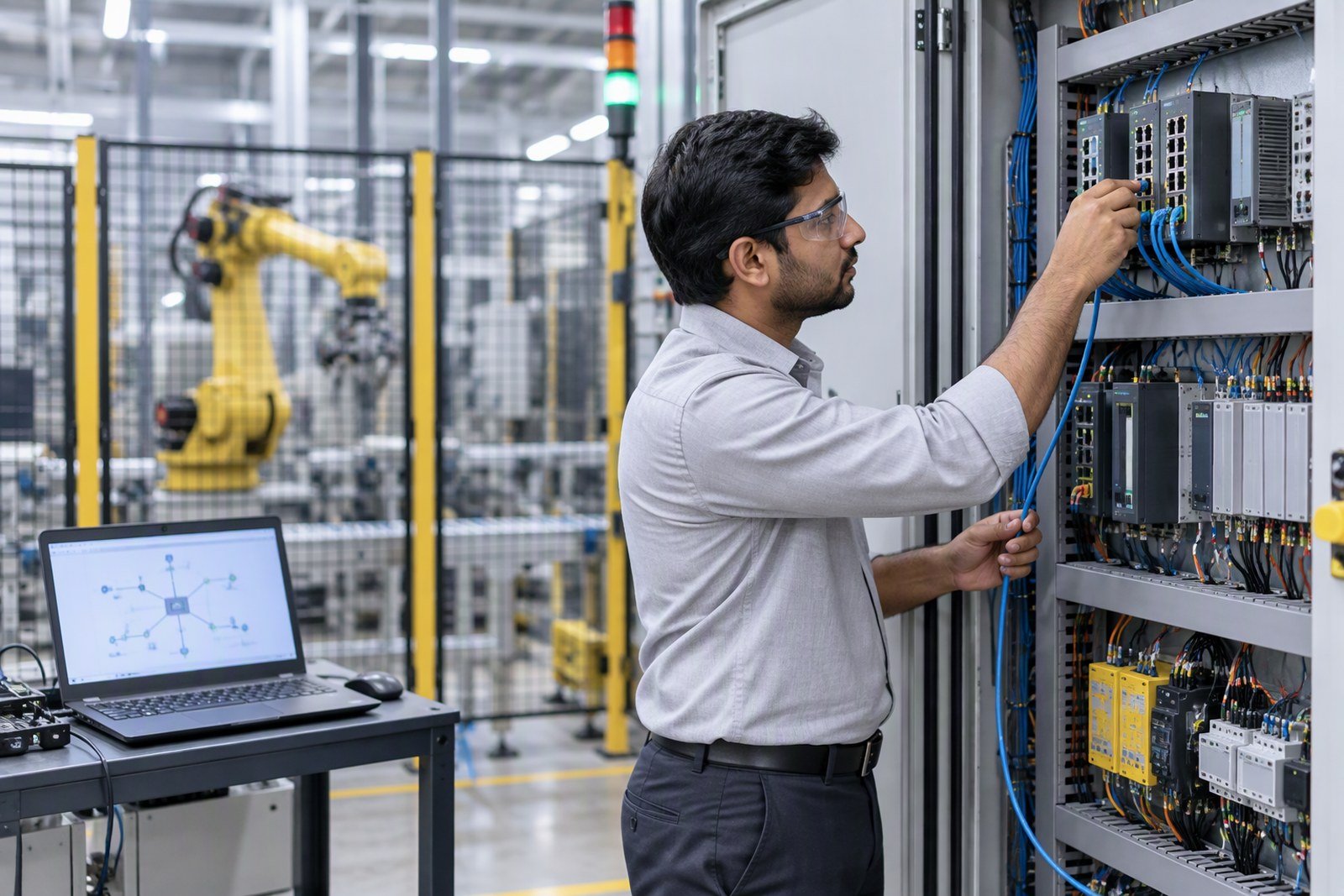
For a typical Indian machine-tending or palletising cell, the robot controller is a slave or a peer on the plant’s PROFINET or EtherNet/IP network, and the PLC sequences the cell. That is the architecture in the controller-versus-PLC comparison, and it is the one that keeps support available locally.
OPC UA: the data layer with a model
OPC UA, published as IEC 62541, is the vendor-neutral answer to a problem Modbus never solved: agreeing on what a value means. Modbus gives you register 40021 and a number. OPC UA gives you a typed node with a name, a data type, a quality flag and a timestamp, served over a secure session.
In a robot cell it usually appears in one of three places:
- On the controller. Some robot OEMs expose an OPC UA server directly. Check whether it is included or a paid option, and what it exposes.
- On the PLC. Modern PLCs offer an OPC UA server, which is often the cheapest route: the PLC already has every signal you want.
- On an edge gateway. A small industrial PC or gateway that speaks the fieldbus on one side and OPC UA or MQTT on the other.
The OPC Foundation maintains a companion specification for robotics, developed with the machinery industry, which is the closest thing to a standard address book for robot data. Support for it in Indian installations is still thin, but it is worth asking about because it changes how much mapping work you pay for.
The practical benefit is not elegance. It is that a new dashboard, historian or MES connection can read the same model without a new gateway project each time.
What data is actually worth exposing
Teams often expose everything and use nothing. Start with the signals that answer operational questions.
| Signal | Why it earns a tag | Use |
|---|---|---|
| Cell state (auto, manual, faulted, stopped) | Foundation for every availability number | OEE, dashboards, alerts |
| Cycle count and cycle time | Turns a claim into a measurement | Throughput, drift detection |
| Active alarm code and text | The difference between “stopped” and “why” | Maintenance dispatch, history |
| Program or recipe number | Explains variation across a shift | Traceability, quality |
| Mode and safety status | Distinguishes a production stop from an intervention | Availability calculation, audit |
| Joint or axis load and motor temperature | Early warning of mechanical wear | Predictive maintenance |
| Energy per cycle | Cost per part, not just cost per month | Costing, sustainability reporting |
| Part counter with good/reject flag | Links production to quality | Quality dashboards |
A cell with these eight, correctly timestamped, can answer most management questions. A cell with four hundred tags and no alarm text cannot answer the first one.
Do not put safety or motion on the data layer
OPC UA is not a safety protocol and is not deterministic enough for coordinated motion. Safety functions belong on the certified safety channel — PROFIsafe, CIP Safety or hardwired circuits — and motion coordination belongs on the fieldbus the OEM supports, or on a vendor-specific high-rate link.
This matters in India because it is a common shortcut: a gateway is installed to “get data out”, and someone later routes a start command back through it to avoid wiring a signal. That turns a monitoring path into a control path with none of the guarantees, and it usually surfaces during a fault investigation rather than at design review.
The related trap is a data path that can stop production. If a gateway crashes and the cell stops, the gateway was on the control path by accident. Test it: pull the gateway’s power during a run and confirm the cell keeps producing.
Security is a design constraint, not a checklist
The moment a robot controller is reachable from the office network, it is reachable from wherever that network reaches. Four rules carry most of the weight:
- Segment. Cell networks on their own VLAN, with a firewall or industrial DMZ between them and enterprise IT.
- No direct internet exposure. Remote access through a controlled gateway with logging, not a port forward.
- Certificates and accounts. OPC UA supports certificate-based trust; use it, and do not leave the anonymous user enabled because it made commissioning easier.
- Least privilege. Read-only accounts for dashboards. Writing a setpoint from a dashboard should require a separate, named account.
These are the same controls that make an incident review survivable. A cell whose logs show who changed what, and when, is a cell you can defend.
What to put in the specification
Six lines, agreed before the order, prevent most of the arguments:
- The fieldbus between robot controller and PLC, by name and version, and which device is master.
- The exact data points to be exchanged at the control layer, in a signal list with addresses, types and scaling.
- Which node exposes OPC UA, whether it is licensed, and the tag list it will publish.
- Who supplies, configures and owns the gateway, and who supports it after handover.
- The network diagram, including IP ranges, VLANs and the firewall boundary.
- Documentation: IO list, tag list, network drawing and a backup of every configuration, handed over at acceptance.
If a supplier answers “it supports all standard protocols”, ask for the model datasheet and the licence line item. Support is usually per protocol and often per option.
Common mistakes in Indian installations
- Choosing a protocol the plant’s maintenance team cannot support. The cell works; nobody can diagnose it at 3 a.m.
- No signal list at order. The wiring is done from memory during commissioning.
- Gateway treated as IT equipment. It sits in a panel with no spare, no backup and no owner.
- Data exposed but not timestamped. Counters are useless without time.
- OPC UA server left with anonymous access enabled.
- Cloud dashboard built before the local historian. The plant loses data when the link drops.
- No backup of the gateway or PLC configuration, so a replacement takes days instead of an hour.
All seven are cheap to prevent at design and expensive to discover in production.
Where this fits with the rest of the cell
Connectivity is not a separate project bolted on after acceptance. It changes what you specify, what you test at factory acceptance, and what you insist is handed over. The commissioning checklist treats the signal list and the backups as acceptance items for exactly this reason.
Once the data exists, the useful next step is a model of the cell that runs before the physical one — covered in digital twin for a robot cell — and a way to see many cells at once, covered in robot fleet management software.
Frequently asked questions
Does my robot support OPC UA?
Some controllers include an OPC UA server, some offer it as a paid option, and some do not offer it at all. Check the model datasheet and the licence line item rather than the brochure. If the controller does not support it, the PLC or an edge gateway can usually publish the same data.
Should I use OPC UA or MQTT?
They solve different problems. OPC UA gives a structured model with quality and timestamps inside the plant. MQTT is a lightweight publish-subscribe transport that suits many sites and intermittent links. Plenty of architectures use OPC UA between PLC and edge, and MQTT from edge to cloud.
Can I control the robot over OPC UA?
For non-safety, non-motion commands such as selecting a recipe, yes. For motion and safety functions, no. Those belong on the fieldbus and the certified safety channel, where timing and integrity are guaranteed.
What is the difference between PROFINET and EtherNet/IP?
Both run over standard Ethernet and both carry safety profiles, but they are governed by different organisations and are not interchangeable. The practical choice follows your plant's PLC standard, because that determines what your maintenance team can support.
Which data points should I ask for first?
State, cycle count and cycle time, active alarm code, program number, mode and safety status. Add energy per cycle and axis load later. These eight answer most operational questions and cost very little to expose.
How do I keep remote access secure?
Segment the cell network, put a firewall or industrial DMZ between it and enterprise IT, and allow remote access only through a logged gateway with named accounts. Never forward a controller port directly to the internet.