A strain wave gear (harmonic drive) wins an axis that reverses under load and must return to the same angle; a planetary wins an axis that runs all day, takes impacts, or has to clear a budget. The precision gap is real — one family is sold in arc-minutes of lost motion, the other in arc-minutes of mesh clearance — but efficiency, stiffness and life assumptions pull the other way. Flip point: past roughly five arc-minutes of tolerable lost motion, or for any continuous-duty joint, buy the planetary.
The mechanism difference, stated precisely
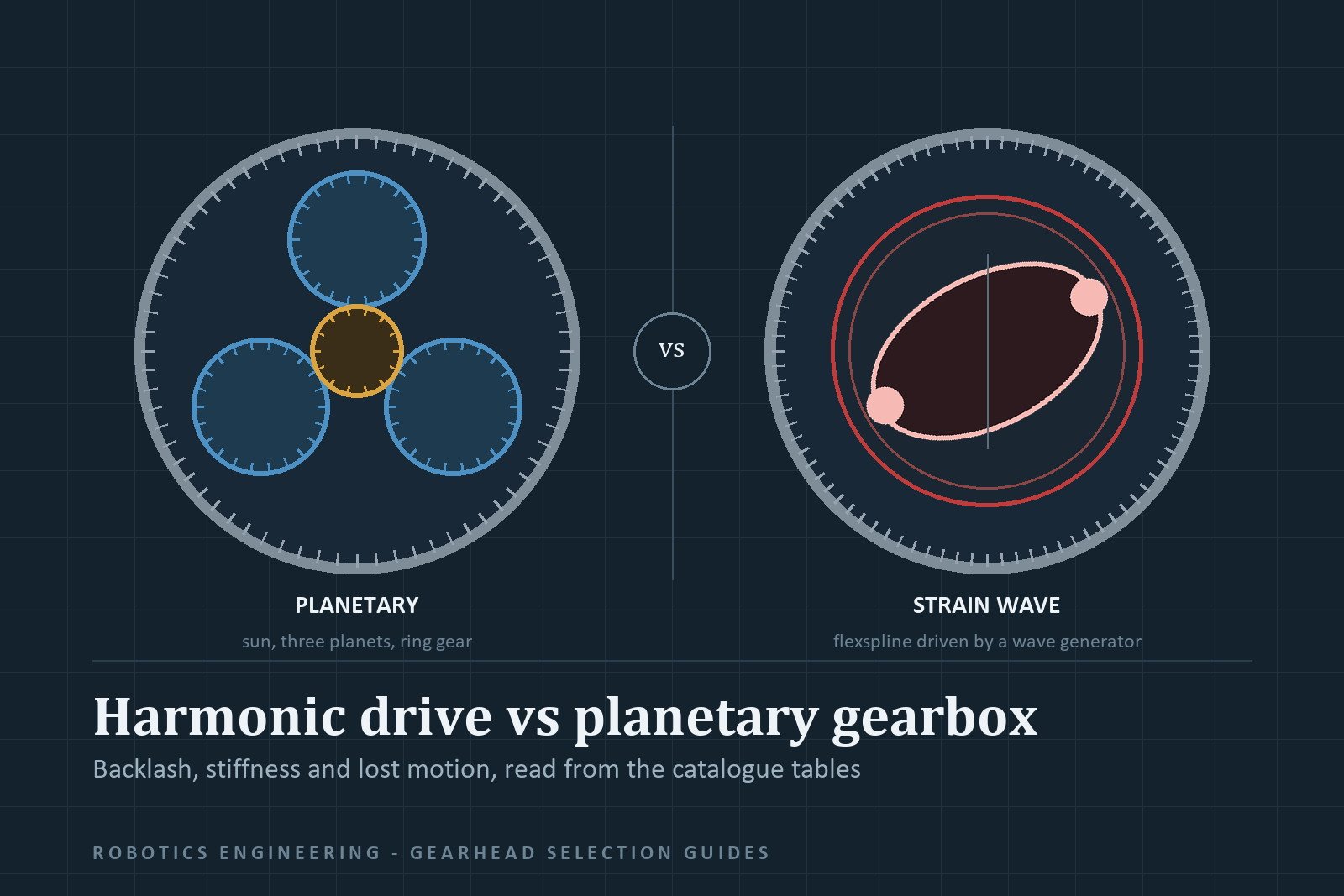
A planetary gearbox is involute gearing folded into a coaxial envelope: a sun drives two or three planets against a fixed ring; the carrier is the output, and every mesh needs clearance. KHK’s metric gear reference gives the reasons — jamming prevention, lubricant space, differential expansion between gears and housing — plus the rule that smaller backlash demands more accurate machining (KHK Elements of Metric Gear Technology, PDF). That clearance stacks through stages.
A strain wave gear deletes the clearance requirement. An elliptical wave generator flexes a thin-walled flexspline against a rigid circular spline that carries two teeth more than the flexspline has (Harmonic Drive Solutions gear catalogue, PDF), which forces engagement at two diametrically opposed points on the ellipse’s major axis and puts up to 30% of the teeth in contact — versus 15% on the older tooth form (Harmonic Drive SE CSF/CSG catalogue, PDF). Engagement is a preload, not a fit, so the catalogue says it flatly: “The gear element has zero backlash.”
Zero mesh backlash is not zero reversing error. Harmonic Drive sells the accuracy as hysteresis loss and lost motion: 3 arc-minutes right across sizes 8–32 at ratio 30, and 1 arc-minute from size 14 up at ratio 50 (CSF/CSG catalogue tables 40 and 44, PDF). Positioning accuracy at ratio 30 is 2.0 arc-minutes for sizes 8–14 and 1.5 from size 17 up, with a 1.0 arc-minute special tolerance; at ratio 50 and above the standard column is already down to 1.0 arc-minute from size 20. Repeatability is published separately as better than ±0.1 arc-minutes (Harmonic Drive Solutions gear catalogue, table 1.1.9, PDF) — a different measurement from all three of the others, which is exactly why the same unit appears to have four different accuracies. Then the parts list adds its own error: the standard Oldham coupling contributes a backlash outside the tooth mesh that Harmonic Drive’s own table puts at 60 arc-seconds for a size-14 unit at ratio 30 and 5 arc-seconds for the largest frames (table 1.1.10, PDF); a solid wave generator or the “Direct Drive” option avoids it (CSF/CSG catalogue, PDF).
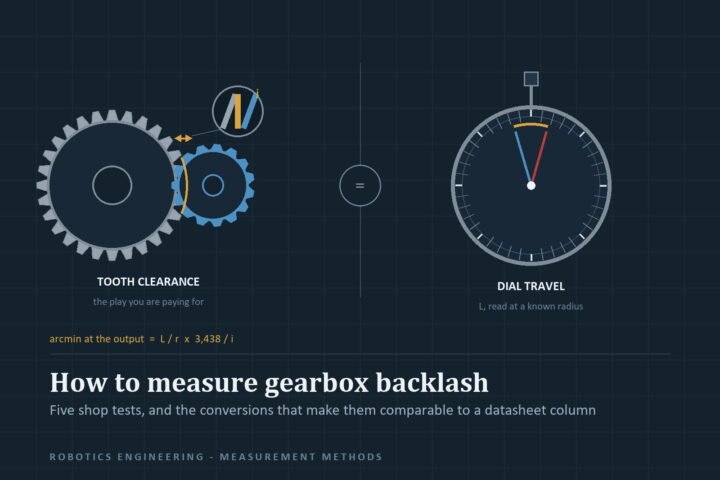
Proving that on the axis in front of you takes a dial, a known radius and a stated test load; the shop tests for gearbox backlash run the conversion end to end.
The planetary side is sold as clearance classes, and the ladder is wide. Apex Dynamics lists economy series (AB, AF, AD) at under 8–12 arc-minutes, high precision (AH, AP) at 3–7 and premium at 1–2 — measured at 2% of rated output torque, single stage, and worse with more stages (Apex Dynamics backlash page). The same publisher’s AB/ABR catalogue runs a three-step ladder of its own — micro-backlash P0, reduced P1 and standard P2 — with printed values from 1 arc-minute at P0 to 9 at P2, every class stepping up on the larger frames and the higher step counts (Apex AB/ABR catalogue, PDF); two Apex documents, two ways of slicing the same gearbox, which is worth remembering when a datasheet looks precise. Neugart’s PLE economy line spans 6–22 arc-minutes across frames 040 to 160, and its per-frame columns tighten with size (Neugart PLE catalogue, PDF). A 5-arcminute planetary and a 1-arcminute strain wave are both “precision”; the gap is deadband you either compensate or fight forever.
| What you buy | Strain wave (Harmonic Drive SE) | Planetary (Apex / Neugart) |
|---|---|---|
| Reversing error | hysteresis loss 1–3 arcmin; mesh zero-backlash | clearance 1–12 arcmin by class; economy 6–22 |
| Added by the coupling | Oldham up to 60 arcsec, none with a solid wave generator | none (clamped solid input) |
| Published accuracy | hysteresis, lost motion, positioning, repeatability < ±0.1 arcmin — four different tests | one backlash figure per class |
Torsional stiffness is where the servo loop feels it
Backlash is the reversal deadband; stiffness is what happens after the deadband closes. Harmonic Drive measures torsional stiffness with the input locked and the output loaded, states that the curve “is non-linear”, and approximates it with three slopes rising with torque (CSF/CSG catalogue engineering data, PDF). For the CSF-32 at ratio 30 the catalogue prints K1 = 2.4, K2 = 3.0 and K3 = 4.9 × 10⁴ Nm/rad, with the breakpoints at 29 Nm and 108 Nm of output torque: stiffest under high load, softest in the low-torque band where pointing actually happens. The same table prices that soft band in angle — the flexspline has already twisted 4.3 arc-minutes by the time the unit reaches its first breakpoint. The S-tooth claim of 100% more stiffness “in the low & mid torque ranges” admits where the weakness sat.
Planetary catalogues publish one torsional rigidity per series — preloaded involute meshes stay roughly linear in the working band — and Apex’s ABR table runs the row from 3 Nm/arcmin at ABR042 to 225 at ABR220 (Apex AB/ABR, PDF). The two publishers use different units, so put them on one scale: divide the Harmonic Drive slopes by 3,438 arc-minutes per radian and the CSF-32 reads 7.0, 8.7 and 14.3 Nm/arcmin — which sits comfortably inside Apex’s published span. The catalogue’s own angle column agrees with the conversion, since 29 Nm over the 4.3 arc-minutes of twist at that first breakpoint is 6.7 Nm/arcmin. A strain wave is not automatically the softer gearbox; it is the softer one at its own size, and a large planetary on a small axis is the worse trade. Nabtesco publishes the same quantity for its RV-E range as a reference spring constant, and the row carrying 784 N·m of rated torque reads 196 Nm per arc-minute of twist (Nabtesco RV catalogue, PDF) — fourteen times the stiffest of the three CSF-32 slopes, and the arithmetic behind a cycloidal drive being the default for a shoulder joint that must hold its angle while it is loaded.
Now follow that into the servo loop. A gear is a spring between the rotor and the arm’s inertia, and every spring-inertia pair has a natural frequency: softer spring, lower frequency, more detuning of the current and velocity loops to stop ringing. With a strain wave, the soft torque-dependent K1 band moves that resonance with load state, so gains stable at zero torque can oscillate mid-move. The symptom is settling time — the axis arrives, overshoots, and lands in the position window later than a stiffer train on the same motor. Our servo drive selection guide covers the drive-side knobs this argument lands on.
Efficiency and heat: do the arithmetic yourself
Harmonic Drive states that strain wave efficiency “depends on gear ratio, input speed, load torque, temperature, quantity of lubricant and type of lubricant”, and that below rated torque a compensation factor applies (CSF/CSG catalogue, PDF). The German catalogue works one: for a CSG-20-80 running at 1,000 rpm, the curve reads 80% at rated torque; a load of 20 Nm against a rated 44 Nm gives a torque factor of 0.45 and a calculation factor K = 0.87, so the efficiency you actually get is 80% × 0.87 = 70% (Harmonic Drive Solutions catalogue, calculation example, PDF). Cold is worse — low-end efficiency falls “due to an increase in viscosity” of the grease.
Planetary meshes are near-lossless next to that. KHK’s gear-type table puts parallel-axis gearing at 98–99.5% theoretical efficiency, with the caveat that the figures exclude bearing and lubricant losses and assume ideal mounting (KHK, PDF). Whole units land lower: Neugart prints 98, 97 and 92% for the PLE at one, two and three stages and footnotes the row so that the ratio-specific value has to be read out of its Tec Data Finder (Neugart PLE catalogue, PDF), and Apex prints 97% for a single-stage AB and 94% for a two-stage (Apex AB/ABR, PDF). Wittenstein’s CP block publishes an efficiency-at-full-load figure, a service life above 20,000 hours and a +90 °C maximum housing temperature (Wittenstein alpha CP/CPS catalogue, PDF).
The arithmetic, which you can repeat: loss at constant output power is P_loss = P_out × (1/η − 1). For a joint delivering 250 W continuous — a small palletiser wrist:
- strain wave at η = 0.80: 250 × 0.25 = 62.5 W of heat in the joint;
- the same joint at partial load, η = 0.70: 250 × 0.43 = 107 W;
- two-stage planetary at the 94% Apex publishes: 250 × 0.064 = 16 W.
One consequence: the strain-wave joint is a 60–100 W heater bolted to the arm, and sealed aluminium sheds it only by heating up. The catalogues themselves tie life and accuracy to lubricant temperature, and a hot casing derates the neighbouring motor and drifts its encoder. Decision rule: compute P_loss at your real duty before choosing anything below 85% efficiency; if the housing cannot shed it passively, duty cycle — not backlash — picks the gearbox. Comparing within the planetary family is the next step (planetary vs spur gearbox).
Inertia and speed: the ratio-squared tax
Two formulae decide most small-robot motor hunts. Reflected inertia: output inertia J reaches the motor as J / i² — Harmonic Drive states the conversion the other way round in its actuator tables: “Inertia shown in this table is at input side. To convert to output side, multiply the inertia by (ratio)²” (Harmonic Drive general catalogue, PDF). Output speed: the catalogue defines the gear ratio as “the reduction of input speed to the output speed”, so output rpm is input rpm divided by that ratio — and the ratio itself comes from the two-tooth difference between the circular spline and the flexspline (Harmonic Drive Solutions catalogue, engineering data, PDF).
Take 0.02 kg·m² of payload-plus-gripper inertia at a joint output. Through a 50:1 strain wave the motor sees 8 × 10⁻⁶ kg·m²; through a 9:1 two-stage planetary, 2.5 × 10⁻⁴ — for scale, Harmonic Drive’s own FLA-11A joint lists 0.00013 kg·m² of input-side inertia (general catalogue FLA table, PDF). High ratio makes the load nearly invisible to the motor. Then the tax: a capped input speed over a big ratio caps output speed. The grease-lubricated CSF tables allow 3,500 rpm of average input up to size 32 and 2,500 rpm at size 50; the larger CSG frames fall to 1,900 rpm at size 65 (CSF/CSG rating tables 1–4, PDF). At 3,500 rpm in and ratio 50 the strain-wave wrist tops out near 70 rpm continuous. A planetary in the 3–10 ratio band rated 5,000 rpm nominal and 10,000 rpm maximum input (Apex AB/ABR, PDF) lets the motor run where its torque curve still pays (motor selection for robots); the same load-inertia logic is why stepper torque curves collapse early with an over-reflected load.
Life, wear modes and the assumption behind L10
The families age in opposite directions, and both say so in print.
Strain wave: rated torque is “allowable continuous load torque at 2000 rpm input”, and the published lives are L10 = 7,000 hours (CSF) and 10,000 (CSG), L50 35,000/50,000, with the law Lh = Ln · (Tr/Tav)³ · (Nr/Nav) (CSF/CSG catalogue, PDF). Read the assumption: 10,000 h is rated torque at 2,000 rpm average input, and L10 means one unit in ten gone by then. At half rated torque and 1,000 rpm the cube law claims 16× — 160,000 hours. Deliberate oversizing outlives the headline; undersizing fails in the flexing cup. The failure vocabulary is specific: repeated peak torque (roughly double the rated figure in the CSF tables) is the accel/decel budget, momentary peak is the collision budget with an occurrence ceiling, and past the ratcheting limit “the teeth wear excessively and the ratcheting torque may be lowered” — self-amplifying damage. A crashed strain wave has spent life you cannot inspect.
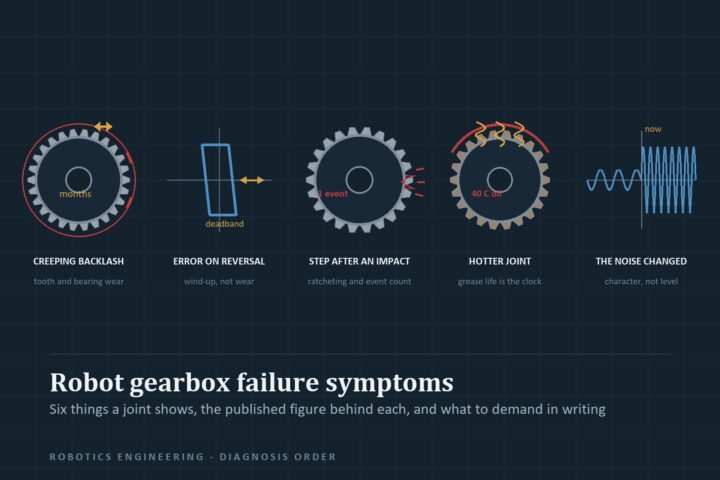
How that spent life shows up on the floor is a separate page: robot gearbox failure symptoms orders the six observable signs and gives the event-count arithmetic behind the sudden ones.
Planetary: life is mesh and bearing wear, published as 20,000 hours under Neugart’s conditions (PLE, PDF) or “> 20,000 h” in Wittenstein’s CP block (CP/CPS, PDF), and the symptom is creeping backlash: wear widens the clearance band, and KHK calls excessive backlash “objectionable, particularly if the drive is frequently reversing”. Shock tolerance is designed in — Wittenstein permits its emergency-stop torque 1,000 times over gearbox life and peak acceleration torque up to 1,000 cycles per hour (CP/CPS data block, PDF).
| Question | Strain wave | Planetary |
|---|---|---|
| Wear mode | flexspline fatigue; ratcheting damage | tooth/bearing wear → backlash growth |
| Published life | L10 7,000–10,000 h at rated torque, 2,000 rpm | 20,000 h+ under stated conditions |
| Life lever | under-torque it: cube law | duty factor; lifetime grease |
| Shock | strict collision ceilings | cycle-limited peak ratings |
| Backlash over life | jumps after a crash event | creeps up steadily |
Cost, lead time and repairability: what to ask, since nobody publishes
No catalogue cited here states a price or lead time for either family, so none is invented. The structural difference is public and drives the purchase order: a strain wave ships as a component set — the German catalogue states it consists of only three precision parts, circular spline, flexspline and wave generator — with the housing, bearings and output flange left to the machine builder, integrated to published assembly tolerances (Harmonic Drive Solutions catalogue, PDF; CSF/CSG assembly section, PDF); a precision planetary arrives as a sealed unit: an IP54 housing and lifetime grease on the PLE (Neugart PLE catalogue, PDF), and a gearbox whose price already includes a standard adapter plate on the Wittenstein CP (Wittenstein CP/CPS, PDF). Integration is engineering hours either way (cobot buying guide India). This site is published by the automation agency Jaadu Digital; the questions worth putting to every gearbox quotation are: the input speed and torque behind the L10 figure; the torque level at which backlash was measured; lubricant type and refill interval; authorised-channel proof against re-marked units; and a per-unit test sheet, not a datasheet. Whether a worn flexspline is a spare or a whole-unit swap is unpublished — get it in writing, per part number, if repairability decides the build.
Where this comparison is usually done badly
Three mistakes, in the order they appear. First, catalogue backlash measured at zero load. Apex states its figures are measured at 2% of rated torque (Apex backlash page); Harmonic Drive’s hysteresis numbers come from input-locked full-torque reversal sweeps. Two “1 arcmin” figures are not the same measurement, and under working torque the planetary’s single stiffness number and the strain wave’s three slopes diverge. Second, ignoring what the gear does not see: mounting runout, housing deflection, arm bending. That 4.3 arc-minutes of CSF-32 twist is measured at the gear’s own first breakpoint, with the machine assumed perfectly built — and it is still small against the deflection a cantilevered gripper adds at the tool tip. Position error is a stack, and past a metre of aluminium the gear is rarely the biggest layer; the repeatability vs accuracy guide works the stack through. Third, predictable backlash is compensable: a redundant output encoder forgives several arc-minutes of clearance that would sink an open-loop axis.
The decision, stated plainly
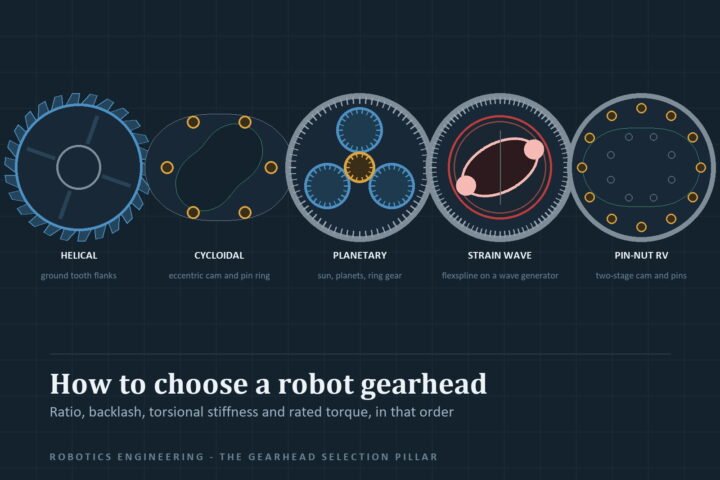
Pick a two-stage precision planetary — ≤5 arcmin class, 20,000 h rating, ≥90% efficiency, sized on peak-torque duty, deadband compensated in code or absorbed by longer lever arms — for a lab-scale or light industrial arm that runs continuous cycles and gets knocked occasionally. A tool-camera axis or a wrist whose entire specification is reversal accuracy at low torque wants a strain wave at ratio 30–50 where the hysteresis table reads 1–3 arc-minutes, deliberately oversized so the cube law works for you, heat-checked with the P_loss maths above. Neither family wins a high-payload base or shoulder that must hold arc-minute accuracy under impacts of five times rated torque — that is the harmonic drive vs cycloidal gear argument, and Nabtesco is the counter-example, with the same health warning every catalogue here needs. Its feature list promises backlash and lost motion “within 1 arc.min.” and impacts “5 times the rated torque”; the specification table under it prints 1.5/1.5 arc-min against the smallest RV-6E and 1/1 against every larger frame, a 6,000 h rated life that rises to 9,000 h on the RV-1500E, and a 2.5× acceleration allowance that is 2.0× on that same smallest frame (Nabtesco RV catalogue, PDF). Marketing bullets are series-wide claims; the columns are the per-frame truth. Do the torque and inertia maths for your actual arm first; the payload calculation guide and the robot gearhead selection guide cover it. For deeper involute theory, the publisher’s mechanical-engineering information site EngiTech is what we point to.
Frequently asked questions
Is a harmonic drive always more accurate than a planetary gearbox?
No. A strain-wave unit holds far less lost motion at the same ratio because its teeth are preloaded into engagement — Harmonic Drive publishes 1 to 3 arc-minutes of hysteresis loss against 3 to 22 arc-minutes of clearance for precision and economy planetary classes — but the gap narrows under torque: strain-wave stiffness is softest at low load, and its positioning accuracy is measured without reversal.
Why is harmonic drive efficiency so much lower than planetary efficiency?
The flexspline is bent through a full ellipse every input revolution and the wave generator adds bearing friction, so Harmonic Drive's catalogues tie efficiency to ratio, speed, load and lubricant temperature — their worked example reads 80% at rated torque and 70% at part load — while KHK puts parallel-axis gearing at 98 to 99.5% theoretical and Apex publishes 94% for a two-stage planetary. The gap becomes heat inside the joint.
What does harmonic drive backlash mean when suppliers say zero backlash?
The gear element has no tooth clearance, but a component set ships with an Oldham coupling worth up to 60 arc-seconds of play outside the mesh, and real reversing error lives in the hysteresis-loss and lost-motion columns. Compare arc-minutes of lost motion, not the word backlash.
Can a planetary gearbox work on a robot arm?
Yes, if the accuracy budget allows. A 3 to 5 arc-minute reduced-backlash planetary on a light arm's shoulder and elbow, deadband compensated in closed-loop control, is normal practice and cheaper; keep the strain wave for the wrist or tool-orientation axis, where reversal error is the whole specification.
Which lasts longer, strain wave or planetary?
Compare assumptions, not headlines: Harmonic Drive publishes L10 of 7,000 hours (CSF) and 10,000 (CSG) at rated torque and 2,000 rpm input, with a cube law on torque, while Neugart and Wittenstein publish over 20,000 hours under their stated conditions. An oversized strain wave at half torque beats both numbers; a crash-loaded one loses to a planetary outright.
How should I compare two gearbox catalogue pages fairly?
Match four conditions before comparing digits: the torque level at which backlash or lost motion was measured (Apex states 2 percent of rated), the ratio and number of stages, the input speed and duty behind the life rating, and efficiency at your real partial load rather than rated torque.