Robotics is not a list of machines. It is a loop: sense the world, decide what to do, act on the world, and check whether it worked. Everything else — the board, the sensors, the arm, the AI model — is a way of running that loop in a particular place.
That definition matters for students in India, because it explains why a ₹1,500 line follower and a factory welding arm belong to the same field, and why “learning robotics” cannot mean memorising one board or one software stack. Once you can see the loop, you can look at any robot and ask useful questions: what does it sense, what decides, what moves, and what happens when the decision is wrong.
The loop, in rupees
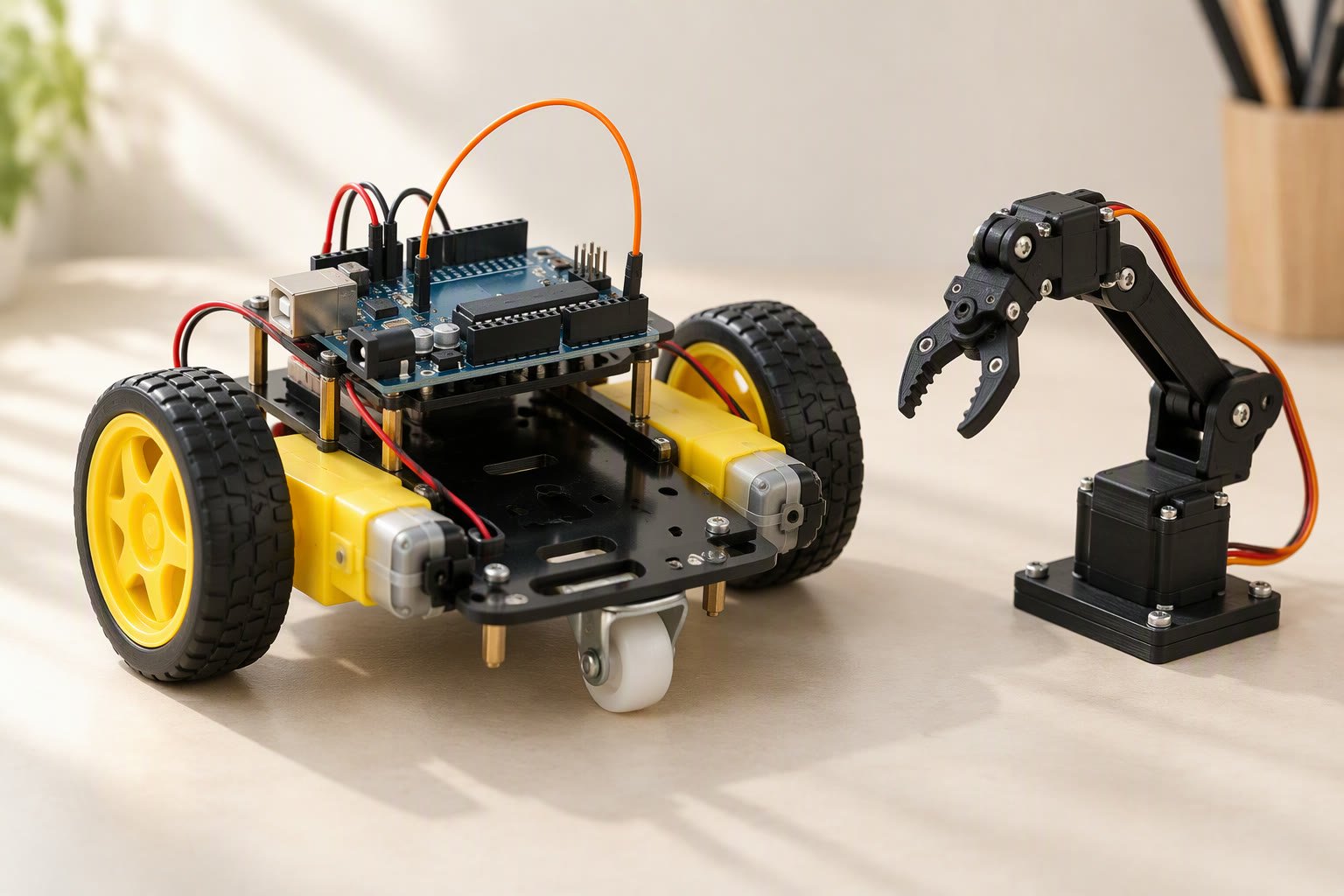
Take the cheapest honest example: a two-sensor line follower. The IR sensors measure whether the floor under them is black or white — that is sensing. The Arduino compares those two bits with a rule — that is deciding. The motor driver switches current to two geared motors — that is acting. If the robot drifts off the line, the sensors see it and the next decision corrects it — that is feedback, and it is the part that separates a robot from a remote-controlled toy.
Nothing in that build is intelligent. It is a control loop with a threshold, and it is a complete robot in the same sense as a warehouse picker: sensors, decisions, actuators, feedback. The complexity of each block can grow enormously, but the structure does not change.
What counts as a robot
Three tests separate robots from other machines. First, it senses its environment or its own state rather than replaying a fixed mechanical motion. Second, it can change its behaviour based on what it senses. Third, it acts physically on the world. A washing machine has a controller and an actuator but no meaningful sensing of a changing environment, so most people call it automation. A remote-controlled car has actuators and a human in the loop, so it is a teleoperated machine, not an autonomous robot.
The line is blurry at the edges, and that is fine. A robot vacuum that bumps into a chair, backs off and tries another angle is a robot. A conveyor belt with a timer is not.
The six layers inside any robot
| Layer | What it does | Student-level example |
|---|---|---|
| Mechanical | Structure, joints, wheels, gearbox | Acrylic chassis, 3D-printed bracket, TT gear motor |
| Power | Stores and converts energy safely | 2S 18650 pack, buck converter, fuse, common ground |
| Sensing | Turns the physical world into signals | IR reflectance, ultrasonic, IMU, encoder |
| Control | Runs the decision loop in real time | Arduino sketch, PID, state machine |
| Perception | Turns signals into meaning | Camera line detection, AprilTag pose, mapping |
| Communication | Links parts and people | UART between boards, Wi-Fi, ROS 2 topics |
Types of robots, by where they work
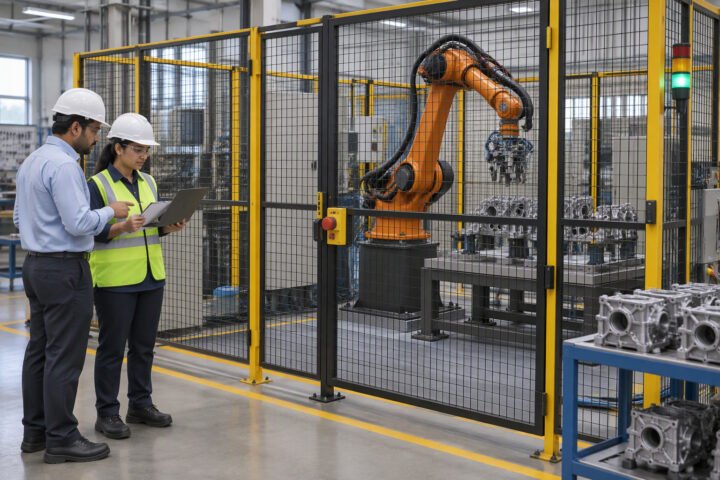
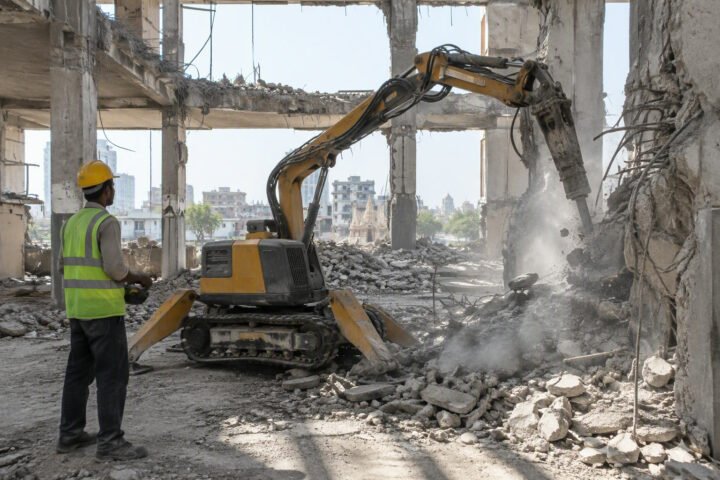
Industrial arms are the largest commercial category: welding, painting, pick-and-place and machine tending, usually bolted down and fenced off. Mobile robots move through space — AGVs in warehouses, delivery robots, rovers, drones. Service robots work near people: vacuums, lawnmowers, hospitality servers, surgical assistants. Humanoids get the headlines and the smallest deployment numbers. Field robots handle agriculture, inspection, mining and disaster response, where the environment is unstructured and the robot must survive it.
For a student choosing a project, the useful split is not the industry name but the problem type: a robot that holds a position, a robot that follows a path, a robot that manipulates an object, or a robot that maps an unknown space. Each maps to a different set of skills and a different set of interview questions.
What robotics is not
- Not the same as AI. A robot can be entirely rule-based. An AI model can run in a browser with no body at all. The interesting work is where they meet: perception and planning.
- Not a single board. Arduino, ESP32, Raspberry Pi and STM32 are tools for different jobs. The board comparison explains when each one fits.
- Not ROS. ROS 2 is middleware that helps parts of a robot talk to each other. Useful, employable, and not required for a line follower.
- Not only humanoids. The jobs are mostly arms, mobile platforms and inspection machines.
- Not a software-only subject. Power, wiring, ground loops and mechanical tolerance decide whether the code ever gets a chance to work.
What it costs to start in India
| Tier | Build | Parts budget | Skill you gain |
|---|---|---|---|
| First contact | Line follower or obstacle avoider on Arduino | ₹1,200–2,500 | Sensors, thresholds, motor driver, power and ground |
| First real robot | Bluetooth or Wi-Fi car with encoder feedback | ₹2,500–4,500 | Serial protocols, telemetry, closed-loop speed control |
| Portfolio build | Arduino plus Raspberry Pi rover with camera | ₹10,000–18,000 | Linux, vision, splitting real-time control from high-level code |
| Employable stack | ROS 2 on a small mobile base with a lidar or depth camera | ₹25,000+ | Nodes, topics, transforms, mapping, navigation |
The mistake beginners make is buying the fourth tier before finishing the first. A ₹30,000 lidar on a robot that cannot hold a straight line produces no useful data and no interview story. The three builds under ₹2,000 and the first-build walkthrough are deliberately boring for this reason.
A thirty-day starting plan
Week 1: get one sensor reading into the serial monitor and one motor turning, with the motor on its own power supply. Week 2: close a loop — the robot follows a line or stops at a wall. Week 3: break it deliberately. Change the lighting, the battery voltage and the surface, and write down what fails. Week 4: fix one failure with a measurement rather than a guess, and record before-and-after numbers.
That last week is what separates a project that survives a viva from one that only works on the builder’s desk. It is also the habit that makes the next project faster.
Where the jobs are
In India, hiring concentrates in industrial automation and system integration, automotive and EV manufacturing, warehouse and logistics automation, drones and inspection, and a smaller set of research and deep-tech roles. The titles are less glamorous than “robotics engineer”: automation engineer, controls engineer, embedded firmware engineer, application engineer, field service engineer. The fresher jobs guide covers the roles and honest pay bands, and the twelve-month roadmap sequences the skills.
Do I need a 3D printer to start robotics?
No. An acrylic chassis, cardboard template or a bought chassis is enough for a first robot. A printer becomes useful when you need custom brackets, which is usually after two or three builds.
Is Arduino enough to learn robotics?
It is enough to learn sensing, actuation, power and control loops, which are the foundation. It is not enough for vision, mapping or ROS 2. Most students end up using both an Arduino-class board and a Raspberry Pi.
How much maths do I need?
For beginner builds, arithmetic, percentages and basic algebra. PID needs an intuitive grasp of rates and error, not calculus. Mapping, localisation and control theory get heavier later, and you can learn them when a project demands it.
Can I get a robotics job with only college projects?
College projects help if you can explain the failure modes and the measurements you took. A documented build with real test data is stronger than five unfinished ideas.
What is the difference between robotics and embedded systems?
Embedded systems is the discipline of programming hardware with constraints. Robotics is a system that senses, decides and acts in the physical world. A robot contains embedded systems; an embedded product is not necessarily a robot.
Is robotics a good career in India in 2026?
It is a real career with real openings, concentrated in industrial automation, manufacturing and logistics. Salaries for freshers are closer to core engineering than to software, and grow with systems experience. The jobs guide has the honest ranges.
The biggest commercial use of robots is still manufacturing: the guide to robotics in Indian factories covers the machine types, costs and safety rules.
Cobots are marketed as safe by default; the robot safety standards guide explains why TS 15066 still requires a documented risk assessment.
One branch of robotics is the humanoid; see what they can do and what they cost.
Sources and further reading
- ISO 8373:2021 — Robotics vocabulary for the formal definitions of robot, industrial robot and service robot.
- International Federation of Robotics for deployment statistics behind the categories described above.
- ROS 2 Jazzy documentation for the middleware layer mentioned in the stack.
Last reviewed: October 2026. Price ranges reflect Indian retail listings and are planning figures, not quotes. Definitions follow ISO 8373 where a formal term exists.