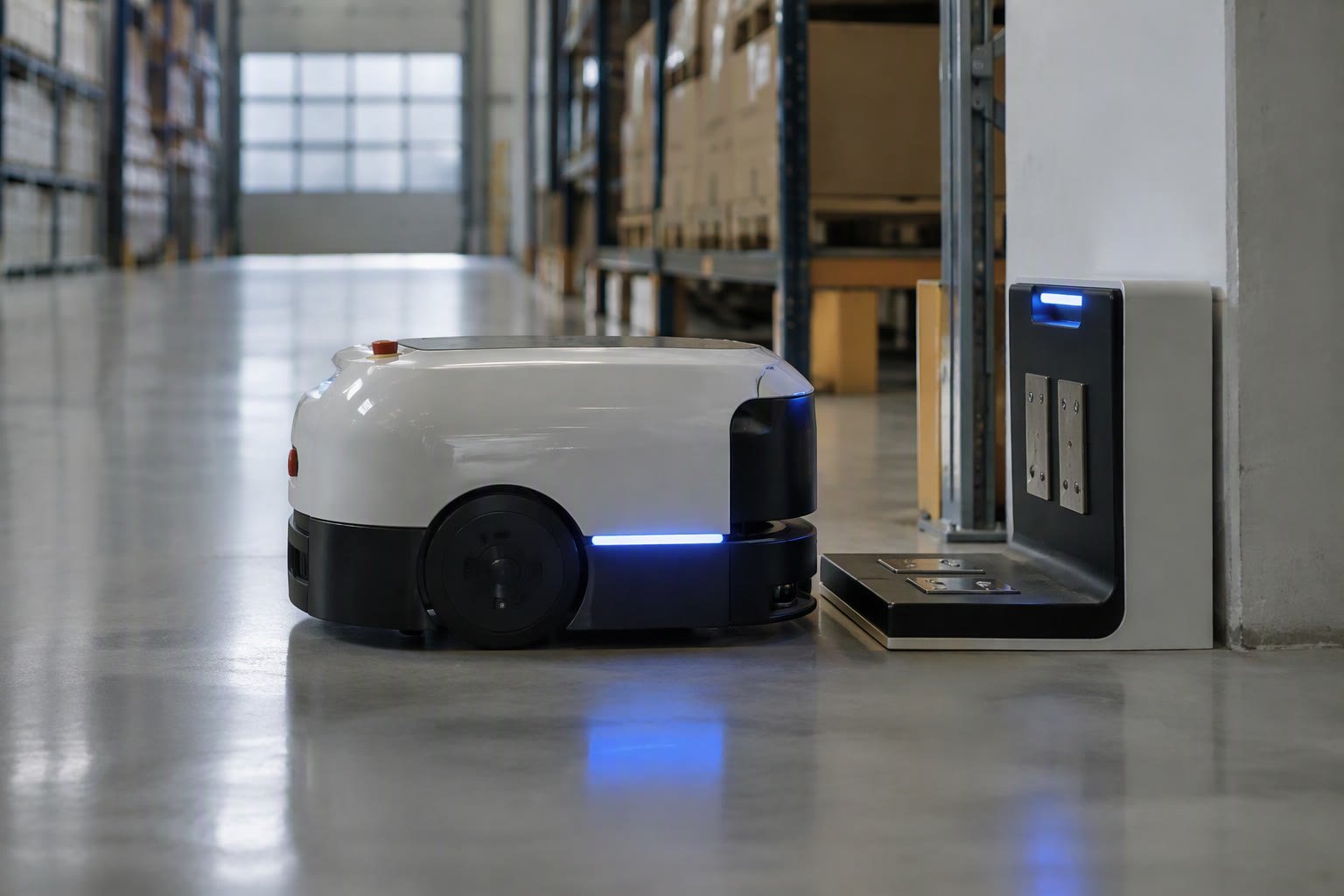
A mobile robot’s uptime is decided at the dock, not on the route. Navigation gets the attention, but a robot that misses its charge, arcs a contact or cooks a battery is unavailable regardless of how well it plans paths. Charging is an electrical, mechanical and operational problem at the same time.
This guide covers contact and inductive docking, battery chemistry choices, the power budget that sizes a charger, 2026 costs in India, and the failure modes that show up after a few hundred cycles.
Three ways to get energy in
| Method | How it works | Strengths | Weaknesses |
|---|---|---|---|
| Manual swap | Operator replaces the pack | Cheap, no dock infrastructure | Labour, downtime, safety risk |
| Contact docking | Spring-loaded contacts meet pads on the dock | Efficient, simple, low cost | Alignment tolerance, wear, arcing |
| Inductive docking | Coils transfer power without contact | No exposed contacts, tolerant of dirt | Lower efficiency, higher cost, alignment still matters |
Most indoor service robots use contact docking because it is cheap and efficient. The engineering effort goes into alignment: the robot must approach within a few millimetres, and the contacts must tolerate the error that remains.
Battery chemistry
| Chemistry | Energy density | Cycle life | Notes |
|---|---|---|---|
| Sealed lead-acid | Low | 300–500 | Cheap, heavy, sensitive to deep discharge |
| Li-ion NMC | High | 500–1,000 | Light, needs a proper BMS and thermal care |
| LiFePO4 | Medium | 1,500–3,000 | Safer, longer life, heavier than NMC |
For a robot that charges daily in a public building, LiFePO4 is often the better commercial choice because of cycle life and thermal stability. For a weight-sensitive robot, NMC with a good battery management system is reasonable. Lead-acid still appears in low-cost platforms, but the weight and cycle life usually cost more over five years.
The power budget
Start with average draw, not peak. A delivery robot might draw 150 W while moving, 40 W while idle and 300 W during a lift. Multiply each by its share of the hour to get an average, then size the pack for the shift plus a margin.
Example: 24 V, 40 Ah pack = 960 Wh. At 150 W average, that is about 6.4 hours of ideal runtime. Real-world derating for cold, aging and hills brings it closer to 4.5–5 hours. If the shift is 8 hours, the robot needs an opportunity charge in the middle or a larger pack.
Charger size follows the pack. A 0.3C charge is gentle and takes over three hours; 0.5C takes about two hours and stresses the cells more. For opportunity charging during natural breaks, 0.5C is common. For overnight charging, 0.2–0.3C is kinder to the battery.
What charging hardware costs in India
Indicative 2026 ranges, before GST.
| Item | Indicative range | Comment |
|---|---|---|
| 24 V 10 A smart charger | ₹4,000–12,000 | CC/CV with temperature cutoff |
| 48 V 20 A charger | ₹12,000–30,000 | For larger packs and faster charging |
| Contact dock, custom | ₹15,000–60,000 | Mechanical alignment plus contacts |
| Inductive dock | ₹50,000–2,00,000 | Coils, controller and alignment hardware |
| LiFePO4 pack, 24 V 40 Ah | ₹25,000–45,000 | Includes BMS in most packs |
| Li-ion NMC pack, 24 V 40 Ah | ₹18,000–35,000 | Lighter; verify BMS quality |
| Battery management system | ₹3,000–15,000 | Balancing, protection, communication |
A complete docking station with a charger, contacts and alignment hardware typically lands between ₹30,000 and ₹80,000 for a contact system. That is a small fraction of the robot cost and a large fraction of its reliability.
Dock design details
- Alignment tolerance. Decide how accurately the robot can arrive, then design the dock to accept at least twice that error.
- Contact pressure. Spring-loaded pogo pins need consistent force; too little causes arcing, too much wears the pads.
- Contact material. Gold plating on the signal contacts, hard-wearing pads on the power contacts.
- Drainage and debris. A dock on a wet floor needs a drain path and a lip to keep water away from live contacts.
- Cable strain relief. Cables fail at the connector if the dock is knocked.
- Visual and IR alignment. A reflector or IR beacon makes docking repeatable without relying on map accuracy.
Safety and standards
Lithium packs need a BMS that protects against overcharge, over-discharge, overcurrent and short circuit, plus a fuse on the pack output. Charging in an occupied area requires attention to thermal runaway risk: charge on a non-combustible surface, avoid charging damaged packs, and provide ventilation.
For products sold in India, electrical safety and battery standards apply, including BIS requirements for many battery types and IEC 62133 for portable lithium cells. Check the current scope with your supplier before assuming a pack is compliant.
Uptime maths for a small fleet
One robot with a 5-hour runtime and a 2-hour charge has a duty cycle of about 70% if it charges once per shift. Two robots can cover a continuous task only if their charge windows overlap with low demand or if one charges while the other works. Plan charging around the workflow, not around convenience.
Track three numbers after deployment: average state of charge at dock arrival, charge time to 90%, and docking success rate. A falling arrival SOC means routes are getting longer or the pack is aging. A rising charge time means the pack or charger is degrading. A docking success rate below 95% will annoy operators long before the battery fails.
Related: robot battery guide, how to power a robot, service robots in India, AGV vs AMR, SLAM for beginners.
How do mobile robots charge?
Most use contact docking, where spring-loaded contacts on the robot meet pads on a dock. Some use inductive charging without exposed contacts. Manual battery swapping is still used in low-cost fleets.
How long does a mobile robot take to charge?
It depends on pack size and charge rate. A 24 V 40 Ah pack charged at 0.5C takes about two hours; at 0.3C it takes over three. Opportunity charging during breaks is common.
Should I use LiFePO4 or Li-ion for a robot?
LiFePO4 gives longer cycle life and better thermal stability, at higher weight. Li-ion NMC is lighter and cheaper but needs a good BMS and careful thermal design.
Why do docking contacts fail?
Usually misalignment, insufficient contact pressure, dirt or arcing. Designing the dock to accept more alignment error and using spring-loaded contacts with proper plating reduces failures.
Can a robot charge overnight and run all day?
Only if the pack is sized for the full shift with margin. Most service robots use opportunity charging during breaks to keep packs smaller and lighter.
Battery and dock care belongs on the same schedule: robot maintenance for a small fleet.
Docking needs a good map and reliable uplink; see SLAM Toolbox and MQTT telemetry.
Docking decisions depend on state of charge reported by the BMS.
Docking accuracy improves when the charger carries an ArUco marker the robot can localise against.
Dock charging still depends on pack-level protection, which is why the LiPo safety guide belongs beside any docking design.
Docking needs a pose good to a centimetre, which is why odometry calibration comes before adding markers.
Charging infrastructure is easy to leave out of the budget, and our cost breakdown gives it a line of its own.
Charging is a fleet scheduling decision, not a robot-level one, as the fleet management guide explains.
Sources and further reading
- Bureau of Indian Standards — standards for batteries and electrical equipment in India.
- IEC — IEC 62133 for portable lithium battery safety.
- Battery University — charging profiles, cycle life and temperature effects.
- Nav2 documentation — docking and navigation behaviours used by mobile robots.