An AGV follows a path. An AMR decides one. That single difference drives the cost, the installation work, the flexibility and the failure modes of a mobile robot project. Choosing between them comes down to how stable your layout is, how often the route changes and whether your team can support the software.
The difference in one paragraph
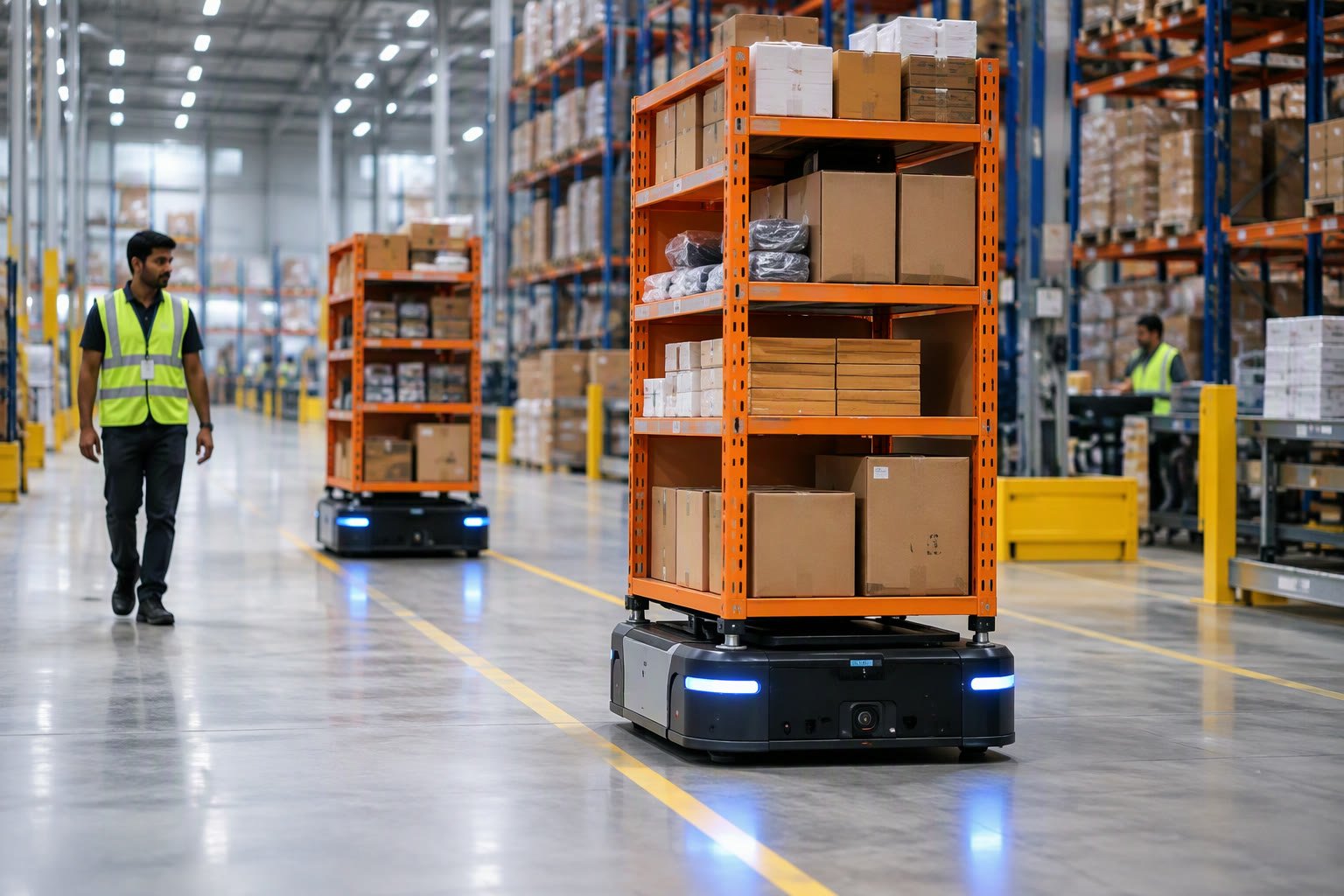
Automated guided vehicles follow fixed references: magnetic tape on the floor, a painted line, a wire buried in concrete or reflective markers on a wall. Autonomous mobile robots build a map with laser scanners or cameras and work out their own route, rerouting around obstacles and people. An AGV is cheaper and extremely repeatable. An AMR is flexible and needs more computing, mapping and integration.
| Factor | AGV | AMR |
|---|---|---|
| Navigation | Tape, wire, markers or rails | SLAM with lidar or cameras |
| Route change | Re-lay the path | Redraw the map |
| Indicative price | ₹6–20 lakh per vehicle | ₹8–30 lakh per robot |
| Installation | Floor work, long lead time | Mapping and Wi-Fi survey |
| People and forklifts | Needs a clear route | Detours around obstacles |
| Fleet software | Simple traffic control | Orchestration with priorities |
| Best fit | Stable, repetitive moves | Changing layouts, mixed traffic |
Where AGVs still win
AGVs are not obsolete. They are excellent when the route never changes: a tow tractor pulling a train of trolleys from stores to the line every 20 minutes, a vehicle shuttling between two fixed conveyors, or a heavy load moving along a dedicated aisle. In those cases an AGV is cheaper, simpler and easier to certify because its behaviour is predictable.
Heavy payloads also favour AGVs. Moving several tonnes on a repeatable path is a well-understood engineering problem, and the cost of a large AMR rises quickly with payload.
Where AMRs earn the premium
- The layout changes. Racking moves, new lines appear, seasonal zones shift. Re-taping a floor every quarter is not a plan.
- People and forklifts share the aisle. An AMR detours; an AGV stops and waits, or the route has to be separated.
- The fleet grows. AMR software coordinates dozens of robots with traffic rules and priorities; adding an AGV often means re-engineering the path network.
- The site is rented. Floor tape and buried wire are hard to take with you.
- Multi-purpose transport. The same AMR can carry totes, shelves, carts or a custom top module.
Infrastructure checklist before you choose
| Item | AGV requirement | AMR requirement |
|---|---|---|
| Floor | Clean, flat, tape or wire installed and protected | Flat, good traction, no steep ramps |
| Wi-Fi | Optional for many models | Strong coverage with roaming, no dead zones |
| Charging | Fixed stations near the route | Opportunity charging at idle points |
| Traffic | Separated lanes | Rules in fleet software, plus physical awareness |
| Lifts and doors | Discrete I/O triggers | API or I/O integration, often both |
| IT support | Low | Moderate: network, servers, updates |
Most AMR projects that disappoint trace back to Wi-Fi or floor quality, not to the robot. Walk the route with a site survey before signing, and test at peak traffic rather than at 8 a.m. on a Sunday.
Safety and standards
Driverless industrial trucks fall under ISO 3691-4, which covers risk assessment, protective functions, braking and operating zones. In India, the Factories Act and state factory rules add obligations around moving machinery and safe systems of work. A vendor’s CE mark is a starting point, not a site risk assessment.
Practically, plan for marked pedestrian zones, speed limits near crossings, audible or visual warnings, and a documented response when a robot faults in an aisle. A robot stopped in a main aisle during dispatch is an operational problem long before it is a safety one.
Integration with WMS and ERP
A mobile robot that moves what a spreadsheet tells it is a toy. Value comes from the fleet manager receiving tasks from the warehouse management system and reporting completion back. Ask three questions: which API does the fleet expose, who writes the connector, and what happens when the WMS is down for maintenance?
Budget for the connector. It is usually a fixed integration fee plus internal IT time, and it can take longer than the physical installation.
A simple payback model
monthly saving =
  (trips per day × days × minutes saved per trip / 60 × loaded labour rate)
  + (reduction in forklift damage and overtime)
  − (lease or depreciation + software subscription + maintenance)

payback months = project cost / monthly saving
For a two-shift warehouse moving 400 totes a day, saving four minutes of a material handler’s time per trip at a loaded cost of ₹180 an hour comes to roughly ₹48,000 a month. Against a ₹25 lakh project that is a 52-month payback before any allowance for accuracy or damage reduction. The business case has to come from throughput or space, not just labour minutes.
Procurement questions
- What is the measured uptime in comparable Indian sites, and can I speak to two of them?
- Who supplies and supports the Wi-Fi, and what coverage is assumed?
- What payload can the robot carry at the speed you quote, on my floor?
- How does the fleet handle a blocked aisle and a dead robot?
- Which WMS connectors already exist, and which need custom work?
- What does the software subscription cost per robot per year after year one?
- Where are spares held, and what is the response time for a drive or scanner failure?
- Can I start with two robots and scale without replacing the fleet manager?
How to decide quickly
If the route is fixed, the load is heavy and the floor is yours, price an AGV first. If the layout changes, people share the aisles and you expect to add robots, price an AMR. If you are unsure, run a paid two-week trial on the real floor and measure trips completed, interventions per shift and battery behaviour. A trial is cheaper than a wrong fleet.
Sizing the fleet without guessing
Fleet size comes from cycle time, not from the vendor’s demonstration. Measure one complete trip on the real floor: pickup, travel loaded, drop, travel empty, plus waiting at charging points and intersections. Then divide the total transport demand by what one robot can deliver in a shift.
trips per robot per shift =
  usable minutes per shift / measured minutes per trip

robots needed =
  total trips per shift / trips per robot per shift

add 15–25% headroom for charging, blocking and peaks
Usable minutes are not shift minutes. Subtract breaks, charging time, planned maintenance and the reality of a warehouse where aisles are blocked during dispatch. A robot that completes 30 trips an hour in an empty test bay may complete 18 during peak. Size for peak, not for the demo.
Running a trial that proves something
- Define the metric before the trial. Trips completed per shift, interventions per 100 trips, average wait time at pickup and battery cycles per day.
- Run at peak, not at convenience. A trial on a quiet Sunday proves the robot can move, not that it can work.
- Include the awkward loads. The damaged tote, the overloaded cart and the pallet that is 5 cm out of position.
- Log every manual intervention. Each one is a hidden labour cost that will not appear in the vendor’s ROI sheet.
- Test the network under load. Ask the IT team to run normal traffic during the trial, not a quiet network.
A two-week trial with clear metrics is the cheapest insurance in the project. If a vendor will not support one, that is information too.
Frequently asked questions
What is the main difference between an AGV and an AMR?
An AGV follows a fixed path such as tape, wire or markers. An AMR maps the space and chooses its own route, so it can detour around obstacles and handle layout changes without new floor infrastructure.
Which is cheaper in India, an AGV or an AMR?
AGVs generally start lower at roughly ₹6–20 lakh per vehicle against ₹8–30 lakh for an AMR, but total project cost depends on floor work, Wi-Fi, integration and software subscriptions.
Can an AMR work without Wi-Fi?
Most fleet software needs a network for task assignment and coordination. Some robots can continue a current task offline, but a weak network will limit fleet size and reliability.
Do I need to change my warehouse floor for an AMR?
The floor must be flat and provide good traction, with no steep ramps or large gaps. You do not need tape or wire, but you do need a route survey and often better Wi-Fi coverage.
How many robots does a typical Indian warehouse start with?
Most first projects start with two to six robots on one process, prove the payback, then scale. Starting with a large fleet before the process is stable is the most common expensive mistake.
Related: warehouse robotics in India, industrial robot costs, robotics in manufacturing, robot safety standards.
Whichever platform you pick, plan the charging and docking setup early – it decides how many robots you actually need.
The same navigation hardware is moving into hospitality; see service robots in Indian hotels and restaurants.
Both depend on pack protection and charge reporting for uptime.
Both vehicle types rely on scanners, covered in the safety laser scanner guide.
AGV platforms with steered wheels behave differently from skid steers, as explained in Ackermann steering for robots.
Before choosing between AGV and AMR, price the whole project with our warehouse automation cost guide so the vehicle is not the only number on the table.
Fleet size and traffic control decide whether a mixed or single-technology layout works, as covered in the fleet software guide.
Sources and further reading
- ISO 3691-4 — safety requirements for driverless industrial trucks.
- International Federation of Robotics — mobile robot and service robot statistics.
- A3 (Association for Advancing Automation) — AGV and AMR terminology and guidance.
- Ministry of Labour and Employment — Factories Act and occupational safety framework.