A robot is only as fast as the conveyor that feeds it. Most cells that miss their cycle time are not limited by the arm, but by indexing accuracy, handshake timing and parts that arrive out of position.
This guide covers the conveyor choices that suit robot cells, the throughput arithmetic, the handshake design, and what to put in a request for quotation when you buy in India.
Which conveyor suits a robot cell
| Type | Best for | Limitations |
|---|---|---|
| Flat belt | Boxes, cartons, general parts | Tracking can wander; not for small loose parts |
| Modular plastic belt | Wet, oily or high-temperature parts | Higher cost, more noise |
| Roller conveyor | Pallets and rigid containers | Needs flat-bottomed loads |
| Indexing chain | Fixture-based assembly | Fixed pitch; design change is expensive |
| Vibratory feeder | Small parts, bulk orientation | Tuning per part; noisy |
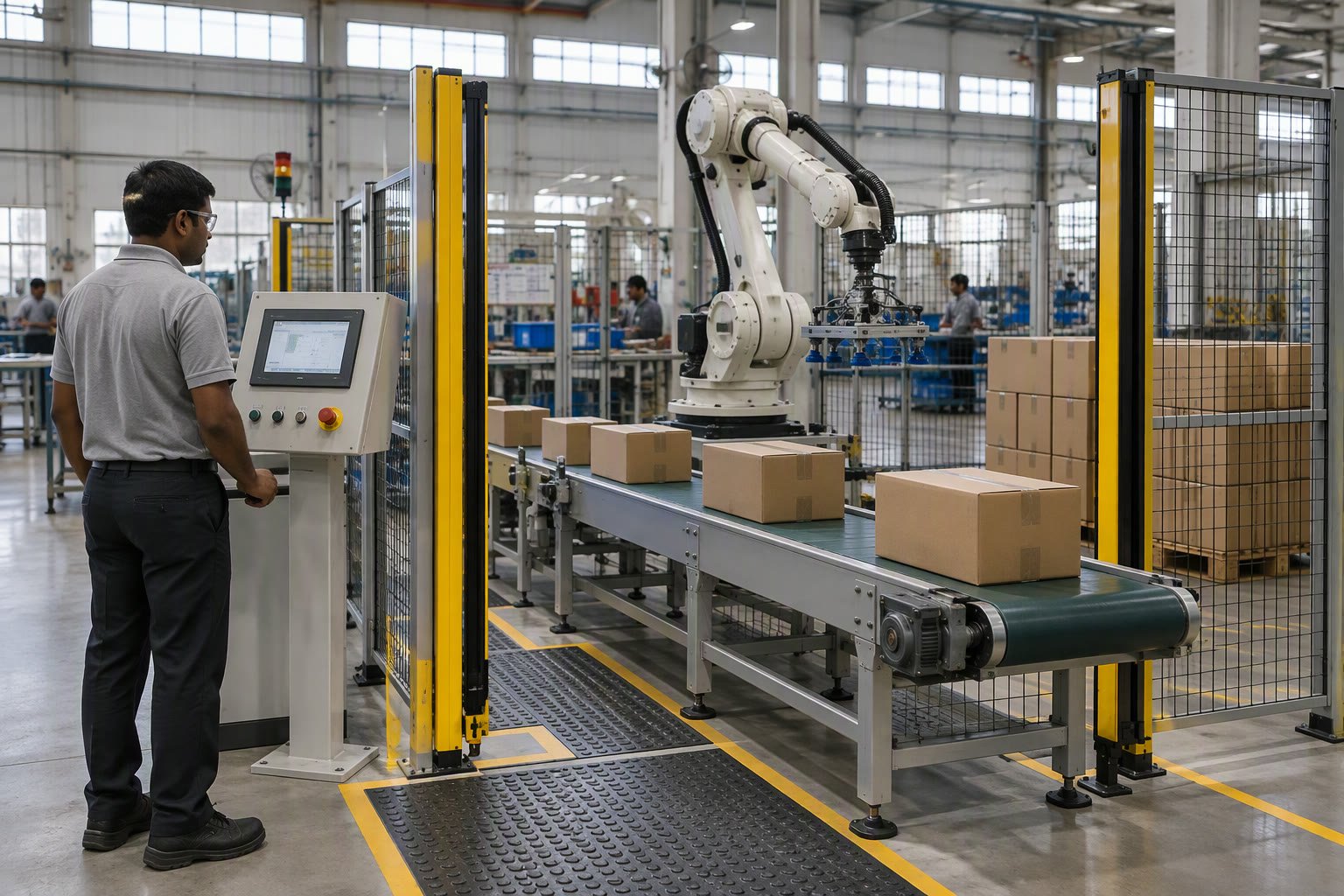
For a first robot cell in a small Indian workshop, a flat belt with side guides and a mechanical stop is usually the cheapest reliable choice. It handles a useful range of parts and fabricators are easy to find. Add fixturing only when the pick accuracy demands it.
Throughput arithmetic before hardware
Conveyor throughput is speed divided by spacing. A belt at 0.2 m/s with parts every 0.4 m delivers 0.5 parts per second, or 30 per minute. If the robot needs 4 seconds per pick, the belt will outrun the robot, and parts will queue or fall off the end.
parts_per_minute = (belt_speed_mps * 60) / spacing_m
cycle_time_s = 60 / parts_per_minute

# 0.2 m/s, 0.4 m spacing
# 30 parts/min, 2 s per part
Do this calculation with the robot’s real cycle time, including approach, grip, lift and retreat. If the robot is slower, the belt must index rather than run continuously, or you need two lanes feeding one robot.
Stopping accurately is the hard part
A conveyor that stops within 20 mm is fine for a vacuum gripper with a large cup. It is not fine for a two-finger gripper picking a 30 mm part. The stop method decides the accuracy, and the cost rises with it.
| Method | Typical repeatability | Notes |
|---|---|---|
| Photo-eye plus VFD ramp | 10 to 30 mm | Cheapest; depends on load and speed |
| Brake motor | 5 to 15 mm | Faster stop, more wear |
| Mechanical stop with soft start | 2 to 5 mm | Parts must tolerate impact |
| Servo-driven indexing | Under 1 mm | Highest cost, best for fixtures |
| Vision correction on the fly | Robot accuracy | Needs camera and conveyor tracking |
Conveyor tracking, where the robot follows a moving part, removes the stopping problem entirely but adds a vision system and a real-time link between encoder and robot. It is worth it for high throughput and hard to justify for a few hundred parts a day.
The handshake between conveyor and robot
Two devices that each wait for the other will deadlock, and one that assumes the other is ready will crash. The handshake must be explicit on both sides with timeouts on every state.
- Part present sensor triggers a request to the robot.
- Robot confirms it is ready, conveyor stops or indexes to the pick position.
- Conveyor reports at-position, robot enters and picks.
- Robot reports pick complete, conveyor resumes.
- Every state has a timeout that raises a fault and stops the cell safely.
For the link itself, discrete 24 V IO is the most robust and the easiest to troubleshoot with a multimeter. Modbus over RS485 is common when the conveyor has a VFD, and industrial Ethernet is the choice when the cell already has a network. Whichever you use, keep an emergency stop path that does not depend on the communication link.
Safety around a moving belt
A conveyor is a continuous motion hazard with nip points at every roller. In a robot cell, the robot and the belt must both stop when a guard is opened, and neither may restart automatically when it closes.
- Guard the nip points and the transfer between belts.
- Use interlocked guards with a manual reset, not an automatic restart.
- Light curtains at the operator opening, wired to a safety relay, not to the PLC’s standard input.
- Emergency stops on both sides of the cell, in reach of the operator at the load and unload points.
- Label the maximum load and keep it honest; an overloaded belt stalls and a stalled motor overheats.
What drives the price in India
Conveyor quotes vary enormously because the frame, belt and drive are only part of the cost. Controls, guarding and installation often exceed the mechanical price. The ranges below are budgetary, for a single short conveyor feeding one robot, and they move with belt width, length and controls.
| Configuration | Budget range | What is included |
|---|---|---|
| Small flat belt, fixed speed | Rs 40,000 to 90,000 | Frame, belt, geared motor, local starter |
| Flat belt with VFD and sensors | Rs 90,000 to 1.8 lakh | Variable speed, photo-eye, basic panel |
| Indexing belt with brake motor | Rs 1.5 to 3 lakh | Repeatable stops, controls, guarding |
| Servo indexing line | Rs 3 to 7 lakh | Servo axis, controller, fixtures, safety |
These are planning figures, not quotations. Local fabrication can bring the mechanical cost down, while imported modular belt and servo drives push it up. Ask for a breakdown of mechanical, drive, controls, safety and installation, because quotes that only show a total are hard to compare.
The specification to send with an enquiry
- Part range: size, weight, material, whether it can tip or roll.
- Required throughput in parts per minute, and the shift pattern.
- Belt width and length, plus the available floor space and height.
- Stop accuracy and whether the robot or a fixture locates the part.
- Environment: coolant, dust, temperature, washdown.
- Controls: fixed speed, VFD, indexing, and which protocol the cell uses.
- Safety requirements and who supplies the guarding.
- Power available at the location, usually 415 V three-phase in Indian workshops.
- Installation, commissioning and training responsibilities.
- Spare parts and response time for service.
Most late projects trace back to a vague enquiry. A fabricator who knows the part weight, the stop accuracy and the protocol will quote a different machine from one who is guessing, and the difference shows up during commissioning.
Related: machine tending robots, Modbus and RS485 for robot cells, palletizing robot cost, robot safety standards in India, cycle time calculation.
Do I need an indexing conveyor for a robot cell?
Only if the robot needs the part at a repeatable position without vision. A continuously running belt with a mechanical stop and side guides is cheaper and works for many parts. Indexing becomes necessary when stop accuracy or fixture alignment matters.
How fast can a robot pick from a moving conveyor?
That depends on the robot, the conveyor tracking option and the vision system. Many cells pick from an indexed belt instead, because it is simpler to commission and easier to prove safe. Conveyor tracking is justified by high throughput, not by convenience.
What is the cheapest reliable handshake between conveyor and robot?
Discrete 24 V IO with a defined sequence and timeouts on both sides. It is easy to troubleshoot with a multimeter and does not depend on a protocol stack. Modbus is a good second choice when a VFD is already there.
Can one PLC control both the conveyor and the robot?
Yes, and it is common in Indian cells. The PLC owns the conveyor and the safety interlock signals, and the robot exchanges a small handshake with it. Keeping safety functions in a dedicated safety relay or safety PLC is still necessary.
What lead time should I plan for?
A simple fabricated belt can be ready in two to four weeks. Indexing lines with controls, guarding and commissioning commonly take six to ten weeks, and imported modular belt or servo systems add shipping time. Plan the robot installation to finish after the conveyor is proven.
Conveyor motors and sensors in a wash-down area need the right IP rating, not just a bigger box.
Throughput measurement belongs to the same monitoring layer; start with the machine monitoring overview before buying sensors.
Moving parts between cells can use a conveyor or a mobile robot, and the AMR and AGV comparison explains when each makes sense.
Conveyors link receiving, ASRS racking and dispatch, so design the interfaces together.
In food lines the conveyor is a hygiene surface, not just transport, as the food industry robot guide explains.
Conveyors that buffer cartons decide whether the palletizer can keep up; the end-of-line automation guide works through the arithmetic.
Sources and further reading
- ISO 14120 guarding standard — design and selection of guards.
- OSHA conveyor safety guidance — nip points and guarding practice.
- ISO 10218-2 — robot systems and integration requirements.