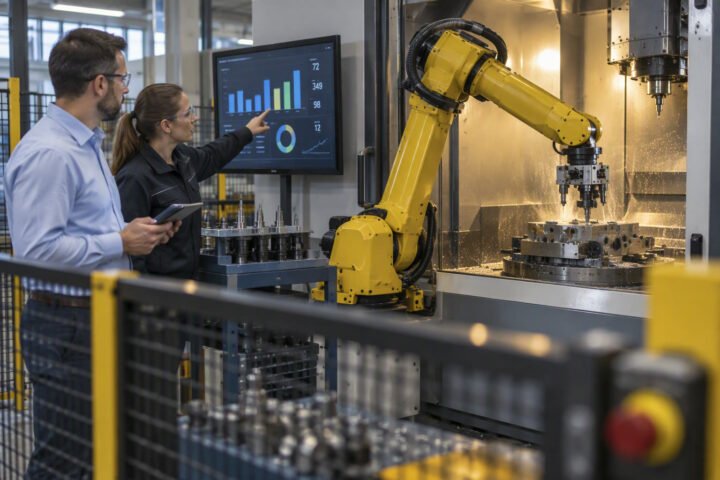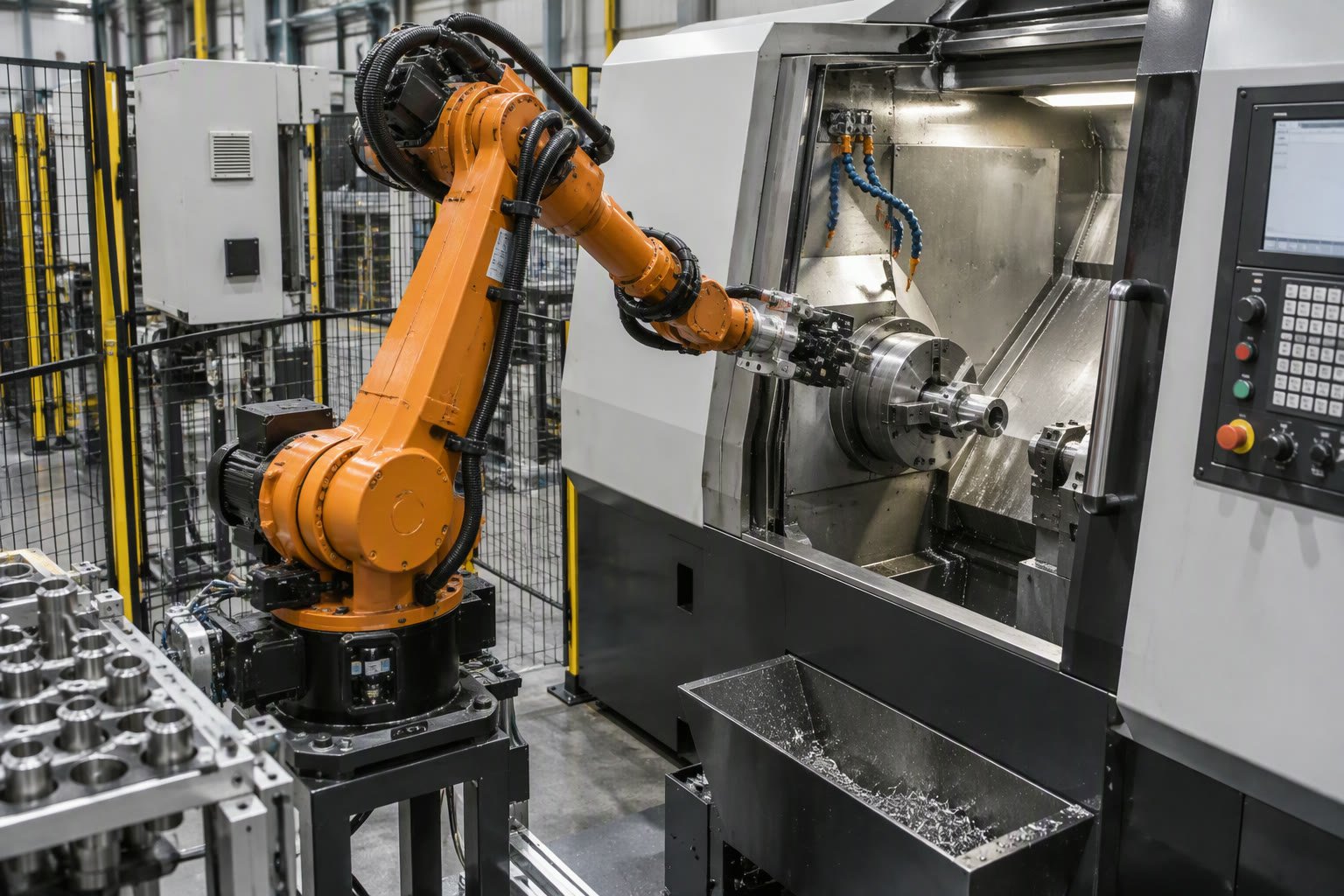
Machine tending is the least glamorous robot job and often the easiest one to justify. Loading a CNC lathe or injection moulding machine is repetitive, dirty and shift-dependent. The part is always in the same place, the cycle is known, and the savings are easy to count.
That is why machine tending is one of the first automation projects a small Indian manufacturer should consider — and why so many first attempts still fail on fixtures, chip control and door interlocks rather than on the robot itself.
What a tending cell includes
| Part | Job | Where projects go wrong |
|---|---|---|
| Robot arm | Move parts between magazine and machine | Reach and payload chosen for the brochure, not the part |
| Gripper | Hold raw and finished part | One gripper for two geometries, no compliance |
| Part magazine or conveyor | Present parts in a known pose | Operators load it inconsistently |
| Machine interface | Open door, clamp, start cycle, read status | No safe handshake with the machine controller |
| Safety fence and interlocks | Keep people out during cycle | Fence added after the robot is installed |
| Chip and coolant control | Keep the robot and gripper clean | Chips jam the gripper or block the door |
The robot is usually the most reliable component in the cell. The magazine, gripper and machine handshake decide whether the cell runs unattended or needs an operator standing beside it — which defeats the business case.
Three ways to automate a machine
A six-axis industrial robot is the classic choice for CNC tending. It reaches into the machine, handles 5–20 kg parts and can serve two machines if they are placed within reach. It needs a fence and a proper risk assessment.
A cobot is cheaper to install and easier to redeploy, but it is slower and its safety claim depends on the tool and the application. A cobot handling a sharp, heavy part at speed may still need guarding. Treat the “no fence” promise as a starting point for a risk assessment, not a conclusion.
A gantry or dedicated loader is common on injection moulding machines and small presses. It is fast, occupies little floor space and is built for one machine. It is less flexible than a robot arm but often cheaper per machine.
What it costs in India
| Configuration | Indicative cell cost | Best for |
|---|---|---|
| Cobot, 10–16 kg payload, single machine | ₹8–20 lakh | Small parts, low volume, frequent changeover |
| Six-axis robot, 10–20 kg, single machine | ₹18–35 lakh | Higher speed, two-shift production |
| Six-axis serving two machines | ₹25–50 lakh | Stable high-volume part family |
| Gantry loader on injection moulding | ₹6–20 lakh | One machine, fast cycle, simple part |
| Vision-guided bin picking add-on | ₹8–25 lakh | Parts arrive in random orientation |
These are planning ranges before GST, and they move with arm brand, gripper complexity, fencing and integration. A cell quoted at the bottom of a range usually excludes door automation, chip management or commissioning time.
The payback maths
Start with the labour the cell replaces, not the robot price. One operator at ₹20,000–30,000 per month, across two shifts, costs ₹4.8–7.2 lakh a year including statutory costs. If the cell removes one operator per shift, the annual saving is real — but only if the cell actually runs unattended.
Then add the gains that are easier to defend: consistent cycle time, fewer scrapped parts from manual loading, and the ability to run a third shift without hiring. A cell that raises machine utilisation from 60% to 80% can pay back faster than the labour saving alone suggests.
Be honest about the costs that do not disappear: someone still loads the magazine, checks the first part, clears chips and responds to alarms. A tending cell reduces headcount; it rarely eliminates the operator.
Feasibility checklist before you request quotes
- Part family. How many variants, and how different are their geometries? Every variant needs a gripper plan.
- Cycle time. Can the robot load and unload inside the machine cycle, or does it become the bottleneck?
- Part weight and grip. Raw castings are heavier and rougher than finished parts.
- Machine interface. Does the controller expose a safe remote-start and door-open signal?
- Floor space. Fence, magazine, robot base and maintenance access often need more room than expected.
- Chips and coolant. Who cleans the gripper, and how often?
- Changeover time. A cell that takes four hours to change over will not run small batches.
- Safety. Risk assessment, fencing, interlocks and operator training are part of the project, not extras.
Mistakes that kill the business case
| Mistake | Consequence | Prevention |
|---|---|---|
| Buying the robot before designing the gripper | Cell cannot hold the part reliably | Prototype the gripper on real parts first |
| Ignoring chip evacuation | Gripper jams, door blocks, downtime | Add air blast, drip trays and a cleaning routine |
| No machine handshake | Robot and machine collide or wait forever | Define the signal sequence and test it dry |
| Magazine loaded inconsistently | Pick failures that look like robot errors | Design poka-yoke nests and train operators |
| Fence designed last | Layout rework and delayed commissioning | Include guarding in the layout from day one |
| No changeover plan | Cell sits idle on the next part number | Design quick-change grippers and recipes |
Related: industrial robot cost in India, cobot buying guide, robot gripper design, TCP calibration, robot safety standards.
What is machine tending in robotics?
Machine tending is loading and unloading a machine such as a CNC lathe, machining centre, press or injection moulding machine with a robot, including opening the door, clamping the part and starting the cycle.
How much does a machine tending robot cost in India?
A cobot cell for one machine typically costs ₹8–20 lakh, a six-axis cell ₹18–35 lakh, and a cell serving two machines ₹25–50 lakh. Gripper, fencing and integration decide the final number.
Is a cobot or an industrial robot better for machine tending?
A cobot suits low volume, frequent changeover and tight floor space. A six-axis robot suits higher speed and two-shift production. The safety claim of a cobot depends on the tool and the risk assessment.
How long does a machine tending project take?
A straightforward single-machine cell takes roughly 8–16 weeks from purchase order, including gripper design, integration and commissioning. Complex grippers or machine interfaces add time.
Can a robot tend a CNC machine without a fence?
Only if a risk assessment shows it is safe. A cobot handling a sharp or heavy part at speed may still need guarding, and the machine door and spindle area must be interlocked.
Machine tending works with both robot types; cobot vs industrial robot explains the trade-offs.
Machine tending cells are usually justified on labour and uptime; calculate the ROI before committing.
Tending cells live or die on the handshake; see PLC and robot controller integration.
Machine tending cells are often built on used arms; read the used robot buying guide first.
Machine tending is a brand-sensitive application; read the brand comparison first.
The gripper choice decides cycle time; see end effector types.
Machine tending cells are usually limited by the machine cycle rather than the arm, and the cycle time calculation guide shows how to check before buying.
The clearance and access rules are in the robot cell layout guide.
The gripper is where machine tending cells lose parts, so size it with the robot gripper buying guide.
Tending cells suit short and seasonal production, which is where renting a robot usually wins on cost.
Machine tending fails when a part is mislocated, and force sensing catches the jam before the spindle does.
Machine tending fixtures usually clamp with air, and cylinder force and air consumption set the compressor requirement.
VFDs on the machine and the cell conveyor usually sit on Modbus RTU, covered in this guide.
Feeding a machine tool usually means a conveyor and a handshake, covered in the conveyor integration guide.
Machine tending cells add air lines and coolant to the arm, so review the dress pack design before commissioning.
Moulding machines are a machine-tending case with a fixed cycle, and the take-out robot guide covers the specifics.
Cleanroom machine tending follows the same rules plus validation, covered in the pharma robotics guide.
Rows of machines are sometimes served by a cantilever gantry instead of an arm on a track.
Randomly stacked blanks need 3D bin picking; a part feeder or tray works better if your parts allow it.
Die casting is the harshest form of machine tending because the part is hot and the window is short; see the foundry-specific requirements.
Sources and further reading
- ISO 10218 — safety requirements for industrial robots and robot systems.
- International Federation of Robotics — machine tending application data and case studies.
- FANUC — machine tending cell configurations and robot specifications.
- Universal Robots — cobot machine tending guidance and safety notes.