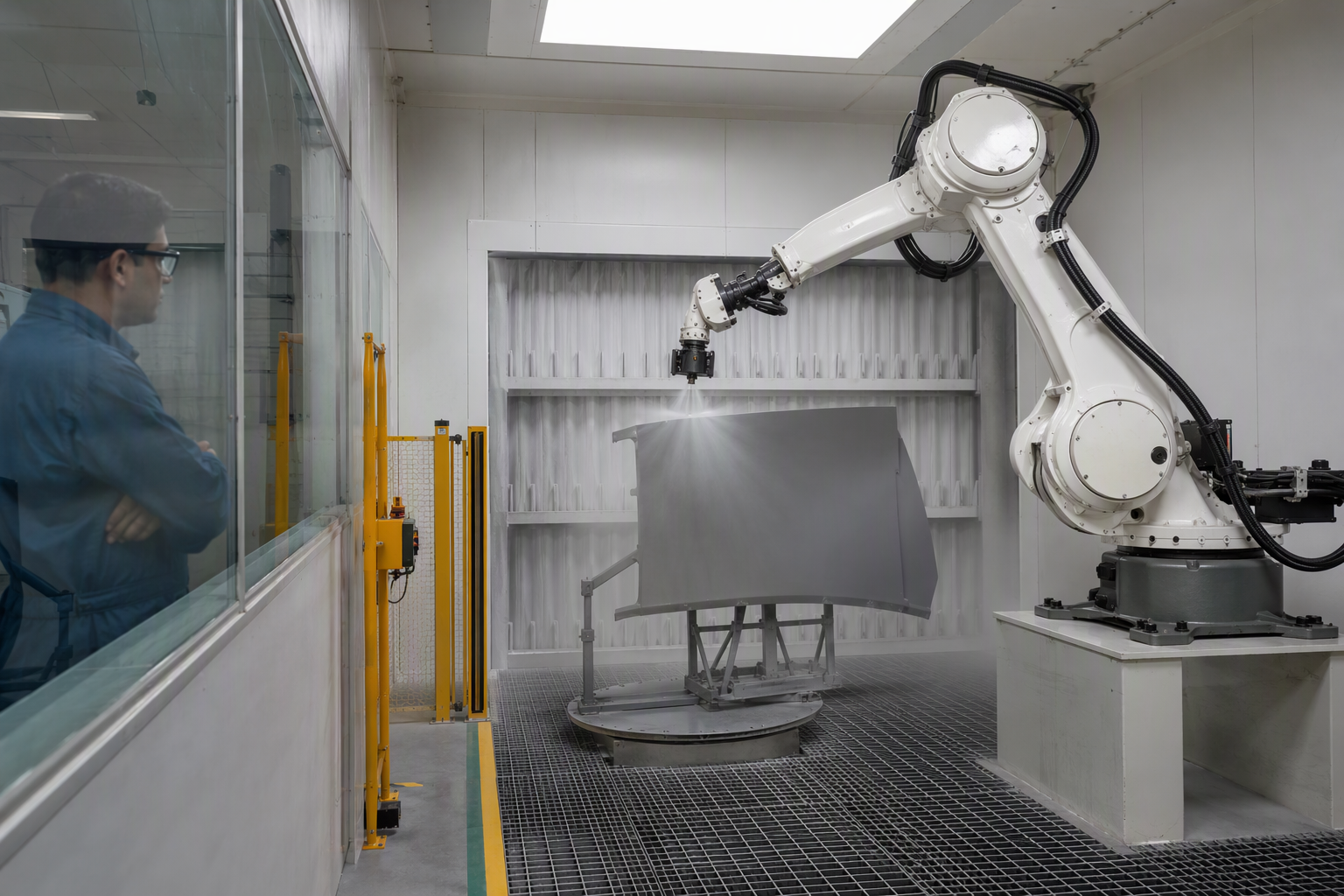
A painting robot in India is two purchases wearing one name. The arm is the smaller one: a paint-duty robot with 10 to 20 kg payload appears in Indian marketplaces from about ₹7 lakh, and a new explosion-proof machine from a tier-one maker is quoted, not listed. The cell around the arm is the larger one: booth and airflow, spray package, part handling, safety and integration usually cost as much again or more. A single-robot cell for a small job shop typically lands between ₹18 lakh and ₹45 lakh. The number you were quoted is only meaningful if you can see which of those two halves it covers.
What the quote is actually buying
A paint robot cannot be dropped on a shop floor like a welding robot. Solvent paint turns the working envelope into a hazardous area, and everything inside it — the arm, the gun, the cables, the sensors — has to be built for that. That is why two quotes for “one painting robot” can differ by a factor of three and both be honest.
| Line item | Planning range (₹ lakh) | What changes the number |
|---|---|---|
| Paint-duty robot arm | 7 – 25 | Payload, reach, explosion protection, new versus refurbished, tier-one versus regional brand. |
| Spray package | 2 – 8 | Air spray gun versus rotary bell, number of colours, pumps, colour-change valves, pressure and flow control. |
| Booth, enclosure and airflow | 3 – 12 | Downdraft or crossdraft, filter class, exhaust stack, whether the booth already exists. |
| Part handling | 1.5 – 8 | Stationary fixture, indexing turntable, reciprocator, or a conveyor with tracking. |
| Controls and safety | 2 – 6 | Robot cell PLC, HMI, gas detection, interlocks, fencing, light curtains, earthing monitoring. |
| Integration and commissioning | 2 – 6 | Simulation, path teaching, recipes, operator training, documentation, travel and site days. |
| Working single-robot cell | 18 – 65 | Low end is a stationary cell spraying one family of parts; high end is a tracked conveyor line. |
These are planning ranges built from public marketplace listings for Indian painting systems and standard component pricing, not quotes. Indian listings show complete robotic painting systems from around ₹15 lakh and industrial painting robots from around ₹7 lakh, while imported bare arms of the same class are advertised from roughly US$4,000 to US$10,000 before freight, duty and explosion protection. Every real cell is quoted against a part drawing, and the part drawing moves the number more than the robot brand does.
The explosion-proof line nobody explains
Solvent-based paint releases flammable vapour. Inside the spray zone, ordinary motors, relays, connectors and even some sensors are ignition sources. Hazardous-area practice under the IEC 60079 series classifies that zone and requires equipment rated for it. In practice, a paint robot built for solvent duty is not a standard robot with a cover: makers pressurise the arm with clean air so that flammable gas cannot enter, and the arm carries the certification to prove it. FANUC’s P-250iB, for example, is a 15 kg, 2,800 mm paint robot whose arms are kept under internal pressure for exactly this reason.
Three consequences follow, and they are where projects lose money:
- Waterborne and powder change the rules. Waterborne paint is far less flammable, and powder coating is a different process altogether. If your line will switch to waterborne, say so before the robot is specified — you may not need the most expensive protection level.
- The booth is part of the safety system. Airflow, filters, gas detection and the interlock that stops the robot when airflow fails are not optional extras. A cheap booth with a certified robot is not a compliant cell.
- Earthing is a daily check, not an installation detail. Parts on the conveyor or fixture must have a reliable path to earth. Paint build-up on hooks breaks that path and creates both a fire risk and a finish defect.
Transfer efficiency is the number that pays for the robot
Painting is the one robot application where the consumable can cost more than the labour. A robot that applies the same film with less overspray saves paint every shift, and that saving compounds. The method matters more than the arm:
- Rotary bell atomiser: highest transfer efficiency of the common methods. An applicator supplier’s comparison puts it at 85 to 95 per cent, against 65 to 90 per cent for HVLP guns. It also gives the most consistent film on large flat panels.
- HVLP gun: good efficiency for small parts and touch-up, more sensitive to operator technique — which is exactly what the robot removes.
- Conventional air spray: cheapest to buy, lowest efficiency, most overspray and most VOC to extract.
Here is the arithmetic that convinces a plant manager. Take 200 parts a day, 0.25 m² of painted surface each, a 60 µm dry film, paint with 45 per cent volume solids and a density of 1.2 g/cm³, at ₹800 per kg. The paint that actually lands on each part is about 40 g, worth roughly ₹32. At 5,000 parts a month that is ₹1.6 lakh of deposited paint. A process at 40 per cent transfer efficiency consumes about ₹4.0 lakh of paint a month to deposit it; one at 80 per cent consumes about ₹2.0 lakh. The difference is ₹2 lakh a month, ₹24 lakh a year, before you count the labour, the booth filters or the VOC abatement that also shrink.
Treat that as a model, not a promise. Fill in your own part area, film thickness, solids content and paint price. If the gap is small, the robot is buying consistency and labour relief, not paint savings — and the payback case has to be made on those terms instead.
Five numbers to collect before you call an integrator
- Parts per hour at peak, not average. The robot is sized for the busiest hour, and the conveyor is sized for the peak plus a buffer.
- Largest part envelope, in millimetres, including the hanger or fixture. Reach is decided by the biggest part in the worst position, not the typical one.
- Paint chemistry: solvent, waterborne or powder, and the number of colours per shift. Colour changes drive purge losses and valve count.
- Part presentation: stationary fixture, turntable, or moving conveyor. Conveyor tracking adds encoders, software and cost.
- Floor space and height, including the booth, the robot base, the control panel and the maintenance access the manual will ask for.
A payback that survives a skeptical accountant
Assume a ₹30 lakh cell, one shift, 25 days a month. Paint savings from the example above at half the volume: ₹1 lakh a month. Labour released: one painter at ₹22,000 a month, with the loader and the inspector still needed. Rework down by a modest ₹20,000. Maintenance, spares and power: ₹25,000. Net saving is about ₹1.17 lakh a month, so payback is roughly 26 months on one shift. Run two shifts with the same parts volume and the paint saving does not double, but the labour and rework savings do — which is why the utilization question comes before the robot model.
Two things break that arithmetic. First, a cell that sits idle because the upstream process cannot feed it. Second, a part mix that changes every week, so every changeover needs a new program and a new test panel. Both are solvable, but they are solved with planning, not with a bigger robot.
What goes wrong in Indian paint cells
- Wet compressed air. Paint needs dry, oil-free air. A refrigerated dryer and coalescing filters are cheaper than the fish-eye defects they prevent, and they are the first thing to be cut from a tight budget.
- Booth airflow below spec. If the downdraft cannot carry overspray away, the robot’s consistency is wasted and the operators breathe the difference.
- Hanger density. Parts hung too close shadow each other. The robot sprays what it is taught; the hanger decides whether the coating is even.
- No recipe discipline. Every part family needs a stored recipe with gun distance, speed, trigger points and bell speed. Without it, the robot is reprogrammed by hand every time and the savings evaporate.
- Spares planned after failure. Bell cups, air-motor bearings, gun needles and seals are consumables. A cell waiting three weeks for a seal is a cell that has stopped paying back.
The buying sequence that avoids rework
- Measure the paint you use now, per part and per month, from purchase records. This is the baseline every claim is tested against.
- Decide the process — bell, HVLP or powder — before the robot. The process dictates the arm’s protection class and the booth.
- Send three integrators the same part drawings, volumes and paint data, and ask each for a line-item breakdown, not a lump sum.
- Ask for a simulation of the worst part in the worst position, and a cycle-time guarantee tied to it.
- Visit a running cell spraying a similar part. Ask the owner what broke in the first year.
- Budget training and spares in the same approval as the robot. They are not optional and they are not free.
If the volumes are small and the parts are light, a collaborative paint robot is now an option — FANUC lists an explosion-proof collaborative paint model — but check the payload, the rate and the risk assessment before assuming it removes the fence. For the wider comparison of robot classes, see cobot versus industrial robot.
Frequently asked questions
How much does a painting robot cost in India?
A paint-duty arm is listed from about ₹7 lakh, and complete robotic painting systems appear from around ₹15 lakh. A working single-robot cell usually costs ₹18 lakh to ₹45 lakh once the booth, spray package, safety and integration are included. Conveyor lines and multi-colour systems go higher. Always ask which items a quote covers.
Do I need an explosion-proof robot for water-based paint?
Not always. Waterborne paints are far less flammable than solvent-based ones, so the hazardous-area classification can be lower. The classification must come from the paint data sheets and the booth design, not from a rule of thumb. Powder coating uses a different process entirely.
Can a painting robot replace all my painters?
No. It replaces the spraying motion. Loading, unloading, masking, inspection, colour changes and booth maintenance remain manual in most small cells. A realistic estimate is one to two heads per shift released, not the whole paint shop.
How long does a paint robot take to pay back?
On one shift, with paint savings, one head released and modest rework reduction, a ₹30 lakh cell can pay back in roughly two years. On two shifts the same cell pays back faster, but only if the upstream process can keep it fed. Ask for the payback model in writing and change the assumptions yourself.
What paint robot brands are available in India?
Tier-one industrial robot makers all sell paint-duty models, and several regional brands and importers sell lower-cost systems. The practical difference is not the arm alone but the local service, the spares network and the integrator's experience with your part family.
Sources
- FANUC, Paint Robot P-250iB/15 — payload, reach and internal-pressure explosion protection.
- FANUC Europe, Paint robots — paint-duty range, including the explosion-proof collaborative model.
- IndiaMART, Painting robots — marketplace listings for robotic painting systems and industrial painting robots.
- Made-in-China, Spray painting robots — advertised bare-arm prices before freight and duty.
- SprayVision, Rotary bell applicator components — how bell atomisers work.
- Shuangshuo, Rotary atomiser versus HVLP — supplier comparison of transfer efficiency.
Related reading: what an industrial robot costs in India · integration costs · welding cell costs · robot safety standards · MSME automation subsidies.