Sizing a palletizing robot comes down to three measurements and one multiplication. Payload is the product plus the gripper, multiplied by 1.3 for acceleration and off-centre loads. Reach is the distance to the furthest pallet corner at the top layer, plus 100 mm of clearance. Rate is the measured pick-and-place time divided by your realistic availability, not the catalogue cycle time. Get those three right and the machine type usually chooses itself. Get them wrong and the cell runs at half the promised rate for the next ten years.
Four different machines called a palletizer
| Type | Typical payload | Rate | Best for |
|---|---|---|---|
| 4-axis dedicated palletizer | 100 – 315 kg | High | One or two carton sizes, steady flow, single pallet position. |
| 6-axis articulated robot | 10 – 300 kg | Medium | Mixed SKUs, depalletizing as well as palletizing, awkward shapes. |
| Collaborative robot | 5 – 16 kg | Low | Small cartons, low volume, shared floor space, fence-free after risk assessment. |
| Layer palletizer | Whole layer | Very high | Single product, one pattern, 24-hour production, where flexibility does not matter. |
The 4-axis machine is the workhorse. FANUC’s M-410iC/185, for example, carries 185 kg to a 3,143 mm reach on four axes — enough for two cartons at a time and a double pallet station. The 6-axis robot costs more per cycle but can also unload a truck, pick from a mixed conveyor and place at an angle. The cobot is the cheapest way into palletizing and the slowest; it is honest only for low volumes and light cartons.
Payload: the 30 per cent rule
The payload on the datasheet is the gross mass at the tool flange, including the gripper. A 185 kg robot with a 45 kg vacuum gripper has 140 kg left for product. Then subtract the dynamic margin: acceleration, braking, and a load whose centre of gravity sits away from the flange all increase the moment on the wrist. A 30 per cent margin covers ordinary carton work; unusual shapes or long grippers need more.
Worked example. Cartons of 20 kg, two per pick, plus a 35 kg gripper: 75 kg. Multiply by 1.3 and the requirement is 97.5 kg, so a 110 kg class machine is the minimum and a 130 kg class is the comfortable choice. Dropping to one carton per pick halves the payload requirement but doubles the cycle count — which is why the payload and the rate are decided together.
Reach: measure the worst corner, not the middle
Take the pallet footprint, the pallet position relative to the robot base, and the top layer height. The distance from the robot’s J1 axis to the furthest top corner, plus 100 to 150 mm for the gripper and clearance, is the reach you must buy. A robot that reaches the near corner of a 1200 × 1000 mm pallet comfortably can still miss the far corner at full stack height.
Two constraints are easy to forget. Robots have a dead zone close to their base, so a pallet placed too near the robot can be unreachable even though the far side is fine. And the reach figure is measured to the wrist flange, not to the tip of the gripper or the carton.
Cycle time: the number the sales sheet hides
A cycle is pick, lift, traverse, place, release, return, and wait. Add them as measured seconds, not as a catalogue figure:
- Pick and grip: 1.0 s
- Lift and traverse to the place point: 1.8 s
- Lower, place and release: 1.2 s
- Return to the pick point: 1.6 s
- Settle and wait for the next carton: 0.4 s
That is 6.0 s per cycle, or 600 cycles an hour at perfect availability. At a realistic 75 per cent — stops, missing cartons, pallet changes, stretch wrapping — the cell delivers about 450 cycles an hour. At 20 cartons per pallet that is 22.5 pallets an hour. If your line only produces 12 pallets an hour, the robot is not the constraint and a smaller, slower machine will do the same job for less money.
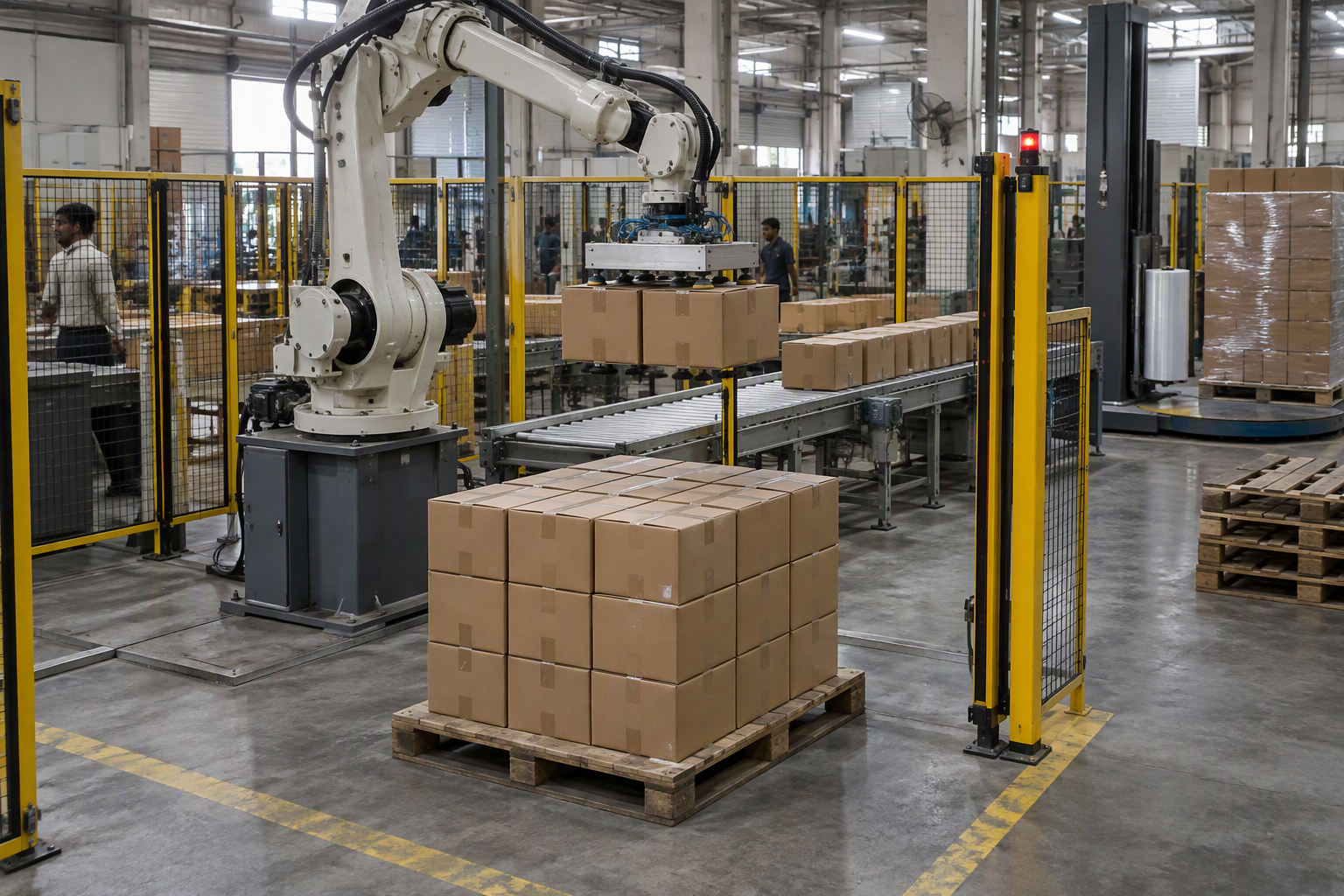
The practical limit is usually the infeed. A palletizer without an accumulation conveyor spends part of every cycle waiting for the next carton, and the waiting is invisible in the cycle-time calculation. Size the accumulation to hold at least one minute of line output.
The gripper decides more than the robot
A palletizer is only as good as its end effector. Vacuum cups suit cartons with flat, sealed tops and are the cheapest option; they fail on dusty or porous surfaces and on bags. Clamp grippers handle cases and drums but need side clearance. Fork-style tools pick trays and layer boards. Bag grippers pinch the top seam and are the least forgiving of variation in fill level.
Two rules save money. First, keep the gripper light — every kilogram of tool is a kilogram of product you cannot lift. Second, design it for the worst carton, not the average one: a crushed corner on the top layer is a customer complaint, not a robot fault. The wider options are covered in robot end effector types and vacuum gripper design.
Safety and the standards that apply
An industrial palletizer is a high-payload machine moving at speed, so it is guarded: perimeter fence, interlocked gate, light curtain or area scanner where operators approach, and a risk assessment that covers the whole cell — infeed, pallet dispenser, stretch wrapper and the gap between them. ISO 10218-1 and 10218-2 are the reference standards for industrial robot safety; collaborative applications add ISO/TS 15066. For a cobot, the fence can come down only after a documented risk assessment, not because the brochure says collaborative.
The safety devices are also throughput devices. A light curtain that stops the robot every time someone walks past costs cycles all day. Place the approach so that operators reach the pallet from outside the robot’s envelope wherever possible.
What drives the price
In a palletizing cell the arm is rarely the largest line. The infeed conveyor, accumulation, pallet dispenser, slip-sheet dispenser, stretch wrapper, guarding and integration together usually exceed the robot. That is why two quotes for “a palletizing robot” can differ by a factor of two while using the same arm. The line-item breakdown is in palletizing robot cost in India, and the wider line in end-of-line packaging automation.
Specifying a cell: the eight-line brief
- Carton or bag dimensions, mass and range — minimum and maximum, not the average.
- Pallet size and pattern, including mixed SKUs and slip sheets.
- Pallets per hour at peak, measured over a shift.
- Infeed type and buffer length.
- Pallet and slip-sheet supply method.
- Floor space, ceiling height and column positions.
- Operator access points and the guarding concept.
- Who owns maintenance, and what spares must be on site.
When not to automate
Below roughly two pallets an hour, with a wide and changing SKU mix, a lift-assist or a vacuum tube lifter is usually the better purchase. The same applies when packaging is unstable, when the line stops often, or when there is no floor space for the infeed buffer. A palletizer amplifies a steady process; it does not fix an unsteady one. If AGVs or AMRs are part of the plan, read AGV versus AMR before laying out the cell.
Frequently asked questions
How much weight can a palletizing robot lift?
Datasheet payloads range from about 5 kg for collaborative models to 315 kg and beyond for dedicated 4-axis machines. The usable product weight is the payload minus the gripper, with a 30 per cent margin for acceleration and off-centre loads. A 185 kg robot with a 45 kg gripper is realistically a 100 kg product machine.
How fast is a palletizing robot?
A 4-axis palletizer can complete a light carton cycle in roughly 5 to 8 seconds, which is 450 to 700 cycles an hour after realistic availability. The actual rate depends on the travel distance, the gripper, the infeed supply and how often the cell stops for pallet changes.
Can a cobot palletize?
Yes, for cartons up to about 10 to 16 kg at low rates. A cobot can work without a fence only after a documented risk assessment under ISO/TS 15066. Above those payloads or rates, a 4-axis industrial palletizer is faster and usually cheaper per pallet.
Do I need a conveyor with a palletizing robot?
Almost always. Without an accumulation conveyor the robot waits between cartons and the cell runs below its calculated rate. The buffer should hold at least one minute of line output so that short upstream stops do not stop the palletizer.
What does a palletizing cell cost in India?
The robot is only part of it. Infeed, gripper, pallet dispenser, guarding and integration usually add up to more than the arm. The itemised breakdown is in the palletizing robot cost guide linked above.
Sources
- FANUC, M-410iC/185 palletizing robot — 185 kg payload, 3,143 mm reach, 4 axes.
- RoboDK robot library, FANUC M-410iC/185 — kinematic data and application notes.
Related reading: palletizing robot cost in India · end-of-line packaging automation · warehouse automation costs · end effector types · robot safety standards.
A palletiser is one application of a general sequence. The industrial robotics index covers the payload, cycle-time, cell-layout and commissioning steps that surround it.