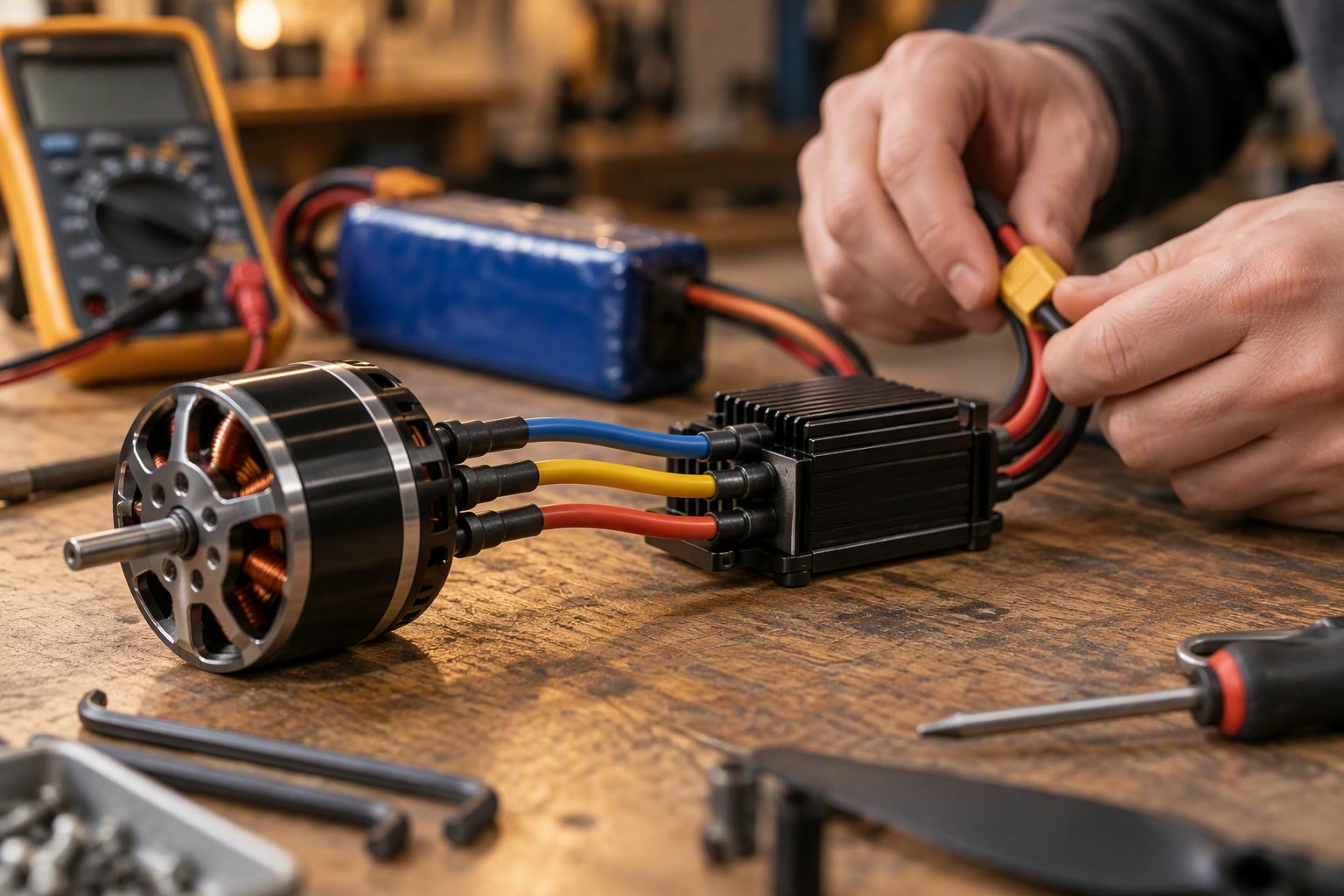
A BLDC motor is the right answer to a question most beginners ask too early. Brushless motors give high power for their weight, long life and good efficiency, which is why drones and serious mobile robots use them. They also need an electronic speed controller, correct voltage and a control signal that is nothing like the PWM you used for a hobby servo. Get those three wrong and the motor stutters, the ESC overheats, or both. This guide explains the numbers, the wiring and the cases where a brushed motor is still the better choice.
How a BLDC differs from a brushed motor
A brushed motor switches current mechanically through brushes and a commutator. A brushless motor moves that switching into electronics, using three phases and a controller that energises them in sequence. No brushes means less wear, better efficiency and more power per gram, but it also means the motor cannot spin without a driver. The ESC is not optional.
| Property | Brushed DC | Brushless DC |
|---|---|---|
| Wiring | Two wires | Three phases plus signal |
| Control | Voltage or PWM through an H-bridge | ESC with PWM, DShot or FOC |
| Life | Brushes wear out | Bearings are usually the limit |
| Efficiency | Moderate | High |
| Low-speed torque | Good with gearing | Needs gearing or FOC control |
| Cost for a small robot | Low | Higher, because of the ESC |
The numbers on the label
- KV is RPM per volt with no load. A 1000 KV motor on 12 V spins at roughly 12,000 RPM unloaded. Lower KV means more torque per amp and usually a larger propeller or slower wheel.
- Cell count sets voltage. A 3S lithium pack is nominally 11.1 V, 4S is 14.8 V and 6S is 22.2 V. The ESC must be rated for that voltage.
- Continuous current is the number that matters for the ESC. A motor that pulls 30 A at full throttle needs an ESC rated above 30 A with margin, not exactly 30 A.
- Peak current lasts a second or two. ESCs quote both; size for continuous and allow headroom for peaks.
- BEC is a small voltage regulator inside some ESCs that powers the receiver or controller. Do not rely on a cheap BEC to power a Raspberry Pi.
Sizing an ESC
Add up the worst-case current the motor can draw, then add 20–30%. That is your continuous ESC rating. Also check the voltage rating, the signal protocol and whether the ESC supports bidirectional operation if the robot needs reverse.
| Application | Typical motor | Battery | ESC guidance |
|---|---|---|---|
| Small drone | 2207, 2400 KV | 4S | 30–45 A, DShot capable |
| Robot drive wheel | 5065, 270 KV geared | 6S | 40–60 A, sensored or FOC preferred |
| Hoverboard hub motor | 6.5 inch, 350 W | 36 V | Dedicated controller board, not a hobby ESC |
| Camera gimbal | Small gimbal motor | 3S–4S | FOC driver, low current |
The control signal
Most hobby ESCs accept a PWM signal similar to a servo: about 1000 µs for zero throttle, 1500 µs for half and 2000 µs for full. Some need arming, where the ESC sees low throttle for a few seconds before it will spin. Racing ESCs use digital protocols such as DShot, which do not need calibration and are far more precise.
Here is the simplest safe test with an Arduino. Remove the propeller or lift the wheels off the ground before running it.
#include <Servo.h>

Servo esc;
const int ESC_PIN = 9;

void setup() {
  esc.attach(ESC_PIN, 1000, 2000);
  esc.writeMicroseconds(1000);   // arm at zero throttle
  delay(3000);
}

void loop() {
  for (int us = 1000; us <= 1200; us += 5) {
    esc.writeMicroseconds(us);
    delay(50);
  }
  delay(2000);
  esc.writeMicroseconds(1000);
  delay(3000);
}
Start with a narrow throttle range. If the motor stutters at low throttle, the ESC is not commutating cleanly at that speed, which is normal for sensorless ESCs. Sensorless control needs the motor to be spinning fast enough to estimate rotor position, so very low speeds are unreliable.
Wiring that does not fail
- Short, thick power wires. Long battery leads add inductance and voltage spikes. Keep them short and twisted where possible.
- Add a capacitor. Most ESCs expect a low-ESR capacitor across the power input. Use the value the manufacturer specifies and mount it close to the ESC.
- Common ground. The signal ground must connect to the controller ground. A missing ground causes erratic arming.
- Fuse the battery. A shorted ESC can draw hundreds of amps. A fuse or a properly rated breaker protects the pack and the wiring.
- Respect the voltage. A 4S-rated ESC on 6S fails, often spectacularly. Check before connecting.
- Secure the motor. A spinning BLDC with a loose mount becomes a projectile. Use threadlocker and check mounting screws.
When not to use a BLDC
- You need precise position at low speed. Use a stepper, a geared DC motor with an encoder, or a sensored FOC setup. A sensorless hobby ESC is a poor position controller.
- Budget is tight and the load is light. A geared brushed motor with an L298N or TB6612FNG is cheaper and easier for a first robot.
- You need holding torque with power off. BLDC motors do not hold position without a brake or closed-loop control.
- You cannot handle the safety risks. High-current lithium packs and spinning props deserve respect. If you are not confident, start with smaller brushed motors.
The upgrade path: FOC and closed loop
Field-oriented control drives the motor as a set of currents rather than a sequence of voltage steps. It gives smooth low-speed torque, quiet operation and accurate torque control, which is why robot arms and mobile bases increasingly use it. SimpleFOC is an open-source library that runs on common microcontrollers with a suitable driver board. It is more work than a hobby ESC, but it turns a BLDC into a proper servo-grade actuator.
If your robot needs to hold a position, accelerate smoothly and report its current, plan for FOC from the start. If it needs to spin a fan or drive a wheel at a rough speed, a hobby ESC is enough.
Related: servo vs DC motor vs stepper, motor selection, L298N vs TB6612FNG, robot battery guide, 12 V to 5 V converters.
What does KV mean on a BLDC motor?
KV is the unloaded speed per volt. A 1000 KV motor on 12 V spins at about 12,000 RPM with no load. Lower KV generally means more torque per amp and suits larger props or slower, geared wheels.
Do I need an ESC for a brushless motor?
Yes. A BLDC cannot run directly from a battery because the controller must switch the three phases in sequence. The ESC also sets the speed and handles commutation.
How do I choose the ESC current rating?
Estimate the motor's maximum continuous current, then add 20–30% headroom. Also match the ESC voltage rating to your battery and check whether it supports the signal protocol and reverse operation you need.
Why does my BLDC stutter at low throttle?
Sensorless ESCs need the motor to spin fast enough to estimate rotor position. At very low throttle, commutation becomes unreliable. Use a sensored or FOC driver if you need smooth low-speed control.
Can I use a BLDC motor for a robot arm?
Yes, but use a sensored FOC driver with an encoder, not a hobby ESC. Hobby ESCs are speed controllers, not position controllers, and cannot hold a joint angle accurately.
The same motor and ESC choices appear in the drone build guide.
A BLDC usually needs a reduction stage, so read the gearbox comparison before sizing the drive.
An ESC is not a servo drive; the servo drive selection guide explains the difference in closed-loop control.
Many BLDC controllers accept commands over CAN, and the CAN bus guide explains the wiring and message design behind them.
Sources and further reading
- SimpleFOC documentation — open-source field-oriented control for BLDC motors.
- Arduino Servo library — generating the PWM signal many ESCs accept.
- Texas Instruments BLDC drivers — driver topologies and application notes.
- NXP motor control — reference designs for sensorless and sensored control.