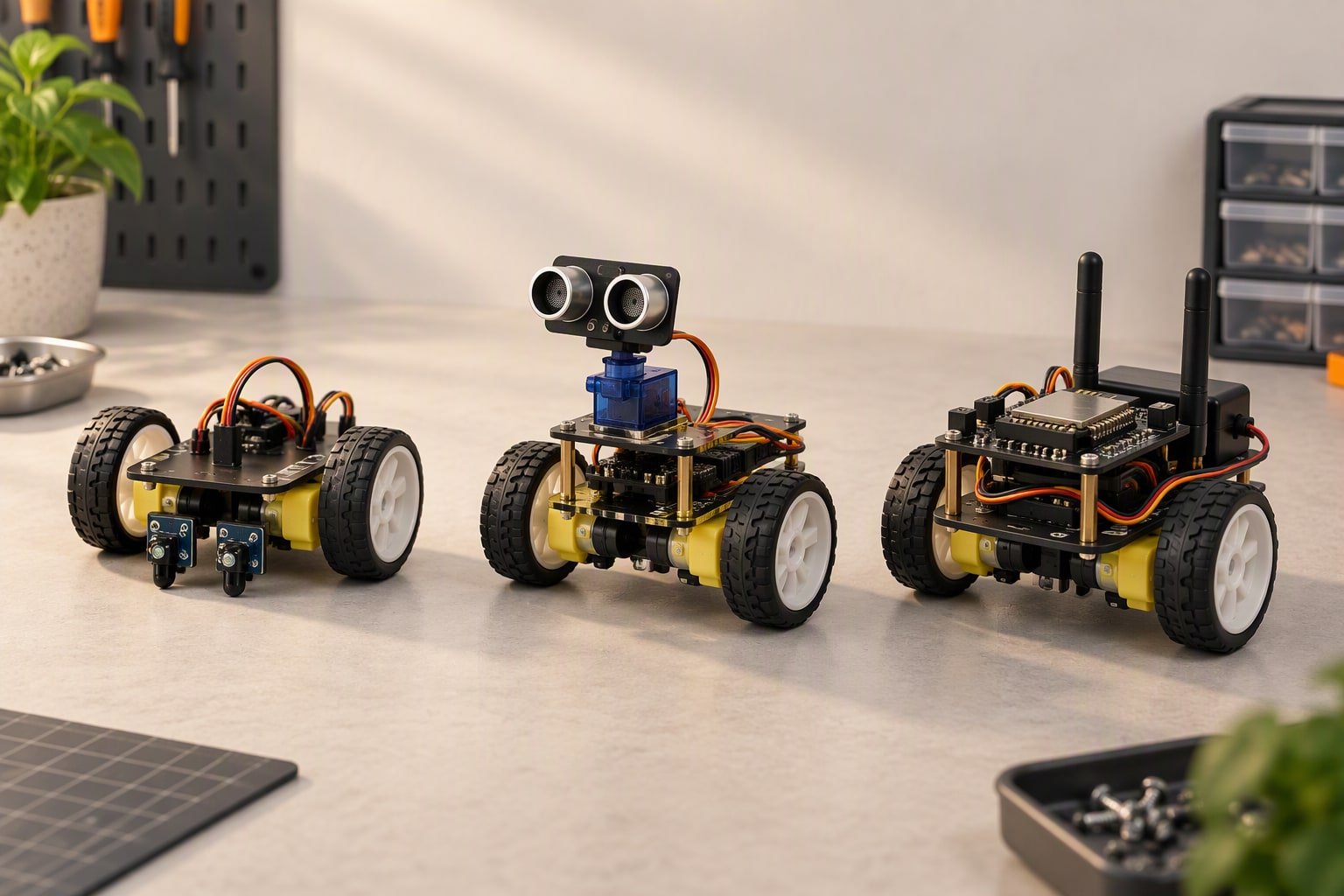
You can build a working robot in India for under ₹2,000 if you spend the money on the parts that touch the floor and save it on the parts that only hold a label. Here are three builds that fit the budget, with rupee bills of materials, honest limits and the costs the listings leave out. Every build below shows how to get a robot under ₹2,000 without cutting the parts that matter.
All three use a clone Arduino Nano or Uno, AA or 18650 power and a cheap chassis. None of them includes tools, shipping or a charger. Those are real costs, and pretending otherwise is how a ₹1,500 plan becomes a ₹3,000 bill.
Build 1: line follower — ₹1,240
| Part | Qty | Unit | Total |
|---|---|---|---|
| Arduino Nano clone | 1 | ₹350 | ₹350 |
| L298N motor driver | 1 | ₹180 | ₹180 |
| TT gear motors with wheels | 1 pair | ₹260 | ₹260 |
| IR sensor modules | 2 | ₹75 | ₹150 |
| 2WD acrylic chassis | 1 | ₹150 | ₹150 |
| Battery holder and switch | 1 | ₹80 | ₹80 |
| Jumper wires and screws | — | ₹70 | ₹70 |
The full wiring, calibration sketch and test plan are in the line follower build sheet. The important limitation is the sensor: a cheap IR module sees a contrast difference, not a line. Black tape on a light floor works; a dark carpet with a shadow does not. Calibrate both sensors over the actual surface before you tune the code.
Build 2: obstacle avoider — ₹1,760
| Part | Qty | Unit | Total |
|---|---|---|---|
| Arduino Nano clone | 1 | ₹350 | ₹350 |
| L298N motor driver | 1 | ₹180 | ₹180 |
| TT gear motors with wheels | 1 pair | ₹260 | ₹260 |
| HC-SR04 ultrasonic sensor | 1 | ₹110 | ₹110 |
| SG90 servo | 1 | ₹180 | ₹180 |
| 2WD chassis | 1 | ₹150 | ₹150 |
| 5 V 2 A buck converter | 1 | ₹220 | ₹220 |
| Battery holder, switch, wires | — | ₹310 | ₹310 |
The buck converter is not optional if you want the servo to scan without resetting the Nano. It gives the servo a stable 5 V rail while the motors run from the battery. The obstacle avoider build sheet has the full sketch and a failure table. Expect the robot to misread soft chairs and thin table legs; that is a property of the sensor, not a bug you can fix in code.
Build 3: ESP32 Wi-Fi car — ₹1,520
| Part | Qty | Unit | Total |
|---|---|---|---|
| ESP32 DevKit V1 | 1 | ₹420 | ₹420 |
| L298N motor driver | 1 | ₹180 | ₹180 |
| TT gear motors with wheels | 1 pair | ₹260 | ₹260 |
| 2WD chassis | 1 | ₹150 | ₹150 |
| 5 V 3 A buck converter | 1 | ₹220 | ₹220 |
| Battery holder and switch | 1 | ₹80 | ₹80 |
| Wires, screws, capacitor | — | ₹210 | ₹210 |
This is the most capable of the three because the ESP32 serves a small web page and controls the motors from the same board. The build sheet in the ESP32 robot car guide includes the full web server sketch and the access-point fallback. The limit is power: Espressif module datasheets ask for a supply that can deliver at least 500 mA, because the Wi-Fi radio draws short bursts of a few hundred milliamps on top of a much lower average. A weak battery or a thin USB cable will cause resets that look like software faults.
Where not to save money on a robot under ₹2,000
- The battery holder and switch. A loose holder causes intermittent resets that waste an evening. Solder the leads or use a proper connector.
- The buck converter for servos or an ESP32. A ₹80 linear regulator that overheats is not a saving. A 2 A buck is ₹200–₹250 and removes a class of faults.
- A spare motor driver. A shorted L298N is hard to diagnose without a known-good replacement. A spare is ₹180.
- Decent jumper wires. The ribbon of super-thin dupont wires that comes with a kit breaks at the crimp. Buy a small set of 24 AWG wires or use soldered connections for the power path.
Where the budget can be cut
- Chassis: a cardboard or 3D-printed plate works for a first prototype if the motors are mounted rigidly.
- Motor driver: a TB6612FNG module costs more but wastes less voltage; if you already own an L298N, use it.
- Servo: skip the scanning servo on the obstacle avoider and use a fixed sensor; you lose side detection but save ₹180.
- Arduino: a Nano clone is enough. Do not buy a genuine Uno for a robot that might drive off a table.
The costs the bill of materials hides
Add batteries, a charger, shipping from two or three sellers, and the tools you may not own yet: a multimeter, a soldering iron, wire strippers and a small screwdriver set. Those tools last for years and should not be charged to one project, but a first build needs them. A realistic first-project envelope is ₹2,500–₹3,500 including tools and power, even when the robot’s parts total ₹1,500.
What is the cheapest robot I can build that actually works?
The ₹1,240 line follower is the cheapest of the three, but it needs a suitable floor and calibrated sensors. The ₹1,760 obstacle avoider is more forgiving of its environment.
Can I use a 9 V battery?
Not for motors. A 9 V alkaline battery has very little current capacity and will sag immediately. Use 4×AA NiMH or a 2S 18650 pack.
Do these prices include shipping?
No. Shipping, batteries, a charger and tools are excluded. Two sellers can add ₹200–₹400.
Which build is best for a college submission?
The obstacle avoider, because it has a visible behaviour and a clear test plan. The line follower is simpler to demo but needs a prepared track.
Related: line follower build, obstacle avoider build, ESP32 car build, project cost calculator.
Keep reading
- Robotics starter kit in India — What a kit should contain before you spend on one.
- Servo buying guide — Which servo copies to avoid at this budget.
- L298N vs TB6612FNG — The driver upgrade that is worth the extra hundred rupees.
- How to power a robot — Stop the brownout resets that end a cheap build early.
- What is robotics? — The sense-decide-act loop, costs and career paths in India.
The chassis decides which wheels and motors will fit: the robot chassis buying guide covers sizes, materials and mounts in rupee terms.
Sources and further reading
Documents used to check the numbers on this page:
- TI L293D datasheet page — a comparable dual H-bridge for current and drop-out numbers.
- Pololu brushed DC motor driver comparison — drop-out voltage and current.
- Arduino Nano documentation — pinout and current limits.
Last reviewed: October 2026. Prices are illustrative planning figures for common modules, not current listings, and change with seller and stock. A spot check found the HC-SR04 at about ₹100 and the SG90 servo at about ₹110 at Indian sellers, so some lines here may be high; check current listings before ordering. Bills of materials exclude shipping, batteries and tools.
Newer builds and guides
- How to make a robot at home — A ₹1,500 first build with parts, wiring and the common mistakes.
- Arduino projects for beginners in India — Twelve beginner projects with rupee costs, ranked by difficulty.