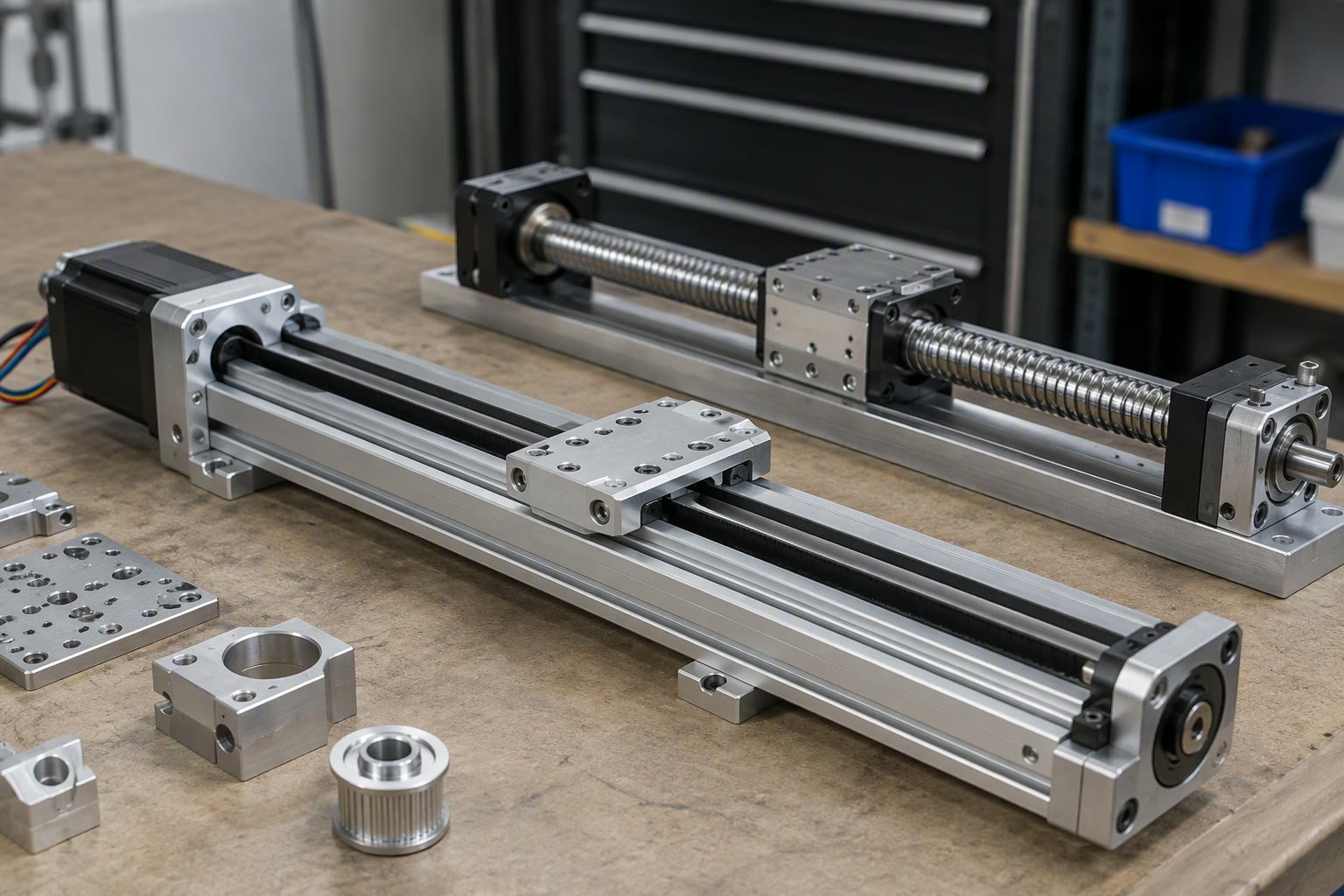
A linear actuator is what you buy when a rotating motor plus a linkage stops being the sensible answer. For a robot arm, rotary joints are compact and efficient. For a gantry, a lift, a sliding gripper or a camera rail, moving in a straight line with a belt, screw or rack is simpler and often cheaper.
This guide compares the main linear drive families, explains how to size thrust and speed, lists indicative 2026 prices in India, and covers the mistakes that turn a rigid axis into a vibrating one.
The four families
| Type | How it moves | Strengths | Weaknesses |
|---|---|---|---|
| Belt-driven | Timing belt between two pulleys | Fast, long strokes, low cost | Stretch and backlash; lower thrust |
| Ball screw | Recirculating balls in a nut | High thrust, efficient, precise | Cost; needs protection from dust |
| Lead screw | Sliding thread, often trapezoidal | Cheap, self-locking, high force at low speed | Friction, wear, lower efficiency |
| Rack and pinion | Gear teeth on a rail | Very long strokes, robust | Backlash, lubrication, noise |
Linear motors exist too, and they are excellent for high acceleration and zero backlash. They are also expensive and need a knowledgeable integrator, which puts them outside most first projects in India.
Size thrust before speed
Start with the force needed to move the load: the weight component along the axis, friction in the guides, and the force needed to accelerate. Add a safety factor of at least 1.5, more if the load is unbalanced or the machine is exposed to shock.
Then check speed. A ball screw with a fine pitch gives high thrust at low speed; a belt gives high speed at modest thrust. The product of the two is limited by motor power, so a small motor cannot deliver both.
Duty cycle matters as much as peak force. An actuator rated for 30% duty will overheat in a machine that runs continuously. Check the thermal rating, not just the catalogue thrust.
Belt, screw or rack: a quick decision
- Choose belt for strokes over a metre, speeds above 0.5 m/s, and loads under roughly 20 kg.
- Choose ball screw for precise positioning, vertical loads, and thrust above a few hundred newtons.
- Choose lead screw for low-cost, slow, self-locking motion such as a lab lift or a clamp.
- Choose rack and pinion for very long travel, such as a gantry on a wall or a large CNC axis.
What it costs in India
Indicative 2026 ranges, before GST. Prices depend heavily on stroke length, rail size and brand.
| Item | Indicative range | Comment |
|---|---|---|
| Belt actuator, 500 mm stroke | ₹8,000–25,000 | Extruded frame, NEMA 17 or 23 mount |
| Ball screw actuator, 300 mm | ₹15,000–45,000 | Precision ground screws cost more |
| Lead screw slide, 200 mm | ₹4,000–15,000 | Good for slow, light motion |
| Linear rail, 500 mm | ₹3,000–12,000 | Pair with carriage; brand matters for preload |
| NEMA 23 stepper and driver | ₹3,500–9,000 | Open loop; fine for many axes |
| Closed-loop stepper or servo | ₹9,000–30,000 | Better for vertical or high-duty axes |
| Linear actuator with built-in controller | ₹12,000–60,000 | Simpler wiring, less flexibility |
A single belt axis with a stepper, driver and limit switches can be built for ₹15,000–30,000. A precision ball-screw axis with a servo costs several times that before the frame and machining.
Backlash, repeatability and stiffness
Backlash is lost motion when the direction reverses. A belt stretches, a lead screw wears, and a rack has tooth clearance. For a 3D printer, a few tenths of a millimetre may be acceptable. For a pick-and-place axis that must stop within 0.1 mm, it is not.
Stiffness is the other half. A long unsupported rail deflects under load, and a thin extrusion twists. If the tool vibrates at the end of a 1 m stroke, the problem is mechanical, not the motor tuning.
Mounting rules that save rework
- Support both ends of a screw or belt axis. Cantilevered mounts flex.
- Align rails before tightening. A twisted frame binds the carriage and wears the bearings.
- Keep the load centred over the carriage. Offset loads create a moment that the bearings must resist.
- Add hard stops and limit switches. Software limits fail; mechanical stops should not.
- Route cables with a drag chain. A cable that snags will eventually break the axis or the connector.
When rotary motion is better
If the motion is short and the force is high, a rotary motor with a crank or linkage can be lighter and cheaper than a linear actuator. If the axis must rotate as well as translate, a robot arm or a rotary table may be the better architecture. Linear actuators are at their best when the path is genuinely straight and the stroke is long relative to the mechanism.
Related: motor selection, stepper motors with Arduino, BLDC motors and ESCs, robot chassis buying guide, robot vision cameras.
What is a linear actuator used for in robotics?
Linear actuators move a load in a straight line: gantries, lifts, sliding grippers, camera rails and conveyor diverters. They replace a rotary motor plus linkage when the path must be straight.
Should I use a belt or ball screw actuator?
Use a belt for long strokes and higher speeds at moderate thrust. Use a ball screw for precise positioning, vertical loads and higher thrust.
How do I size a linear actuator?
Calculate the force to move the load, friction and acceleration, then apply a safety factor of at least 1.5. Check speed and duty cycle against the motor and actuator thermal ratings.
What causes backlash in a linear axis?
Belt stretch, lead screw wear, rack tooth clearance and coupling play. Preloaded ball screws and tensioned belts reduce it, but no mechanical axis is perfectly backlash-free.
Can I build a linear axis for a robot project?
Yes. A belt actuator, stepper, driver and limit switches can be assembled for ₹15,000–30,000. Precision and stiffness depend on the frame and rail quality.
For the rotary and linear electric options in detail, see hydraulic vs pneumatic vs electric actuators.
Most linear actuators are a motor plus a screw or belt and a gearbox; see planetary vs spur for the reduction choice.
Sources and further reading
- HIWIN — linear guide and ball screw technical data.
- Thomson Linear — actuator sizing and life calculation guidance.
- igus India — drylin linear guides and belt axes with published load data.
- NEMA — motor mounting standards referenced by actuator manufacturers.