The cell is running, the acceptance sheet is signed, and the purchase order is closed. Nobody has yet bought a spare.
That is normal. A robot is quoted, bought and financed as a machine; spares are the first cost that belongs to operation, which is why they are usually discovered on the night a cable fails at 2 am.
This is the framework for what sits on your shelf, what a distributor holds, and what you accept as risk. The robot is already chosen — how to choose an industrial robot is a separate decision.
A spare part is a downtime decision wearing a price tag
Every part has two numbers: what it costs, and how long the cell is stopped without it. The stock decision compares the first against the second, and most plants only ever look at the first.
Three inputs settle it: door-to-door time to your stores, the cost of a stopped hour in lost contribution and idle labour, and whether the cell can run degraded while you wait.
If recovery takes longer than the cell can tolerate, stock the part or contract someone who does — the integrator you selected may already hold it. If recovery is shorter, buy on failure and keep the cash. A shelf of untouched parts is waste; a lean shelf that stops a line for ten days is worse.
What actually fails, and why no rate is quoted
There is no public failure-rate dataset for Indian robot cells that you can build a stock list from, and any supplier quoting one is quoting a brochure. Ask your integrator for field data on your model and duty cycle.
General industry practice shows a split between cheap parts that fail often and expensive parts that fail rarely but stop everything:
- Dress-pack cables. Continuous flexing at wrist and elbow is the classic repeat failure; the fault appears at one pose and tests clean at another.
- Encoder and controller batteries. Cheap and scheduled, until a lost position needs remastering.
- Controller fans, filters and power supplies. A dusty plant eats filters, and a failed fan takes the drive with it in May.
- Servo drives, motors and reducers. Uncommon, expensive, rarely stocked in your rating; the reducer is the least frequent failure and the longest recovery, measured in weeks.
- Teach pendant cable. Abused daily; the pendant itself is dropped annually.
- Gripper and end effector. Jaws, cups, sensors and seals stop the cell more often than the robot does.
The pattern is consistent: the arm is reliable, the cell around it is not. One FANUC service partner’s published schedule runs a 3,850-hour service covering grease and batteries, axis grease at three years, and controller batteries and cables at four. Your manual will differ; the shape will not.
Three tiers: on the shelf, in the city, on another continent
Classify every part into a tier and write the tier down. The classification is the plan; the purchase order is its consequence.
Tier A sits in your stores and the cell is back in hours. Tier B is held by your integrator or an authorised distributor in India, and you accept one to three days. Tier C is imported against order, and you accept weeks.
Ask the distributor for stock position in writing. “We keep it” is not a lead time, and regional stock is often one unit already promised to another plant.
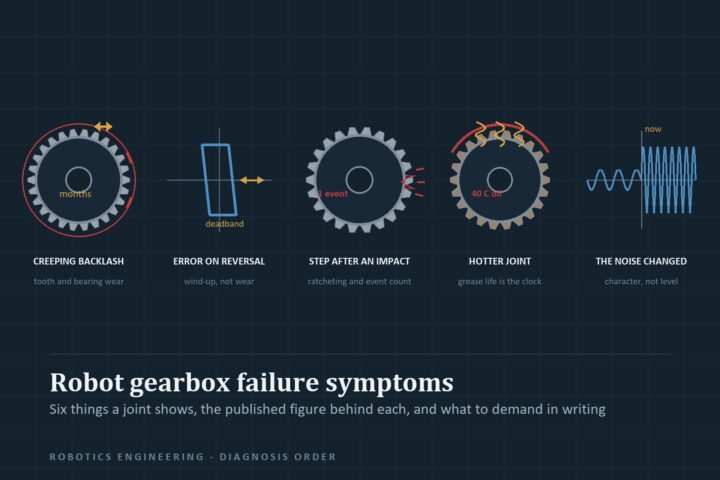
Before you buy the spare, confirm the failure. Robot gearbox failure symptoms separates the wear that needs a unit from the wind-up, misalignment or encoder fault that does not, and flags the warranty triggers a third-party strip can pull.
| Part class | How it shows up | Hold on site | Lead-time risk |
|---|---|---|---|
| Dress pack and axis cables | Intermittent fault at one pose, then a dead axis | Yes, one set | Medium: days locally, weeks if built to order |
| Encoder battery | Battery alarm, then position loss | Yes, one per robot | Low cost, high consequence |
| Teach pendant cable | Dead keys, no enable signal | Yes | Low to medium |
| Servo drive or amplifier | Axis fault, overcurrent, not ready | One rating, after six months | High: model-specific, imported |
| Servo motor | Overheat, brake drag, position error | Critical axis only | High |
| Reducer or gearbox | Backlash, noise, grease weep | No | Very high: weeks, plus a crane |
| Fan, filter, power supply | Over-temperature, random reboots | Yes | Low |
| Safety switch, scanner, relay | Cell will not reset, silent stop | One actuator, one switch | Low to medium |
| Gripper wear parts | Part slip, missed pick, reject | Two-bin kit | Low, but the most frequent stop |
| Process consumables | Weld quality, wheel wear, torch faults | Yes, by consumption | Low: the risk is running out |
The lead-time stack nobody writes into the quotation
An imported spare is not one wait but four: the OEM’s order processing, the freight, the customs entry and the inland leg. Only the total matters to production.
Order processing is usually days, and air freight into an Indian gateway takes a few days. Clearance takes a day or two when invoice, classification and value are clean, and longer when any of them is queried. Inland transport is another one to three days. Sea freight is four to seven weeks door to door for a fraction of the freight cost. These are planning ranges from general practice, not a service commitment, so ask for door-to-door in writing.
Then price the gap. A stopped cell costing ₹20,000 an hour in lost contribution is ₹48,00,000 over ten days. Against that, a ₹1,50,000 drive module stops being a purchasing argument. Use your own numbers, before the failure rather than during it.
Who you buy through changes the stack. If the OEM sells only through a distributor, your lead time includes their order cycle and your price includes their margin and the duty.
The consumables that appear in no datasheet
Half the short stops come from items too cheap for a spares list: cable ties, spiral wrap, bellows, push-fittings and tube, threadlocker, dowel pins, gaskets, filter media, desiccant, switch actuators and gate locks.
Add the process side: torch tips, nozzles, liners and anti-spatter; grinding wheels; vacuum cups, jaw blanks and proximity sensors; the pendant overlay and lanyard, which fail long before the pendant does.
Run these as a two-bin kanban owned by the shift supervisor. A stores requisition for a ₹40 cable tie is how a two-hour stop becomes six. The scheduled work — grease, filters, battery checks — belongs in the robot maintenance checklist.
Customs, currency and warranty: the paperwork that decides the week
Industrial robots sit at HS 8479 50 and their parts at 8479 90, but a motor, gearbox or drive may fall under its own heading, and the heading decides the duty. Settle classification before you order, with the function and part number on the proforma invoice, and get your CHA’s view in writing. Rates and notifications change; confirm current rates with your CHA or finance team.
Currency is the second exposure. A euro invoice paid sixty days later is a currency position before it is a spare part. Cover scheduled purchases forward through your AD bank, and expect the emergency purchase to settle at the worst rate of the year. Under the RBI’s import directions, remittances are to be completed within six months of shipment; the direction was amended in January 2026, so confirm the current text with your bank.
Warranty is the third. Write down whether replacement ships before the failed unit returns, who pays air freight each way, and what entry a no-charge replacement needs — a free part is still an import. Warranty covers the part, not the downtime.
Build the list from the history you are about to create
Year one is a survey. Log every stoppage with date, cell state, fault code, symptom, part replaced, hours to restore and whether the part was on the shelf. Photograph every nameplate and record the serial against the axis, because the wrong rating is a common ordering error.
Review at months three, six and twelve, ranked by downtime hours rather than failure count. A ₹2,000 sensor that stops the cell for an hour outranks a fan changed during lunch. Promote repeat offenders to Tier A and demote what you never touched.
A first-year spares budget worksheet
For a single six-axis cell of 10–20 kg payload, the worksheet below is a structure, not a shopping list. The figures are illustrative planning ranges in rupees, not quotations.
| Line item | Illustrative range | When to buy | Why |
|---|---|---|---|
| Consumables, two-bin stock | ₹30,000–₹80,000 | Before ramp-up | Consumption is unknown in year one |
| Dress pack or axis cable set | ₹40,000–₹1,20,000 | Before ramp-up | Repeat failure, long lead time |
| Encoder batteries and backup media | ₹4,000–₹12,000 | Before ramp-up | Cheap, with a costly miss |
| Teach pendant cable | ₹15,000–₹40,000 | Before ramp-up | Handled daily, fails early |
| Gripper and end effector wear kit | ₹20,000–₹60,000 | Before ramp-up | Frequent short stops |
| Sensors, safety switch, relay | ₹15,000–₹40,000 | Before ramp-up | Cell-stopping and locally available |
| Freight, customs and clearing | ₹15,000–₹40,000 | Reserve | Costs land on top of part price |
| Core kit total | ₹1,40,000–₹3,90,000 | Before ramp-up | Excludes the two rows below |
| Servo drive, one common rating | ₹60,000–₹1,80,000 | Month six decision | Model-specific and imported |
| Servo motor, one critical axis | ₹50,000–₹1,50,000 | Month six decision | Buy on history, not on fear |
The core kit is about ₹1.4–3.9 lakh; adding a drive and a motor takes it to ₹2.5–7.2 lakh. That is stock, not annual spend, which is why the industrial robot cost guide asks about local spares stock and lead time before you sign. If the cell is leased, read the contract first: lease versus buy decides who owns the consumables obligation.
Frequently asked questions
How many spare parts should a plant hold for one industrial robot?
Enough to cover failures that stop the cell longer than you can tolerate. In practice that is a cable set, encoder batteries, a pendant cable, gripper wear parts and common sensors, with a drive and a motor bought only after six months of history.
How long does importing a robot spare part into India take?
Plan in weeks. Order processing, air freight, clearance and inland transport typically add up to one to three weeks by air, and sea freight takes four to seven weeks.
Is it worth stocking a spare servo motor?
Only for the axis your history shows as critical, or where the cell has no manual fallback. A motor is a large sum against an uncommon failure, and a distributor may hold the rating. Confirm that in writing before deciding not to stock it.
Who pays freight on a warranty replacement part?
Whichever party the warranty document says, which is why the document matters more than the duration. Ask for advance replacement, stated freight responsibility each way and the RMA procedure before you sign acceptance.
Can we use refurbished or third-party spares?
Yes, for many mechanical and electronic items, provided provenance and calibration are documented. The risk is a part that fits but is not the same revision. The used industrial robot guide covers older models whose OEM support is thinning.
How often should the spares list be reviewed?
At months three, six and twelve, then annually. Rank by downtime hours rather than failure count, and move parts between the shelf, the distributor and the import tier as the evidence changes.
Sources and further reading
- International Federation of Robotics — World Robotics 2025 press release, India at 9,100 installations in 2024, sixth worldwide
- Reserve Bank of India — Master Direction on Import of Goods and Services, the six-month settlement rule
- Robots Done Right — preventive maintenance for FANUC robots, a service partner’s maintenance calendar
- Tariffnumber — HS heading 8479, showing 8479 50 for industrial robots and 8479 90 for parts