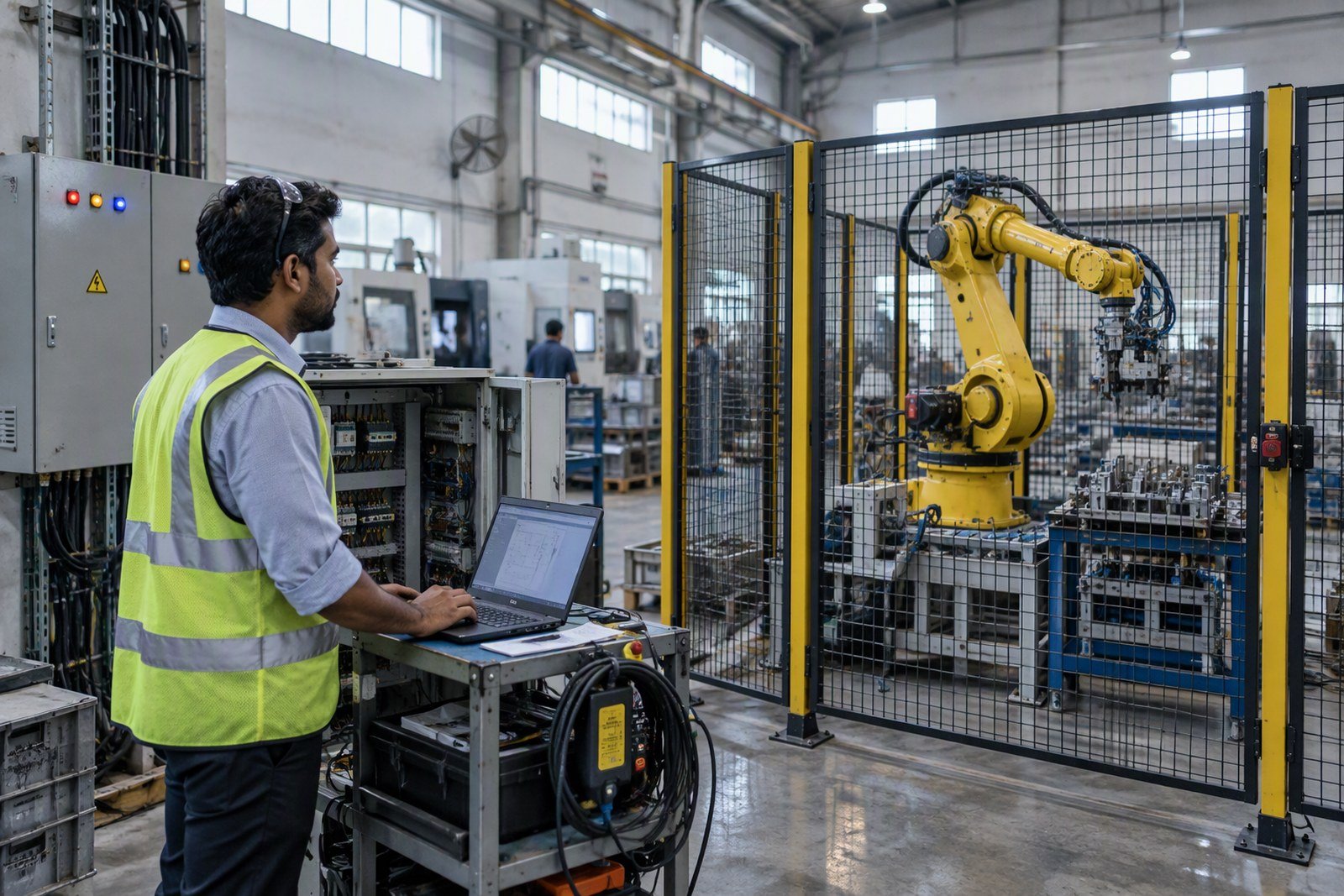
You have the approval, the part family and a budget line. What you lack is a way to tell, from a quotation, whether the firm in front of you will deliver a cell that runs two shifts or a robot that stands still while everyone argues about the conveyor.
An integrator turns an arm and a gripper into a working cell: risk assessment, design, guarding, controls, programming, commissioning and the paperwork that makes it lawful to run. A reseller sells the same arm. Both quote the same number; only one carries the integration risk afterwards.
Picking the arm is a separate decision, covered in how to choose an industrial robot for the process. This is the question set for the firm that builds around it.
Integrator, reseller and machine builder are different businesses
In India one firm often does all three: a systems house may be a dealer for one brand, an integrator for another and an OEM for a third. The question is which business you are contracting, and who will be on your floor in week six of commissioning.
- Reseller. Supplies arm and controller, arranges installation, rarely owns the safety file.
- Integrator. Owns cell design, risk assessment and acceptance, and warrants the cell as a system.
- Machine builder. Supplies a special-purpose machine with a robot inside it, so the interfaces change.
Ask for the legal entity name, GSTIN and the office the project manager works from. A dealer’s letterhead carrying an integrator’s scope is a warning: establish who invoices, who signs acceptance and who you would pursue if the cell never works.
The International Federation of Robotics counted 9,100 industrial robot installations in India in 2024, up 7% on the year before and sixth worldwide. Across every industry, that is a thin base of repeat experience. Assume your cell is close to a one-off.
The scope document decides the project; the quotation only decides the price
A quotation is a price against a list. A scope is a boundary. Insist on a one-page “we supply / you supply” matrix, because every ambiguity becomes a variation order in the week you need production. The scope should state, with numbers wherever a number exists:
- Part family and variants, incoming condition and presentation.
- Cycle time with its assumptions: payload, gripper, operator, upstream buffer.
- Upstream and downstream interfaces, and who owns each handshake signal.
- Utilities you provide: power, compressed air at a stated pressure and dew point, network drops.
- Civil work, guarding, safety functions and the performance level the circuits are designed to.
- Controls architecture, documentation, training, spares, acceptance test, exclusions.
The controls boundary is where many SME cells go wrong. If your PLC sequences the cell and the robot is a slave, the integrator needs your controls engineer from day one. Settle the split between a robot controller and the cell PLC before a panel is built.
Safety sits on the same line. The Occupational Safety, Health and Working Conditions Code, 2020 has been in force since 21 November 2025 in place of the Factories Act. It puts the general duty to keep the workplace safe on the occupier, along with a duty to fence dangerous machinery; a supplier carries separate duties under the Code. The integrator’s safety file supports your compliance but does not transfer it.
References you can actually call
Every integrator has a reference list. Few have references that answer the phone during a shift. Ask for three cells on the same application, in India, commissioned in the last 24 months, and for the plant’s number, not the account manager’s.
When you call, do not ask whether they are happy. Ask what was late, what broke in the first six months, who paid to fix it, and whether they would sign the same contract again.
| Area | What to ask | Good answer | Bad answer |
|---|---|---|---|
| References | Which plant can I call? | Three named plants, same application, direct numbers | “We have done many”; contact through sales |
| Work split | What is subcontracted, and who warrants it? | Named subcontractors, one contract, integrator warrants all of it | “Everything in-house” |
| Safety file | Show a validation record from a delivered cell | Risk assessment, guard drawings, performance level justified | “As per ISO”, with nothing to show |
| Warranty | When does it start, and what is the response time? | From site acceptance, 12 months, stated on-site response | From dispatch, “best effort” |
What is built in-house and what is subcontracted
Every integrator subcontracts something: fabrication, panel wiring, machining, rigging, sometimes safety validation or vision. That is normal. Undisclosed subcontracting is not.
Ask for the split by task and by value, then who supervises each subcontractor and who warrants it to you. If three vendors each warrant their own piece, you are the integrator.
If the workshop is within a day’s travel, visit it. Look for a panel build area and a test bay where cells run before dispatch. A firm with no test bay will commission your cell for the first time at your plant, on your production time.
Acceptance criteria: define “done” before you order
Two gates, both written into the contract with numbers: factory acceptance at the integrator’s works, site acceptance at yours. Factory acceptance should use production parts and the gripper you will actually run: cycle time measured over a stated number of consecutive cycles from a defined trigger, a runoff of a stated quantity with the defect count recorded, every safety function demonstrated with measured stopping performance.
Site acceptance repeats this at your line rate with your operators and re-validates the safety functions where they were installed.
Define the measurements or the numbers will be argued. “Cycle time” means nothing without a start point, an end point and a settling allowance. You are buying cell performance, not a datasheet figure.
The 2025 editions of ISO 10218-1 and ISO 10218-2 are the reference for the cell, and they incorporate the collaborative-application requirements previously published as ISO/TS 15066. Confirm the edition your integrator works to; the wider duties are in the robot safety standards that apply in India.
Then write the remedy: a retest window and liquidated damages per week of delay. Section 74 of the Indian Contract Act 1872 limits recovery to reasonable compensation, so keep the figure genuine.
Payment stages: release money against evidence
A payment schedule is a risk allocation. Each instalment should buy something you can inspect before the money moves.
If the integrator needs cash for a long-lead robot, pay that advance against the OEM’s proforma invoice and order acknowledgement, so you can see the machine was ordered.
| Stage | In hand before you pay | Document you sign | Illustrative share |
|---|---|---|---|
| Order | Signed scope, concept layout, OEM order acknowledgement | Purchase order and scope annexure | 10–15% |
| Design freeze | GA drawings, schematics, safety concept, comments closed | Design sign-off | 20–25% |
| Factory acceptance | FAT report with cycle time and runoff result | FAT certificate | 25–30% |
| Installation | Machine on site, mechanical and electrical work complete | Installation receipt | 10–15% |
| Site acceptance | SAT report, validation in situ, training records | SAT certificate | 15–20% |
| Retention | 30 to 90 days running at the agreed rate | Release or guarantee return | 5–10% |
Those shares are illustrative, not a market norm. Hold retention until the cell has run a full production cycle.
In this example, a two-shift machine-tending cell is contracted at ₹30,00,000. A 10 per cent advance is ₹3,00,000 and a 10 per cent retention is ₹3,00,000 held for 60 days past acceptance: arithmetic on a stated example, not a quotation. The industrial robot cost guide for India covers what drives the total; leasing rather than buying the robot changes who owns the asset, not the integration risk.
Warranty, spares and handover
There are three warranties, not one: the robot OEM’s, the integrator’s workmanship, any component supplier’s. Get each in writing with its own start date; the integrator’s should start at site acceptance, never dispatch or invoice.
Define response, not just duration: who answers, how fast remotely and on site, and what happens when the fix needs a part that is not in India. A twelve-month warranty with a ten-day response is worth less than one with a 48-hour commitment and a stocked spares kit.
The handover pack separates an asset from a dependency. It should contain:
- As-built drawings and schematics, marked with the revision actually built.
- Risk assessment, guard drawings and validation records, including the performance level achieved.
- Robot and PLC program backups, with licences registered in your name and source access agreed in the contract.
- IO list, spares list with OEM part numbers, manuals and training records.
Build the routine from the robot maintenance checklist in week one, and log every stoppage for the first month with a reason code. The pattern tells you whether you have a design problem or a training problem.
Red flags in an Indian robot quotation
- One line item for the whole cell. You cannot compare quotes or value a variation.
- “Or equivalent” against the robot model. You are entitled to a specific model and controller.
- A cycle time with no assumptions. Payload, gripper and presentation move the number.
- “Safety as per standards” with no documents. No risk assessment, no performance level, no guard drawing.
- Full payment before dispatch. You carry the delivery risk and hold no leverage.
- Warranty from dispatch or invoice. Your cell may sit for weeks waiting for power.
- No acceptance test clause. “Commissioning” without a test sheet and a signature is an opinion.
- An exclusion annexure longer than the scope. Guarding, air, cabling and training move to your side.
Integrators hire mechanical people for fixtures, GD&T and BOMs, then expect the controls to be learned on site. Which study route buys that fastest depends on your branch, and the mechanical case is worked through separately, with published eligibility rules and fee tables rather than promises.
Frequently asked questions
How do I check whether a robot integrator in India is genuine?
Verify the legal entity, GSTIN and years in operation, then verify the work: three plants you can call, a cell you can visit, a safety file you can read.
Should I buy the robot directly from the OEM and appoint the integrator separately?
Sometimes. Buying the arm yourself can win a better price and a clearer warranty, but it splits responsibility: when the cell underperforms, the OEM blames the integration and the integrator blames the machine.
What advance is normal for a robot cell in India?
There is no norm worth relying on. What matters is that each payment buys an inspectable deliverable. Ten to fifteen per cent at order is reasonable; half the value before design freeze deserves a bank guarantee.
Who is responsible for safety compliance, me or the integrator?
You are, as the occupier. The Occupational Safety, Health and Working Conditions Code, 2020, which replaced the Factories Act in November 2025, puts the duty to keep the workplace safe and to fence dangerous machinery on you as the occupier; a supplier's duties do not replace it.
What should be in a robot cell acceptance test?
Cycle time over a stated number of cycles from a defined trigger, a runoff on production parts with the defect count recorded, every safety function demonstrated with measured stopping performance, and the documentation pack present. Site acceptance repeats the test at your line rate with your operators.
Can I hold back payment if the cycle time is not met?
Only if the contract says so before the problem appears. Write a retest window, a remedy and a rejection trigger into the acceptance clause, and keep liquidated damages proportionate under section 74 of the Indian Contract Act.
Two documents decide what happens after signing: the commissioning checklist sets out what is proven, recorded and signed before production starts, and the operator training plan decides who is competent to run the cell unsupervised.
Sources and further reading
- The Factories Act, 1948 — full text as it stood before repeal, Directorate General of Mines Safety (replaced on 21 November 2025 by the OSH Code, 2020)
- CEN-CENELEC — the 2023 edition of EN ISO 13849-1 on safety-related parts of control systems
- IBF Solutions — new standards for industrial robots, EN ISO 10218-1 and -2
- International Federation of Robotics — World Robotics 2025 press release