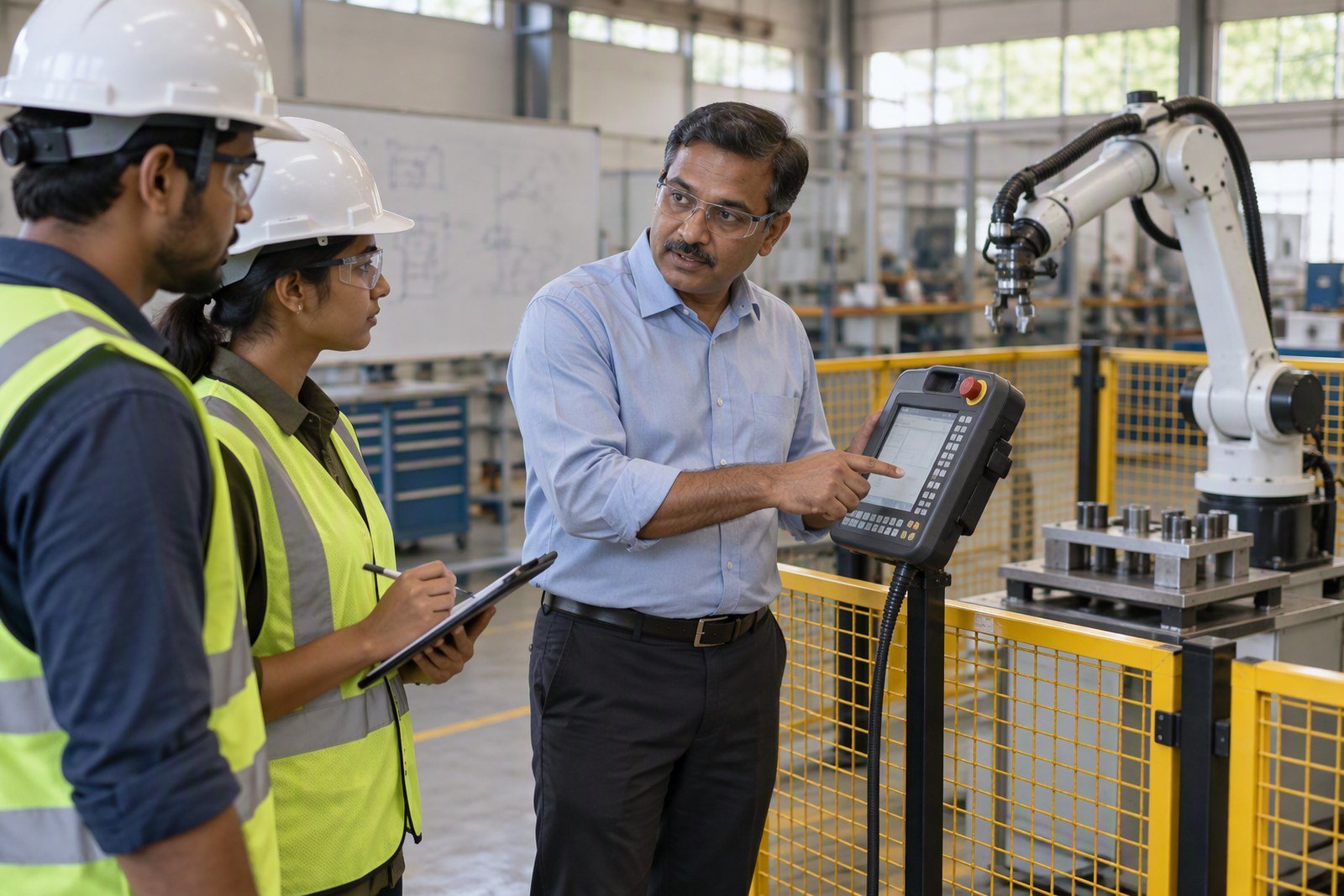
Most Indian plants buy a robot cell with a training line in the purchase order and nothing behind it: a two-day handover, a folder of PDFs and a photograph at the fence.
Then the integrator’s engineer flies home, the first jam lands on second shift at 2 am, and the person clearing it has never seen the cell with the power on.
Training is a commissioning deliverable, with dates, named people and evidence. Plan it before the cell arrives.
Four roles, four different kinds of competence
The usual mistake is one programme for everybody. Operator, setter, maintenance technician and safety supervisor need different things, and only two of them need to understand the program.
Name a person against each role, decide what they must do with no engineer in the building, and you have the syllabus.
| Role | Must do unsupervised | Training route | Evidence of competence |
|---|---|---|---|
| Operator | Start, stop and hand over; load and unload; clear listed faults; use the e-stop | Integrator handover plus an OEM operation course | Observed shift routine on the real part, signed by the shift engineer |
| Setter or technician | Select and offset programs, change grippers, recover jams, teach a point under permit | OEM programming course plus supervised cell time | Timed recovery of an injected fault, repeated after thirty days |
| Maintenance | Greasing, batteries, dress pack, backup and restore, proof tests | OEM maintenance course plus the service manual | Task sign-off with measured values, and a timed restore |
| Safety supervisor | Authorise entry and restart, stop the cell, re-verify guards after any change | Functional safety training, or the validation walk-through | Signed validation review; can explain the worst stopping distance |
In a small plant one person can hold two roles, but not on the same shift. Whoever authorises entry should not be the person inside.
The operator: run the cycle, stop it, and know when not to restart
An operator’s competence is narrow and absolute: start and stop the cell, load and unload without reaching into the envelope, clear the faults on an approved list, and tell a fault worth resetting twice from one worth escalating.
They must never teach a point, edit a program, defeat an interlock or reach through a curtain for a dropped part. Say it in training, put it on a board at the cell, and test it.
Evidence is not a quiz. The operator runs the shift routine on their own shift, on the production part, with the shift engineer watching, and the signature records what was seen.
The setter or technician: recover the cell without calling the integrator
The setter is the role Indian plants most often leave unfilled, and it decides whether a stop costs ten minutes or a shift. The setter changes over the program, adjusts offsets, swaps grippers, clears jams and restarts in sequence.
That work sits across two controllers. Understanding PLC and robot programming as separate skills matters: the setter must know which controller owns the sequence before touching either.
Teaching a point is the line most plants draw badly. Either the setter is trained, authorised and given a permit procedure, or the cell waits for the integrator. The middle ground, nudging a position to get through the shift, is how collisions get written into a program.
Maintenance: the robot is the easy part
Robot maintenance is an OEM schedule; the cell around it is where the stops come from. Grippers, fixtures, conveyors, scanners, safety relays and air cause more downtime than the arm.
Train the technician to do first-line work with the manual open: batteries without losing the backup, greasing to the OEM interval, dress pack inspection at the wrist, air preparation, proof tests, and a restore from backup they have already performed once.
Build the course around the robot maintenance checklist the plant will actually use, so the technician is assessed on the tasks they sign every month.
Test the restore, timed, on a controller that is not in production. If only the integrator can restore the cell, the plant does not own it.
The safety supervisor: authority, not a certificate
Someone must be able to stop the cell, refuse a restart and authorise entry, and that authority has to survive a production meeting.
They need the risk assessment, the safety functions and how each is tested, the difference between a protective stop and an emergency stop, and why a guard changed on Friday invalidates Friday’s validation. Robot safety standards in India sets the framework: ISO 10218-2:2025 for the cell, ISO 13849-1 for the safety-related control system.
What they do not need is a certificate with the word robot on it. India issues no statutory robot-safety supervisor licence.
Put the training inside the commissioning window
Training is worth most while the integrator’s engineer is on site, and that window is short. Book it against commissioning milestones rather than calendar weeks, so a slipped installation moves the training instead of cancelling it; the robot cell commissioning checklist gives the gate sequence.
Write it into the integrator’s scope before the order: named roles, hours on site, assessment method, one return visit after thirty days. Deciding how to select the robot integrator is where that clause belongs.
| Commissioning milestone | Training that must happen | Who delivers it | Evidence captured |
|---|---|---|---|
| Before dispatch | Operators see the cell run and hear the fault list | Integrator | Named attendees in the acceptance record |
| Installation week | Maintenance shadows the build | Integrator and OEM | Checklist initialled by the technician |
| Power-up and I/O | Technician forces inputs and outputs; integrator watches | Integrator | I/O sheet with the technician’s initials |
| Dry run | Setters write the recovery steps, then perform them | Integrator | Recovery procedure with a revision date |
| Safety validation | Supervisor observes every stop test and signs | Integrator or OEM | Stop time and distance sheet |
| Production runoff | Operators run every shift, including nights | Plant | Shift-wise output and intervention log |
| Ramp-up | Fault injection; setter recovers unaided | Plant, integrator on call | Assessment sheet with times |
| Last week on site | Backups, licences, spares and contacts handed over | Integrator | Handover certificate naming competent persons |
When the engineer leaves, the plant should hold a dated list of people who can run, set and repair the cell.
Verify competence with a task, not a signature
Attendance sheets prove presence. Assessments prove the plant can run on the Monday after handover.
- Observe the real task, on the real part, at the real station, with the assessor standing back.
- Inject a documented fault and time the recovery; write the time down.
- Ask why, not just how: why this reset, why this guard cannot be opened, what the person must not do, who they call when unsure.
- Re-test after thirty days, on a shift with no engineer present.
- Record the assessor’s name. A shift engineer who works alongside the person beats a trainer who leaves on Friday.
Two people who can do the task beat ten who watched it. If the re-test fails, the fix is another supervised shift.
What the routes cost and how long they take
OEM courses are cheapest per day and least specific to your cell. Integrator handover is the most specific and the first thing cut when the schedule slips. In-house training produces the only person who can recover your process.
Illustrative planning ranges, not quotations:
- OEM operation and programming, 3 to 5 days at an OEM centre: ₹25,000–₹75,000 per person, plus travel. Large OEMs run these at Bangalore, Chennai, Manesar and Pune.
- OEM maintenance course, 3 to 5 days: ₹30,000–₹90,000 per person.
- Integrator handover, 2 to 4 days on site for six to ten people: usually inside the contract, ₹40,000–₹1,50,000 if priced separately.
- In-house programme, 6 to 10 weeks part-time on the cell: ₹20,000–₹60,000 per person in internal cost and lost production.
- External vocational course, 4 to 12 weeks: ₹20,000–₹1,00,000 per person; useful for recruitment, weak on your cell.
A first cohort of eight to ten people, mixing these routes, usually lands at ₹2–5 lakh. The larger cost is production lost while people learn.
If nobody can be spared, recruit before the cell arrives. The robotics careers section covers what these roles are called and what they pay.
The records an auditor will ask for
The record pack is small, and usually assembled a week before inspection.
- A role matrix: each role, each person, the date they were assessed competent, by whom, when the assessment expires.
- Task assessments showing the part, the fault injected and the time taken.
- OEM and integrator certificates with course names and dates; they support the matrix, not replace it.
- An authorisation list: who may enter, reset and teach a point, signed by the plant.
- Recovery procedures in the language of the shift, with a revision date, plus refreshers: annual for operators, and after any change to the cell, program, guarding or product.
The Occupational Safety, Health and Working Conditions Code, 2020, in force since 21 November 2025 in place of the Factories Act 1948, puts the duty to provide information, instruction, training and supervision on the employer. A dated matrix with names is the simplest evidence that the duty was met; attendance sheets are not.
Train for the Monday after handover, not for the photograph.
Vendor certificates are easier to judge against a degree than against a brochure: the mechanical route map sets out, from the institutions’ own pages, what a five-month executive programme and an OEM training ticket each prove and what neither does.
Frequently asked questions
How long does it take to train a robot operator in India?
For one cell and a defined task, two to three weeks of supervised shifts is a realistic planning figure, on top of a short OEM operation course. Competence is a full shift unsupervised, not a course completion.
Do robot operators need a certification in India?
There is no single statutory robot-operator certificate. The national skills framework does list entry-level robotics qualifications, such as the Electronics Sector Skills Council's Assistant Robotics Technician pack at NSQF level 3, but those are written around small-scale robot systems. Treat them as a recruitment signal, not as evidence of competence on your line.
Can the integrator's handover training replace OEM training?
Partly. The integrator knows your cell and can teach the process, the recovery sequence and the specific faults. The OEM knows the controller, the maintenance intervals and the safety configuration. Budget for both.
How many people should be trained for one cell?
At least two per role per shift, so leave or attrition does not stop the cell. A two-shift cell typically needs four operators, two setters, two maintenance technicians and one safety supervisor, with a deputy who can authorise entry.
Should training be in English, Hindi or the local language?
Deliver the task in the language the shift speaks, and keep the OEM manuals in English as reference. A recovery procedure written only in English is read once; one written in the shift's language, with photographs of the HMI screens, gets used at 2 am.
Which training records should an auditor see?
The role matrix, task assessments with dates and assessor names, the authorisation list, recovery procedures and the refresher schedule, with OEM certificates behind them. An auditor is usually testing whether the person at the cell can do what the record says.
Sources and further reading
- FANUC India Academy — robot operation, programming and maintenance courses at Bangalore, Chennai, Manesar and Pune
- Electronics Sector Skills Council of India — qualification packs, including Assistant Robotics Technician (ELE/Q7203, NSQF level 3)
- Zenia HR — the Factories Act 1948 repealed, and what the OSH Code changed, commencement dated 21 November 2025
- IBF Solutions — the new EN ISO 10218-1 and -2 standards for industrial robots, published 2025