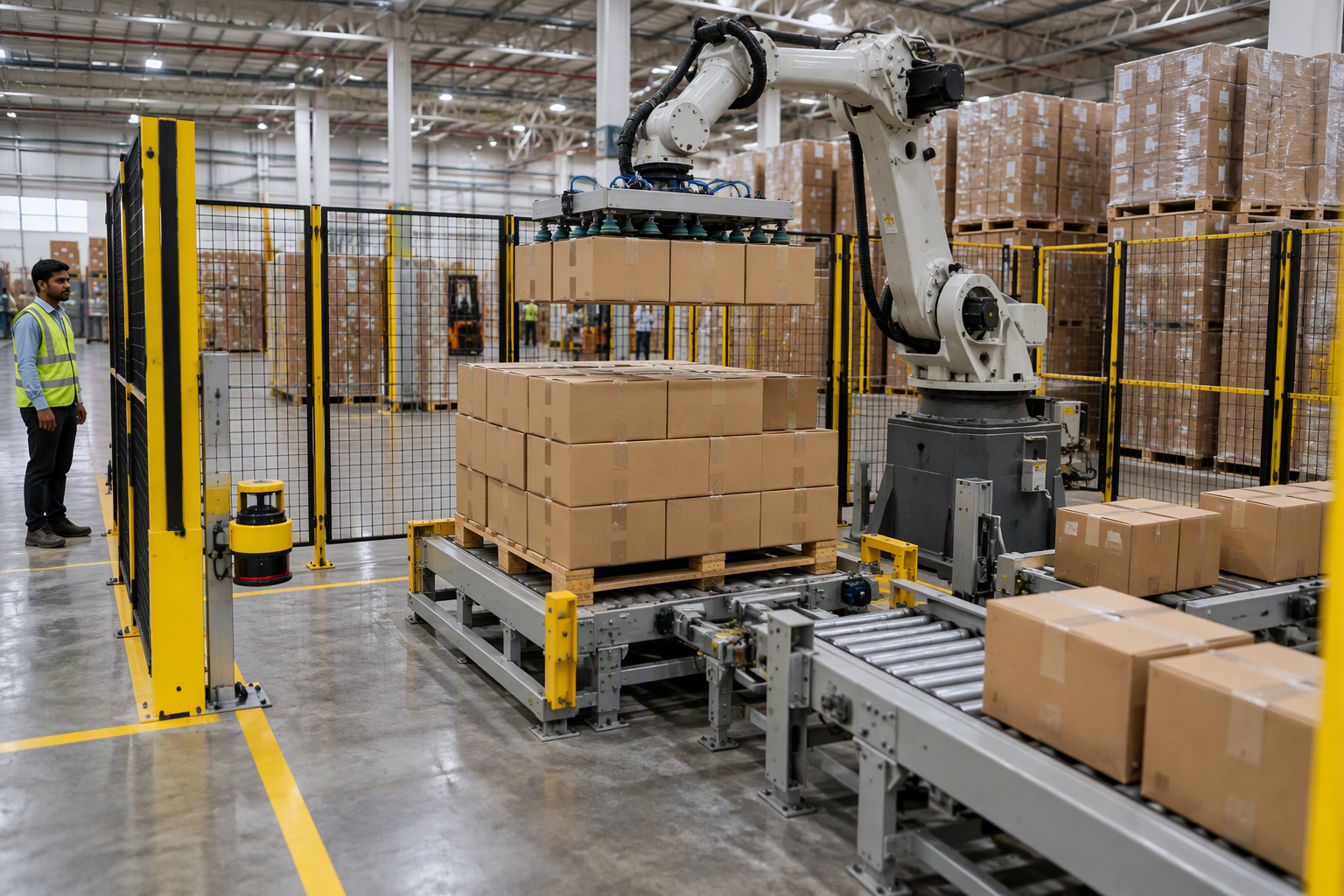
A depalletizing robot is priced by what it has to see, not by what it has to lift. If every inbound pallet carries the same carton in the same pattern, a four-axis robot with a vacuum layer gripper does the job and the cell lands around ₹28 lakh to ₹60 lakh. If the pallets arrive mixed — different cartons, different heights, slip sheets, damaged cases — you are buying 3D vision and software, and the same task costs ₹45 lakh to ₹95 lakh. A high-speed layer machine, the kind that lifts a whole tier of bottles at once, starts above ₹60 lakh and is built for one product and one pattern.
That price gap is the whole decision. Most Indian plants ask for the mixed-pallet version because it sounds safer, then discover that half the cost is vision software they did not need. This page separates the two jobs, gives the reach and rate arithmetic, and shows where the money actually goes.
Three machines, three jobs
| Type | How it unloads | Rate | Best for | Weak at |
|---|---|---|---|---|
| Robotic case depalletizer | Robot lifts one case or a small group per cycle | Medium | Mixed SKUs, several pallet positions, line-side feeding | Very high throughput on one product |
| Robotic layer depalletizer | Robot with a wide vacuum bar lifts a whole layer | High | One carton type, stable layers, 24-hour production | Mixed or unstable pallets |
| Fixed layer depalletizer | Machine lifts layers on a mast, no robot arm | Very high | Beverage, jars, cans, single product, one pattern | Changeovers and odd shapes |
The clearest way suppliers describe the split is between layer depalletizing, which handles uniform pallets, and random depalletizing, which handles mixed inbound. A layer machine is the fastest and lowest-cost option for a single SKU; a robot with vision is the flexible option. Buying the robot when the pallets are uniform pays for flexibility twice — once in capital and again in slower cycles.
Reach and height: the numbers that decide the robot
Palletizing cell builders typically quote 2,400 mm to 3,200 mm of reach to cover pallet height plus gripper clearance. The common robots for this work are the four-axis palletizing family — FANUC M-410iC, ABB IRB 460, KUKA KR PA and Yaskawa PL — usually with vacuum, clamp or fork tooling. Depalletizing uses the same machines, but the arithmetic is less forgiving because the robot starts at the top of a full pallet and has to reach down to the deck.
Work it out before you look at a catalogue. Take a pallet 1,200 mm long, 1,000 mm wide and 1,500 mm tall, with a 400 mm tall layer gripper, on a floor-level conveyor. The furthest pick point is the far top corner of the bottom layer: about 1,500 mm up and roughly 1,250 mm horizontally from a robot base set back from the pallet. The straight-line distance is about 1,955 mm, but the robot must also clear the pallet corner on the way, so the usable reach requirement is higher than the straight line suggests. A 3,100 mm machine has margin; a 2,400 mm machine on the same layout does not.
Three reach traps catch Indian integrators repeatedly:
- Reach is measured to the flange, not to the tip of the gripper. Subtract the gripper depth from the usable envelope.
- The dead zone near the base is larger than the datasheet drawing implies, especially on four-axis machines. The nearest pallet corner may be inside it.
- Slip sheets and pallet lips add height at the bottom. Measure the tallest pallet you will ever receive, not the average one.
The gripper decides your throughput
- Vacuum layer bar: highest rate on stable cartons, but it needs a flat top surface and enough exposed area. Good for single-SKU pallets with consistent cases.
- Case vacuum gripper: one or two cases per pick, tolerant of mixed sizes if the suction cups are zoned and the vacuum is monitored. The standard choice for mixed SKU.
- Fork or clamp gripper: for cases that cannot be sucked — porous bags, shrink-wrapped bundles, crates with open tops. Slower because it must approach from two sides.
A gripper that loses vacuum mid-lift drops the case. The cell must detect vacuum loss and stop, and the gripper must be sized with a safety factor on the suction force, not on the case weight alone. For a mixed line, zone the cups so that a small case does not rely on cups designed for a large one. The wider comparison of end effectors is in the end effector guide and the vacuum gripper design guide.
Throughput: cases per hour, not cycles per minute
Suppliers quote palletizing cells in the range of 10 to 60 cases a minute, but that is the machine’s capability on an ideal pattern, not your plant’s output. Build the number from the cycle.
A single-case pick has four time components: approach and descend to the case, grip and lift, travel to the conveyor, and place and release, plus the return. On a 2.5 m travel, a realistic cycle is 8 to 12 seconds per case, so a single-case robot delivers roughly 300 to 450 cases an hour before availability losses. At 85 per cent availability — a fair figure for a cell with changeovers, jam clearing and operator breaks — plan on 255 to 380 cases an hour. A two-case gripper roughly doubles the rate but adds a pattern constraint: both cases must be liftable together.
Compare that with the manual alternative honestly. Two loaders unloading 12 kg cases at one case every 12 seconds each, with breaks, fatigue and shift handover, deliver about 400 to 500 cases an hour in short bursts and less over a full shift. The robot’s advantage is not raw peak speed; it is that 350 cases an hour continues for the whole shift, every shift, without a fatigue curve.
What the cell costs
| Line item | Planning range (₹ lakh) | Notes |
|---|---|---|
| Four- or six-axis robot with controller | 18 – 45 | Payload, reach and whether the arm is new or refurbished. |
| Case or layer gripper | 3 – 10 | Zone count, vacuum generation, fork or clamp design. |
| 3D vision and mixed-SKU software | 4 – 12 | Only for random depalletizing; this is the line that doubles the project. |
| Infeed and outfeed conveyors | 4 – 15 | Length, accumulation, merges with the production line. |
| Safety scanners, fencing and muting | 2 – 6 | Access for pallet replenishment is the usual layout problem. |
| Integration and commissioning | 3 – 8 | Pattern teaching, handshakes with the line PLC, training. |
| Single-SKU robotic cell | 28 – 60 | Fixed pattern, case or layer gripper, no vision. |
| Mixed-SKU robotic cell | 45 – 95 | 3D vision, mixed cartons, damaged-case handling. |
These ranges are built to sit alongside the site’s palletizing cost guide, which prices a six-axis palletizing cell at ₹35–70 lakh and a layer palletizer from ₹60 lakh up. Depalletizing is usually the same hardware with different software and a taller reach requirement; the vision line is what changes the class of project.
A payback that assumes the cell is fed
Take a ₹55 lakh mixed-SKU cell, three shifts, 25 days a month. It replaces three loaders per shift at a loaded cost of ₹25,000 a month each: ₹27 lakh a year. Maintenance, spares, gripper cups and power at 12 per cent of capital is about ₹6.6 lakh. Net saving is about ₹20.4 lakh a year, so simple payback is roughly 32 months.
Now break it. If inbound pallets arrive at random intervals and the cell waits, the labour is not released — the loaders are still needed to unload trucks. If the mixed-SKU software needs a person to correct misreads, one operator remains. If the line stops every time a damaged case arrives, availability falls below 70 per cent and the payback stretches past four years. Depalletizing projects fail on inbound flow and case condition far more often than on robot capability.
Five numbers to collect before you call an integrator
- Cases per hour at peak, and the pattern of arrivals — steady, batch or truck-driven.
- Case range: smallest and largest length, width, height and weight, including the occasional outlier.
- Pallet range: heights from deck to top, pallet types, whether slip sheets are used, and whether pallets are ever damaged.
- SKU mix: how many cartons per pallet, and whether a pallet is ever mixed. This single answer decides whether you need vision.
- Discharge requirement: single-file conveyor, accumulation table, or directly into a pick station — and the height it must reach.
Safety is not a fence around the robot
A depalletizer has an unusual safety problem: people must approach the pallet to replenish it, and the pallet position is inside the robot’s working envelope. Fixed fencing with an interlocked gate stops production every time a pallet is changed. The practical answer is a safety laser scanner with zone switching — the robot slows or stops when a person enters the replenishment zone, and resumes when the zone is clear — designed under ISO 10218 and the machinery safety chain in ISO 13849. Building cell suppliers commonly design to ANSI/RIA R15.06 and ISO 13849; in India, the risk assessment still has to be yours, and the safety standards guide covers what the file must contain.
Muting matters too. If the outfeed conveyor passes through the fence, the light curtain must mute only when the conveyor is running and the pallet is in the expected position. A muting circuit that can be defeated by a person walking behind a pallet is a common audit finding.
Frequently asked questions
How much does a depalletizing robot cost in India?
A single-SKU robotic depalletizing cell typically costs ₹28 lakh to ₹60 lakh. A mixed-SKU cell with 3D vision costs ₹45 lakh to ₹95 lakh. A high-speed fixed layer depalletizer starts around ₹60 lakh and is built for one product and one pattern.
What is the difference between layer and random depalletizing?
Layer depalletizing lifts a whole tier of identical cases at once and suits uniform pallets. Random depalletizing picks individual cases from mixed or irregular pallets and needs vision and software to find each case. Layer is faster; random is more flexible.
How many cases per hour can a depalletizing robot handle?
A single-case robot typically handles 300 to 450 cases an hour at full speed, or about 255 to 380 after availability losses. A two-case gripper roughly doubles that, at the cost of a pattern constraint. Supplier claims of 60 cases a minute describe ideal conditions, not a real shift.
Do I need 3D vision for depalletizing?
Only if the pallets are mixed, the patterns vary, or case condition is unpredictable. For one carton in one pattern, a fixed program with position sensors is enough and costs far less. Vision is the single biggest cost jump in a depalletizing project.
Can one robot both palletize and depalletize?
Yes, on a shared cell with two pallet positions, but the cycle time is shared and the safety zones get more complex. It usually makes sense when both tasks run at low volume on the same line. At high volume, two dedicated machines are simpler to run and easier to justify.
Sources
- AMD Machines, Robotic palletizing cells — reach range, robot families, tooling options, throughput and safety standards.
- Viroteq, Robotic depalletizing — layer versus random depalletizing and gripper types.
- Comau, Automated palletizing and depalletizing — mixed-SKU handling.
- ISO, ISO 10218-1 — industrial robot safety requirements.
Related reading: palletizing payload, reach and cycle time · palletizing cell costs · end-of-line packaging automation · conveyor integration · warehouse automation costs · robot safety standards.