A robot gearhead is picked in a fixed order: lost motion at the tool tip first, because it decides which families remain; rated and peak torque second, each with the duty allowance its maker attaches; the ratio third, because it decides reflected inertia and therefore the motor. Price enters last. Reverse that order and you buy a gearbox that fits the budget and misses the arm.
What the gearhead buys that the servo alone cannot
A 400 W Yaskawa Σ-7 servomotor, the SGM7J-04A, is rated at 1.27 N·m at 3000 r/min (Yaskawa Sigma-7 rotary servomotor manual). Put a 50:1 gearhead behind it and the joint sees roughly 1.27 × 50 × 0.97 = 61.6 N·m, using the 97% two-stage efficiency Neugart publishes for the PLE line. That multiplication is the obvious job.
The less obvious one is inertia. Reflected load inertia falls with the square of the ratio — Linear Motion Tips puts it as “The gear reduction has an inverse square effect on the load inertia”, and Harmonic Drive states the same arithmetic as a conversion instruction in its actuator tables: “Inertia shown in this table is at input side. To convert to output side, multiply the inertia by (ratio)²” (Harmonic Drive general catalogue): a wrist carrying 5.10 kg·m² reflects 5.10 ÷ 10² = 0.0510 kg·m² behind one stage but 5.10 ÷ 50² = 0.00204 kg·m² behind a 50:1. Yaskawa tables an “Allowable Load Moment of Inertia” per frame as a multiple of rotor inertia, and the SGM7J multiples run 10 to 35 times (Yaskawa manual). At i = 10 you are outside that allowance by an order of magnitude and the servo will not tune stable; at i = 50 you are inside it. The ratio, not the motor frame, is what changed.
Usable torque also collapses near top speed, the shape the stepper torque-curve explanation walks through and which governs brushless servos too. The motor selection guide starts from the robot and ends at the motor, and the gearhead makes that possible.
Three families, three load paths
Construction detail already lives on two pages here: the planetary versus spur gearbox comparison for tooth geometry and stage counts, the harmonic drive versus cycloidal reducer page for both mechanisms. Only what each load path implies about a datasheet follows.
Planetary. Neugart’s PLE is coaxial, with a planet carrier in disc design and low-friction deep-groove ball bearings, cataloged from i = 3 to i = 512 across one to three stages with cyclic output torque T2Z from 5 to 800 N·m (Neugart PLE catalog). Ratio per stage runs 3:1 to 10:1, the stage arithmetic our planetary versus spur guide works through, so a 50:1 costs two stages and a second mesh to lose motion through.
Strain wave. Three parts: the “non-rigid, thin cylindrical cup with external teeth” flexspline, an elliptical plug inside a thin ball bearing, and a rigid internal-toothed circular spline (Harmonic Drive CSF/CSG component catalog). Oval stretching engages its teeth only at the two ends of the long axis, so no lash remains and the gear element “has zero backlash”. Ratio comes from a tooth-count deficit: with the circular spline fixed it equals flexspline teeth divided by two, so 200 teeth give 100:1 in one stage (Nabtesco Precision technology overview). So a strain wave fits an elbow where a planetary needs three stages, and its stiffness is a curve rather than a constant, because torque travels through an elastic member “subjected to repeated deflections”.
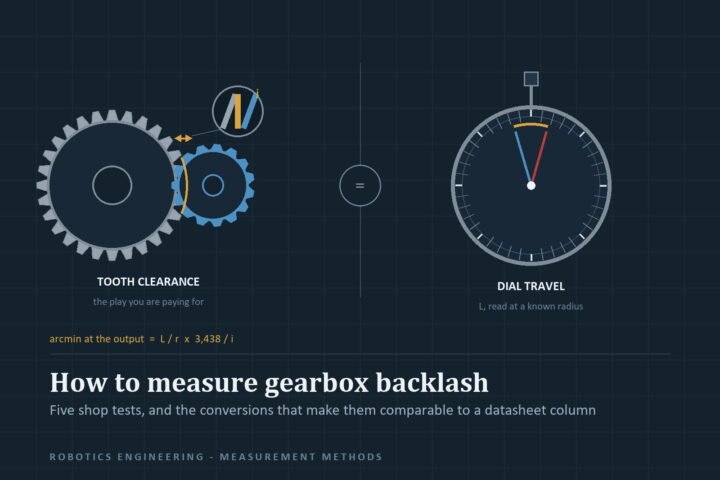
None of those columns mean anything until you have a number off your own joint. The backlash measurement guide works the clamped-output dial test through its arithmetic, including the part catalogue figures leave out: coupling play sits outside the reading.
Cycloidal. Nabtesco’s RV is two-stage: the input shaft drives spur gears, then cams turn inside a housing lined with rollers, and “[t]he cam disk has exactly one cam section less than the ring rollers” (Nabtesco Precision Europe, functional principle of cycloidal gears). Nearly half of each disc’s cams stay in contact (Nabtesco Europe), which is why pure backlash is quoted at 0.1 to 0.2 arcmin. A set of large internal angular support bearings “provides large moment capacity and removes the need for external support devices”, and hollow-shaft models reach 300:1 “without stacking stages in the manner of a planetary gearbox” (Nabtesco Precision). Sumitomo: high ratios “in one or a maximum of two stages, allow for extremely compact designs”, in housings 115 mm to 570 mm across (Sumitomo Fine Cyclo catalog). That moment capacity, not the ratio, is why the hip and shoulder of a six-axis arm are cycloidal territory.
Grades are a different ruler. The JIS and ISO gear-accuracy system carries 13 grades, 0 best and 12 worst (KHK gear technical reference), the current ANSI/AGMA adoption defines 11 flank tolerance classes (AGMA ISO 1328-1-B14 listing), and these datasheets deal in arcminutes.
The six numbers, and how each maker measures them
Makers measure different things and print them in the same column. Read who wrote the row before comparing rows.
| Number | Planetary, Neugart PLE | Strain wave, Harmonic Drive | Cycloidal, Nabtesco and Sumitomo |
|---|---|---|---|
| Rated torque | T2Z cyclic output torque 5 to 800 N·m across the PLE ratio table (PLE) | Tr, the “[a]llowabl[e] continuous load torque at rated speed” (CSF/CSG) | RV-E rated-torque row 58 to 4,410 N·m, printed beside an allowable acceleration/deceleration row starting at 117 N·m (RV-E, Nabtesco RV catalogue) |
| Peak torque and its count | T2Stop on a PLE120 is published from 340 to 520 N·m down the ratio table, footnoted “Permitted 1000 times”; the separate maximum-torque row is capped by an occurrence count Neugart prints in the full catalogue as “30,000 rotations of the output shaft permitted” (PLE, complete catalog) | Momentary peaks carry a computed occurrence ceiling, N = 1.0 × 10⁴ / (2 · n/60 · t), where n is the input speed before the collision and t its duration, and the maker’s own worked case lands at 1,190 events (CSF/CSG); ratcheting at 8 to 9 times rated, buckling at 16 to 17 (Gears catalog) | “up to 500 % of the rated torque” in an emergency stop (Nabtesco Europe) |
| Free play | 6 to 22 arcmin Economy, 3 standard and 1 optional Precision; PLE040 under 15, 19 then 22 arcmin at one, two, three stages (catalog) | No backlash figure, the element having zero; hysteresis loss at 0 to ± rated torque with the input locked, 1 to 3 arcmin, plus a transmission-accuracy row that runs from under 0.5 to under 2.0 arcmin on the CS and CSG pages and out to under 4.5 on other series (CSF/CSG, Gears catalog) | The RV-E feature list claims backlash and lost motion each “less than 1 arc.min.” on separate lines, and the model table beneath it prints 1.5/1.5 arcmin in its first column and 1/1 in the rest (RV-E, Nabtesco RV catalogue); Sumitomo lost motion is “Distortion angle at 3% of nominal torque” (Fine Cyclo) |
| Efficiency | “excellent efficiency of up to 98%”: 98, 97 then 92% at one, two, three stages under full load (catalog) | Load-dependent: a CSG-20-80-2A, TN 44 N·m at 1000 r/min under 20 N·m average load, gives V = 0.45, K = 0.87 and 80% × 0.87 = 70% (Gears catalog) | Between the two, compensated below nominal torque (Fine Cyclo) |
| Rated life | Lh service life 20,000 h, footnoted as an application-specific configuration (PLE); the same maker’s Precision Line literature prints both 20,000 h and 30,000 h tiers (complete catalog) | L10 7,000 h CSF and 10,000 h CSG, scaled by Lh = Ln × (Tr/Tav)³ × (Nr/Nav) at 2000 r/min rated input, the maker’s own case resolving to 7,610 h (CSF/CSG); L10h means “10 % probability of failure” (Gears catalog) | No comparable L10h in either fetched sheet, so the robot maker’s interval governs (KUKA) |
| Grease | “maintenance-free over their service life under normal operating conditions” (catalog) | Interval LGT = LGTn × (Tr/Tav)³ in input rotations; charge by orientation — 30 g horizontal, 35 g output-up, 40 g output-down at size 25 — and sets “[s]upplied without lubricant as standard” (CSF/CSG, Gears catalog) | A, DA and C “lubricated for life in the factory and completely sealed” (Fine Cyclo); KUKA oil at “20,000 h or 5 years at the latest”, cut to 3000 hours for “frequently recurring, short-distance movements” (KUKA) |
Read the two overload budgets as what they measure. Neugart’s “Permitted 1000 times” attaches to an emergency stop, a deceleration the drive commands; Harmonic Drive’s ceiling attaches to a momentary peak, which is a collision, and the catalogue states plainly that such peaks “should, under no circumstance, occur during normal operating cycle” (CSF/CSG). A strain wave’s allowance is not even a fixed number: it is 10⁴ divided by the product of input speed before impact and collision time, so the maker’s worked case at 14 r/min output through 120:1 and a 0.15 s impact comes out at 1,190 events. Two gearboxes can both print a five-figure event count and describe completely different machines.
Convert free play before arguing. One arcminute is 2.91 × 10⁻⁴ rad, 0.145 mm at 0.5 m from the tool center point, so a 6 arcmin economy planetary puts 0.87 mm of slop at the flange — fine on a weld positioner, unusable on a screwdriving spindle, which is the question our repeatability and accuracy guide answers under ISO 9283. Read the table under the headline: Nabtesco’s RV-E feature list says “less than 1 arc.min.” for both backlash and lost motion, while the specification table on the same page prints 1.5 arcmin against its smallest model and 1 arcmin against the rest. Every maker here publishes a marketing line and a per-model row, and they are not always the same number.
Efficiency and life are thermal and statistical statements. Take the CSG joint to 15 N·m at 30 r/min, 47 W mechanical, and the gap between 97% and 70% is 1.4 W of heat against 20 W inside a sealed housing about 90 mm across; hence the advice that “[m]ounting the gear to the surrounding structure improves the dissipation of generated heat” (Gears catalog). Neugart’s 20,000 h and Harmonic Drive’s 7,000 h are not comparable — one is a gearbox life at nominal torque and duty, the other a wave-generator bearing life at a reference speed — so ask in writing what speed and duty a rated figure assumes. Check the revision date on the sheet you were quoted, too: the PLE chapter cited here is the May 2026 issue, and the May 2023 issue of that same chapter printed 30,000 h for the same product. Grease law is cubic: halving average torque multiplies a strain-wave change interval by eight (CSF/CSG), and KUKA warns that its own intervals rest on “typical gear unit temperatures and axis motions” (KUKA).
Worked sizing: the elbow joint of a 10 kg arm
Assumptions, all substitutable: payload 10 kg at 0.62 m horizontally from the J2 axis in the worst pose; link mass 14 kg with its center of gravity 0.30 m from the same axis; g = 9.81 m/s²; peak joint speed 60 r/min reached in 0.3 s; motor rated speed 3000 r/min; no counterbalance, no spring assist.
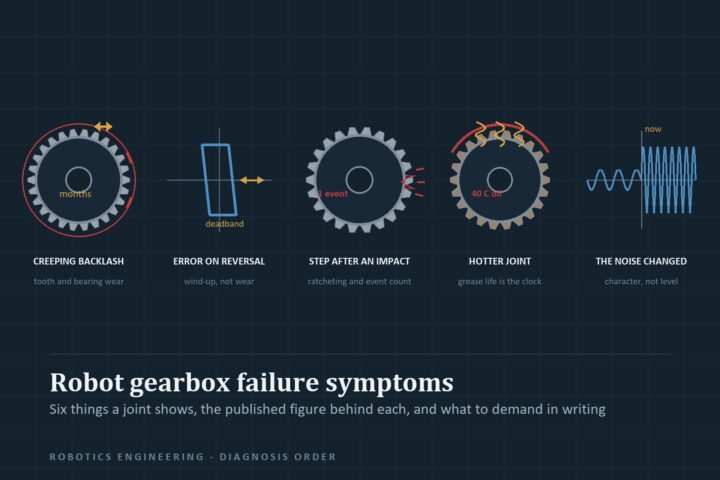
Symptom-by-symptom diagnosis sits in its own guide: robot gearbox failure symptoms works through the six things a joint actually shows, from backlash that creeps over months to a step change after a single collision, and names the published figure behind each one.
| Step | Arithmetic | Result |
|---|---|---|
| Gravity torque | 10 × 9.81 × 0.62 + 14 × 9.81 × 0.30 | 60.8 + 41.2 = 102.0 N·m |
| Combined inertia about J2 | 10 × 0.62² + 14 × 0.30² | 3.84 + 1.26 = 5.10 kg·m² |
| Angular acceleration | (60 × 2π / 60) / 0.3 | 20.9 rad/s² |
| Acceleration torque | 5.10 × 20.9 | 106.6 N·m |
| Peak torque demanded | 102.0 + 106.6 | 208.6 N·m |
| Nominal torque at a 1.5 duty factor | 102.0 × 1.5 | 153 N·m |
| Ratio needed for speed | 3000 / 60 | i ≥ 50 |
| Reflected inertia at i = 50 | 5.10 / 50² | 20.4 × 10⁻⁴ kg·m² |
| Reflected inertia at i = 10 | 5.10 / 10² | 510 × 10⁻⁴ kg·m² |
The last two rows decide the motor. One planetary stage tops out near 10:1 (PLE), so holding at i = 10 leaves 510 × 10⁻⁴ kg·m² on the rotor, past the 10-to-35-times allowance Yaskawa tables for SGM7J frames (Yaskawa manual), and the arm gets bought on a motor several sizes larger than its torque needs. At i = 50 the same arm reflects 20.4 × 10⁻⁴ kg·m², roughly 4:1 against a 5 × 10⁻⁴ kg·m² rotor (illustrative; substitute your datasheet value).
Then check free play under load, because a nominal backlash figure is not the error you get. Neugart’s PLE120 stiffness row prints 15.5 to 21.0 N·m per arcmin for the single-stage part and 17.5 to 22.0 for the two-stage one (PLE); the i = 50 gearbox above is the two-stage case, so ask it for 153 N·m and it twists 153 / 22.0 to 153 / 17.5 = 7.0 to 8.7 arcmin before free play is counted. Zero backlash is not automatically better: CSF-32 at ratio 80:1 and above carries a first-slope limit T1 of 29 N·m at 1.5 arcmin and a second-slope limit T2 of 108 N·m at 4.0 arcmin, after which a third stiffness applies (CSF/CSG) — and 4.0 arcmin is 0.58 mm at a 0.5 m tool radius. Nabtesco publishes the same quantity as a reference spring constant in its RV-E table, and the row that carries 784 N·m of rated torque reads 196 N·m per arcmin (RV catalogue), which is nine times the two-stage planetary number and would put that same 153 N·m at under one arcmin of wind-up. Error at the flange is free play plus torque divided by stiffness; at J2 the stiffness term dominates, and most quotations skip the division.
The verdict is cycloidal. A steady 102 N·m bending moment wants the RV’s integrated angular-contact support rather than its ratio (Nabtesco Europe), and an emergency-stop ceiling stated as a multiple of rated torque instead of an occurrence budget. Buy the precision planetary one size down in the duty, on a SCARA or palletizing axis with a short lever and a real backlash budget, the trade our SCARA guide covers. Put the strain wave at J4 to J6, where torque is tens of N·m, the hollow shaft earns its keep, and wrist mass saved comes back as payload, as the payload calculation shows.
Where each family is wrong
Strain wave fails on shock, and progressively. Apply 8 to 9 times rated torque while the gear is moving and “the teeth between the Circular Spline and Flexspline may not engage properly”; once ratcheting occurs, “the teeth wear excessively and the ratcheting torque may be lowered” (CSF/CSG). Static overload differs: at 16 to 17 times rated torque the flexspline deforms plastically, “eventually leading to a rupture at the bottom of the Flexspline” (Gears catalog). Neither figure is in the standard sheet, since Harmonic Drive SE offers them on request, so a quotation without both means nobody asked. A collision a fixture can cause is a design case, not an accident.
Planetary is wrong where ratio is high and duty continuous, for the reason the efficiency row gives: 92% at three stages is eight to nine watts lost per hundred transmitted, inside the housing that holds the grease. Neugart’s answer is the split range — Economy Line at 6 to 22 arcmin, Precision Line at 3 arcmin with a 1 arcmin option — plus a cage planet carrier, which “increases the torsional stiffness of the gearbox considerably, since the planets are supported at both sides” (catalog). Accuracy is bought back stage by stage, and the maintenance-free claim stays conditioned on “normal operating conditions”; three stages at 92% is not normal.
Cycloidal is wrong at small scale and in single units. The smallest Sumitomo Fine Cyclo housing is 115 mm across and the series is built for “acceleration torques from below 100 Nm up to 30,000 Nm” (Fine Cyclo), so a 15 N·m wrist cannot occupy the cheapest unit at any ratio. Supply binds too: Nabtesco reports cumulative production above 6.0 million cycloidal reduction gear units in 2016 (Nabtesco RV-E), and a market that concentrated has no spot channel. Size a gripper-side wrist whole, with our gripper design basics.
Ordering a gearhead in India: what the quotation has to contain
No maker or authorized agent publishes an Indian gearhead price list carrying a retrieval date, so no rupee band appears here; guessing would be worse than naming the gap. What you can control is whether three quotations describe the same part.
- Ratio plus the stage count it implies. Ask for the model code, not “50:1”. The PLE spans i = 3 to 512 over one to four stages and the backlash band on one frame widens with each, from under 15 arcmin at one stage on a PLE040 to under 22 at three (catalog). “We will do 45:1” means a standard ratio or an added stage.
- Which overload figure, measured how. Rated torque, peak torque, the permitted number of peak events, and for a strain wave the ratcheting and buckling torques, which the maker supplies on request.
- The measurement basis for free play. Planetary torsional backlash, strain-wave hysteresis at ± rated torque and Sumitomo’s distortion angle at 3% of nominal are three numbers; ask which one the sheet reports.
- Service life with its duty assumption. Neugart’s current PLE chapter gives Lh 20,000 h against an application-specific configuration it makes you look up; the same chapter’s earlier issue printed 30,000 h for that product. Harmonic Drive lists 7,000 h for CSF against 2000 r/min rated input. Neither number is a claim about your cell.
- Grease, charge, orientation and interface. Lifetime-greased or regreasing, the gram figure at your orientation, and the flange standard: Neugart builds the output flange to ISO 9409-1 (catalog), so name it or receive an adapter plan.
- Provenance. Ask whether the supplier can obtain a ratcheting torque. That question separates a channel holding the maker’s application data from one moving boxes, and the difference is not price: component sets ship without grease, so a grey-market unit’s charge quantity and grease type are unknowable, and both Sumitomo’s sealed-for-life claim and Neugart’s maintenance-free claim stop applying to anything opened. Downtime arithmetic sits with our spare-parts stocking guide and the lead-time planning page.
A gearhead turns a robot quotation into a mechanical one, so it belongs in the same conversation as arm selection — see the cobot buying guide for India and cell layout design. Jaadu Digital, the agency that publishes this site, writes industrial-automation specifications if the enquiry needs producing. For the metallurgy question left out here, why a case-hardened spur tooth pits rather than stretches, EngiTech’s materials engineering section carries the failure-analysis background.
How this changes your servo drive selection
Add a gearhead and three of the drive’s numbers move at once. Required motor torque falls by the ratio and roughly the efficiency, so the continuous current rating comes down. Reflected inertia falls by the square of the ratio, which stops the inertia allowance binding and lets gain rise. The gearbox’s own input inertia becomes a load the drive sees constantly, and its losses become a housing temperature the thermal model must respect. Peak current sizing follows the peak-torque count, and the count is a different quantity in each datasheet: a fixed 1,000 permitted emergency stops in Neugart’s, a computed ceiling that falls as the impact gets sharper in Harmonic Drive’s. The servo drive selection guide takes these through from the drive side, including regeneration on a vertical axis, where gearhead efficiency decides whether you dissipate energy or return it.
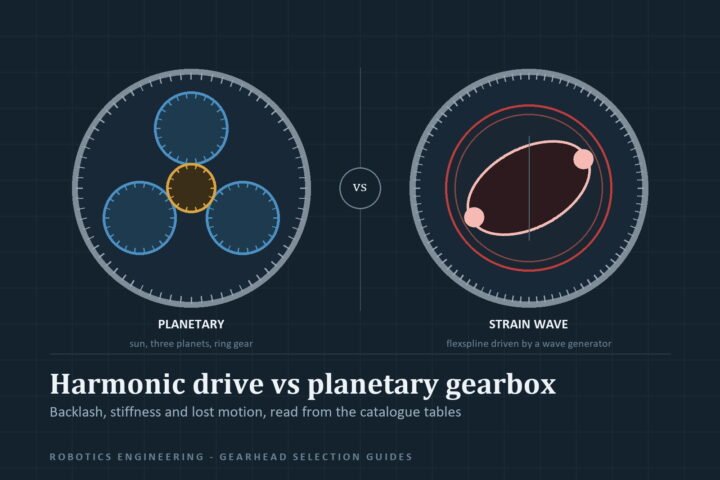
The three families behave differently once you ask which accuracy number you are reading. One is sold as mesh clearance measured at 2 percent of rated torque, another as hysteresis from an input-locked reversal sweep, and their stiffness is not the same shape under load: a planetary prints one straight line, a strain wave prints three slopes that rise with torque. harmonic drive vs planetary gearbox carries that pairing side by side with the catalogue tables named, so the free-play and efficiency rows above have a worked comparison behind them.
Frequently asked questions
Why does gearhead backlash matter more on a robot arm than on a conveyor drive?
The gearbox sits between motor and load, so its lost motion shows at the tool tip scaled by the distance to that tip. One arcminute is 2.91 x 10^-4 radians, 0.145 mm at a 0.5 m radius. A conveyor only has to be in the right place roughly; a screwdriving spindle has to be in it exactly, and a controller cannot correct play it cannot sense.
Should I specify zero backlash and be done with it?
No, because zero free play is not zero positional error. A CSF-32 at ratio 80:1 has no cataloged backlash yet twists 1.5 arcmin at 29 Nm and 4.0 arcmin at 108 Nm, since torsional stiffness is published as three slopes rather than one number. Error at the flange is free play plus torque divided by stiffness, so ask for the stiffness curve too.
Which is better, a harmonic drive or a planetary gearbox?
They answer different questions. Choose the strain wave when you need a large single-stage ratio, a hollow shaft and low wrist mass, and joint torque of tens of Nm or less. Choose the precision planetary when the lever is short, the duty continuous and 3 arcmin of backlash affordable, since it runs at up to 98% efficiency and ships greased for life. Neither wins at a 100 Nm shoulder carrying a steady bending moment, which is cycloidal territory.
How do I compare two gearboxes that both claim 20,000 hours?
Check the load spectrum behind each, and the revision date of the sheet. Neugart's Lh is a gearbox service life at nominal output torque and a stated duty, and its Precision Line literature carries both 20,000 h and 30,000 h tiers for different configurations. Harmonic Drive's L10 of 7,000 hours for CSF is a wave-generator bearing life at rated torque and a 2000 r/min rated input speed, scaled by the cube of rated over average torque. KUKA states that its intervals assume typical gear unit temperatures and axis motions. Two identical hour figures can therefore describe two different tests.
What does a supplier mean when they say they can do a custom ratio?
Usually that they will add or remove a stage rather than machine you new gears. Planetary ratios stack stages of roughly 3:1 to 10:1, and on Neugart's own table the torsional backlash band widens with every stage added at the same frame size. Ask for the model code, stage count, resulting backlash and resulting efficiency, and a 45:1 is a two-stage part with a two-stage price.
Why is a cycloidal gearbox the wrong choice for a small wrist joint?
The architecture does not scale down. Sumitomo's Fine Cyclo housings start at 115 mm external diameter and cover acceleration torques from below 100 Nm up to 30,000 Nm, so a 15 Nm wrist cannot fill the smallest unit at any ratio. Precision cycloidal gears also come from very few manufacturers, so there is no spot channel when a lead time slips.