Twelve ESP32 project ideas cover what an entry-level embedded or robotics role asks about: sensing, a dashboard, camera streaming, BLE, MQTT, audio, closed-loop motor control, GPS, LoRa, on-device machine learning, a robot car and a solar field node. Each build lists parts with quantities, a rupee range and the failure that stops most students. The cheapest lands under ₹700.
Most ESP32 idea lists price parts in dollars and stop at the idea. This one prices every build in rupees and names what goes wrong. Bands are planning estimates from Indian retail listings checked in October 2026; shipping and tools are excluded. Start with the ESP32 board guide and a DevKit whose USB-serial chip has a driver you can install.
The 12 builds at a glance
| # | Build | Core parts | Skills proved | Time | BOM ₹ range |
|---|---|---|---|---|---|
| 1 | Sensor logger | ESP32, BME280, microSD | I2C, logging | 4-6 h | ₹950-2,050 |
| 2 | Wi-Fi dashboard | ESP32, DHT22 | HTTP server | 3-5 h | ₹650-1,250 |
| 3 | Camera stream | ESP32-CAM, OV2640 | Camera, power | 2-4 h | ₹550-1,000 |
| 4 | BLE sensor | ESP32, MPU6050 | GATT, notifications | 4-6 h | ₹550-1,250 |
| 5 | MQTT relay node | ESP32, relay, DHT22 | Topics, last will | 5-7 h | ₹900-1,900 |
| 6 | Voice node | ESP32-S3, INMP441, amp | I2S, wake word | 8-12 h | ₹1,350-3,250 |
| 7 | Motor control | ESP32, driver, encoders | PWM, PID | 8-12 h | ₹1,250-2,600 |
| 8 | GPS tracker | ESP32, NEO-6M, microSD | UART, NMEA | 5-8 h | ₹1,280-2,730 |
| 9 | LoRa link | 2 x ESP32, 2 x LoRa | SPI, band rules | 6-10 h | ₹1,700-4,500 |
| 10 | TinyML classifier | ESP32, MPU6050 | Data, inference | 10-15 h | ₹550-1,250 |
| 11 | Robot car | ESP32, L298N, 4 motors | Motor current | 6-10 h | ₹2,050-4,000 |
| 12 | Solar node | ESP32, panel, charger | Deep sleep | 6-9 h | ₹830-2,150 |
Prices are indicative retail bands observed in October 2026; confirm with the seller before ordering.
The builds, one by one
1. Sensor logger for temperature, humidity and pressure
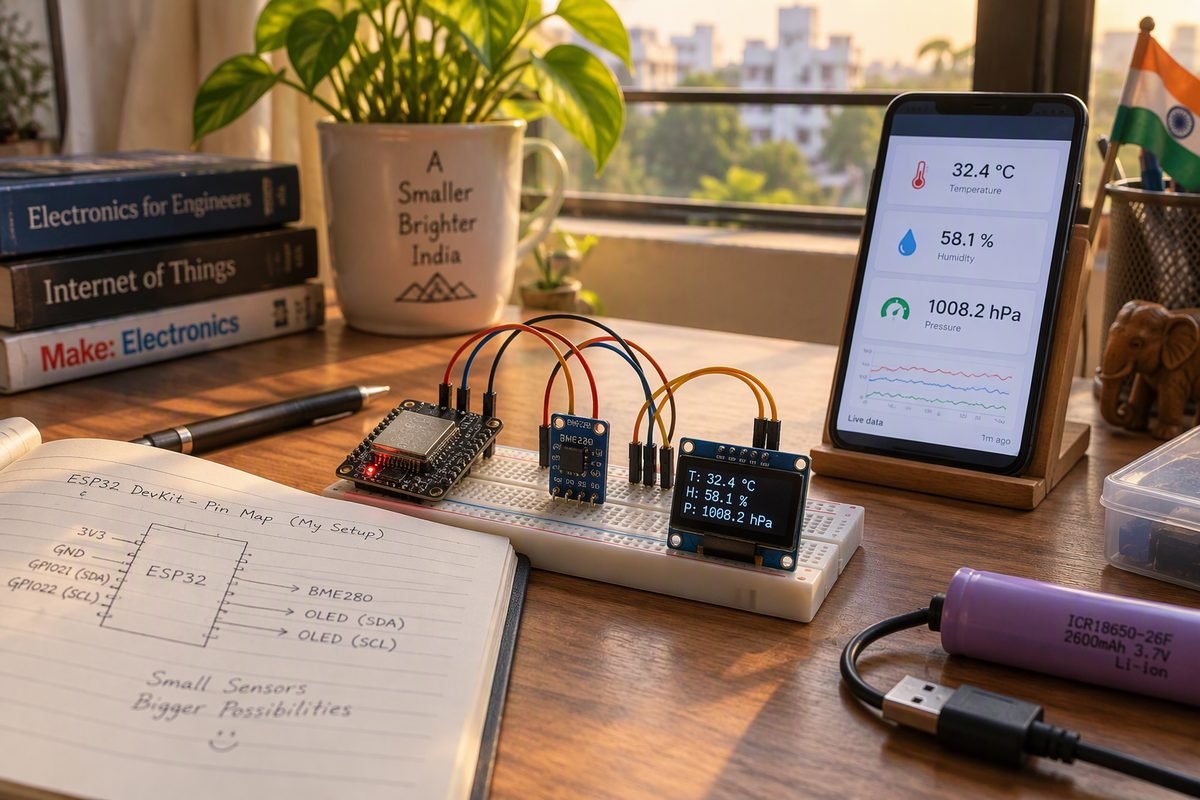
Reads a BME280 once a minute and logs it to a card with a timestamp.
Parts: ESP32 x1 ₹400-900, BME280 x1 ₹200-400, microSD module and card ₹350-750. Approach: scan the bus and note the 0x76 or 0x77 address. Log one CSV line per minute and close the file. Keep analogue sensors on ADC1; ADC2 stops working with Wi-Fi.
What kills it: polling every second warms the package and lifts the reading. Stretch: NTP timestamps and a published feed.
2. Wi-Fi dashboard served from the board
The board serves its own web page, so any phone on the network watches a reading without an app.
Parts: ESP32 x1 ₹400-900, DHT22 x1 ₹250-350, 10 kΩ resistor. Approach: join the router and serve a small page. Fetch a JSON endpoint every few seconds. Print the IP and keep delay() out of loop().
What kills it: one delay() blocks the server, the page times out and looks like a Wi-Fi fault. Stretch: an access-point fallback.
3. ESP32-CAM vision stream
A camera board streams MJPEG to a browser, the quickest route to vision without a Raspberry Pi.
Parts: ESP32-CAM x1 ₹550-900 with the MB USB base, or ₹450-650 bare plus an FTDI programmer ₹200-350. Approach: flash CameraWebServer, select AI Thinker, enable PSRAM. Power it from a supply that survives current spikes. The ESP32-CAM guide has the pin map.
What kills it: brownout. A laptop USB port cannot hold 5 V through the spikes, so camera init fails. Stretch: frame-difference motion capture.
4. BLE sensor with no router
Becomes a Bluetooth peripheral: a phone reads a value or writes a command, with no router.
Parts: ESP32 x1 ₹400-900, MPU6050 x1 ₹150-350, buzzer. Approach: define one service with one characteristic and notify on change. Test with a BLE scanner app before writing phone code. Print the name and UUID to serial.
What kills it: phones cache the last value, so a read shows stale data until notifications are on. Stretch: Wi-Fi credentials sent over BLE.
5. MQTT home automation node
Publishes readings to a broker and subscribes to a command topic that switches a relay.
Parts: ESP32 x1 ₹400-900, 5 V relay module ₹100-250, DHT22 ₹250-350, 5 V supply ₹150-400. Approach: use PubSubClient with a client ID unique to the board. Publish state as retained and set a last-will topic. Feed the coils from the supply, not the 3.3 V pin.
What kills it: two boards sharing a client ID disconnect each other, looking like weak Wi-Fi. Stretch: a local schedule.
6. Voice and audio node
An I2S microphone feeds a wake-word engine or sound-level meter, which proves the audio path.
Parts: ESP32-S3 x1 ₹900-2,200, INMP441 mic ₹100-250, MAX98357A amplifier ₹250-500, 4 Ω speaker ₹100-300. Approach: capture 16 kHz mono audio and plot the waveform first. ESP-SR lists the classic ESP32 among its targets, but memory decides which models fit.
What kills it: wrong I2S clock pins or a mic on a noisy rail produce hiss no model survives. Stretch: three offline command words.
7. Closed-loop motor control
Two geared motors held at speed against load, the line between a toy car and a control loop.
Parts: ESP32 x1 ₹400-900, TB6612FNG or L298N ₹200-450, encoder motors x2 ₹500-900, buck converter ₹150-350. Approach: PWM through LEDC, both encoders on interrupt pins, PID on a fixed 20-50 ms tick. Save a step-response plot. The Arduino and ESP32 comparison covers timers.
What kills it: encoder counts that jump when motor wires run beside signal wires. Stretch: odometry and heading hold.
8. GPS tracker
Reads NMEA from a GPS module, logs coordinates, and publishes position on a known network.
Parts: ESP32 x1 ₹400-900, NEO-6M with antenna ₹350-700, microSD module and card ₹350-750, 18650 ₹150-300, TP4056 ₹30-80. Approach: read UART2 at the default baud rate and parse with TinyGPSPlus. Confirm a fix outdoors before debugging code, and log raw sentences first.
What kills it: testing indoors. A cold start takes minutes outdoors and never finishes beside a window. Stretch: sleep between fixes, send over LoRa.
9. LoRa sensor link
Two boards, one sending and one receiving, over kilometres without a router or SIM.
Parts: ESP32 x2 ₹800-1,800, LoRa modules x2 ₹700-2,200, antennas x2 ₹200-500. Approach: wire the module on SPI and set the frequency to India’s 865-867 MHz plan. Test at 10 metres first. Log RSSI with every packet.
What kills it: the band. The common Ra-02 is an SX1278, a 137-525 MHz part per Semtech, so 868 MHz listings are wrong for India, and transmitting without an antenna can damage the amplifier. Stretch: acknowledgement and a link-budget chart.
10. TinyML classifier on the board
An accelerometer window goes in, a label comes out, and nothing leaves the device.
Parts: ESP32 x1 ₹400-900, MPU6050 ₹150-350. Approach: collect a few hundred labelled windows over serial, then train a model. Convert it for LiteRT for Microcontrollers and infer from a fixed buffer. The ESP32 has 520 KB of SRAM, so model and buffer compete.
What kills it: data collected in one mounting position and tested in another, so the model learns the bracket. Stretch: fan imbalance detection.
11. Robot car controlled from a browser
A four-wheel car driven from a phone browser, with the ESP32 serving the page.
Parts: ESP32 x1 ₹400-900, L298N ₹200-450, TT motors with wheels x4 ₹900-1,600, chassis ₹300-600, cells x2 ₹250-450. Approach: expose two HTTP endpoints per side or one JSON command, and drive speed with PWM. Give the motors their own rail and a common ground. If ₹2,200 is too much, the robot under ₹2,000 builds use smaller parts.
What kills it: motor current. Powering the driver from the board’s regulator resets the ESP32 on every start. Stretch: encoders and heading hold.
12. Solar and battery field node
Wakes on a timer, reads a sensor, sends a packet and sleeps, from a panel and one cell.
Parts: ESP32 x1 ₹400-900, 6 V panel ₹250-700, TP4056 or CN3065 ₹30-250, protected 18650 ₹150-300. Approach: deep sleep with a timer wake and the radio on only for the transmit window. Measure current with a USB meter. Publish battery voltage in every packet.
What kills it: the arithmetic. The chip draws about 10 µA asleep, but a DevKit’s regulator draws far more, and a TP4056 has no maximum power point tracking. Stretch: a measured duty cycle.
What each build proves to a recruiter
Nobody can verify that you know IoT, only what you built.
- Builds 1, 2 and 8 prove telemetry: datasheet reads, timestamps, reconnects.
- Builds 4, 5 and 9 prove protocols: BLE notifications, MQTT retained state, RSSI logs.
- Builds 7 and 11 prove control: PWM, encoder feedback, a tuned loop.
- Builds 6 and 10 prove budget thinking: audio and inference fitted into memory.
- Build 3 proves debugging: a fault in the power supply, not the code.
- Build 12 proves measurement: current, duty cycle and a battery curve you recorded.
What counts is the artefact: a repository with a pin map, a README of what broke, and a short report. None of this guarantees an interview.
Where to buy in India and what to avoid
Four kinds of seller cover this list, and they differ.
- Authorised distributors for genuine modules and full datasheets, at a higher price.
- Indian hobby retailers for single boards and sensors, usually with GST and a datasheet link.
- Marketplace listings for the cheapest unit and slowest verification; photos often show another revision.
- Local component markets for cash and same-day parts, with no returns.
The guide to buying robotics parts in India goes seller by seller. Six traps waste the most money:
- An ESP32-CAM with no USB base or FTDI programmer. It cannot be flashed.
- 868 MHz LoRa boards for an India build. The plan here is 865-867 MHz.
- 5 V sensor outputs on a 3.3 V pin. Check the datasheet ratings.
- Unprotected 18650 cells, and bundles with a battery but no charger.
- Relays and motors powered from the board’s own regulator.
- 30-pin and 38-pin DevKits treated as one board. Pin maps differ.
Buy two of the cheapest part per build: a dead sensor stalls more first projects than bad code. If basics are shaky, the Learn hub covers GPIO, PWM, I2C and UART.
Frequently asked questions
How much does a first ESP32 project cost in India?
A node that reads one I2C sensor and logs to serial costs ₹600-1,300 if you own a USB cable and breadboard. Add ₹250-500 for a card and ₹200-400 for shipping; the first build lands near ₹1,500. Buy a spare sensor.
Do I need an Arduino as well as the ESP32?
No. The ESP32 flashes from the same Arduino IDE once the board package is installed. An Uno is easier for 5 V shields and analogue reads during Wi-Fi, because ADC2 is unavailable then. Pick one board for the build. One board is also cheaper than two.
Which board should a beginner buy: DevKit, ESP32-CAM or ESP32-S3?
Start with a 38-pin DevKit: USB, a regulator and every pin on headers. Buy the ESP32-CAM only for camera work and the S3 only for audio. One DevKit covers most of the twelve builds here; camera, audio and LoRa are the exceptions.
Why does my ESP32 work on USB and reset on battery?
Two causes cover most cases: the rail sags when a motor or the radio starts, and the ground is shared badly. Measure the rail under load. A 3.7 V cell feeding a 3.3 V regulator has almost no headroom; use a boost module.
Can I submit one of these as a final-year project?
Yes, if you add what a college marks: a block diagram, a pin map, a test table with measured results, and a report separating what worked from what did not. Build 7 or 12 with an enclosure reads as a project; without evidence, as a tutorial.
Related reading: Arduino vs ESP32 for robotics · ESP32 pinout for robotics · MQTT telemetry from an ESP32 robot · ESP32-CAM vision streaming.
Sources
- Espressif, ESP32 Series Datasheet
- Espressif, ESP-IDF Sleep Modes
- Espressif, ESP-IDF ADC docs
- Espressif, Arduino ESP32 BLE library.
- Espressif, Arduino ESP32 LEDC
- Espressif, ESP-SR speech recognition.
- Random Nerd Tutorials, ESP32-CAM streaming
- Random Nerd Tutorials, ESP32 MQTT
- MQTT.org: the OASIS publish and subscribe standard.
- Google, LiteRT for Microcontrollers
- LoRa Alliance, Regional Parameters RP002-1.0.2: IN865-867 MHz.
- Semtech, SX1278: 137-525 MHz range.
- ThinkRobotics, ESP32-CAM-MB
- ThinkRobotics, SX1278 module