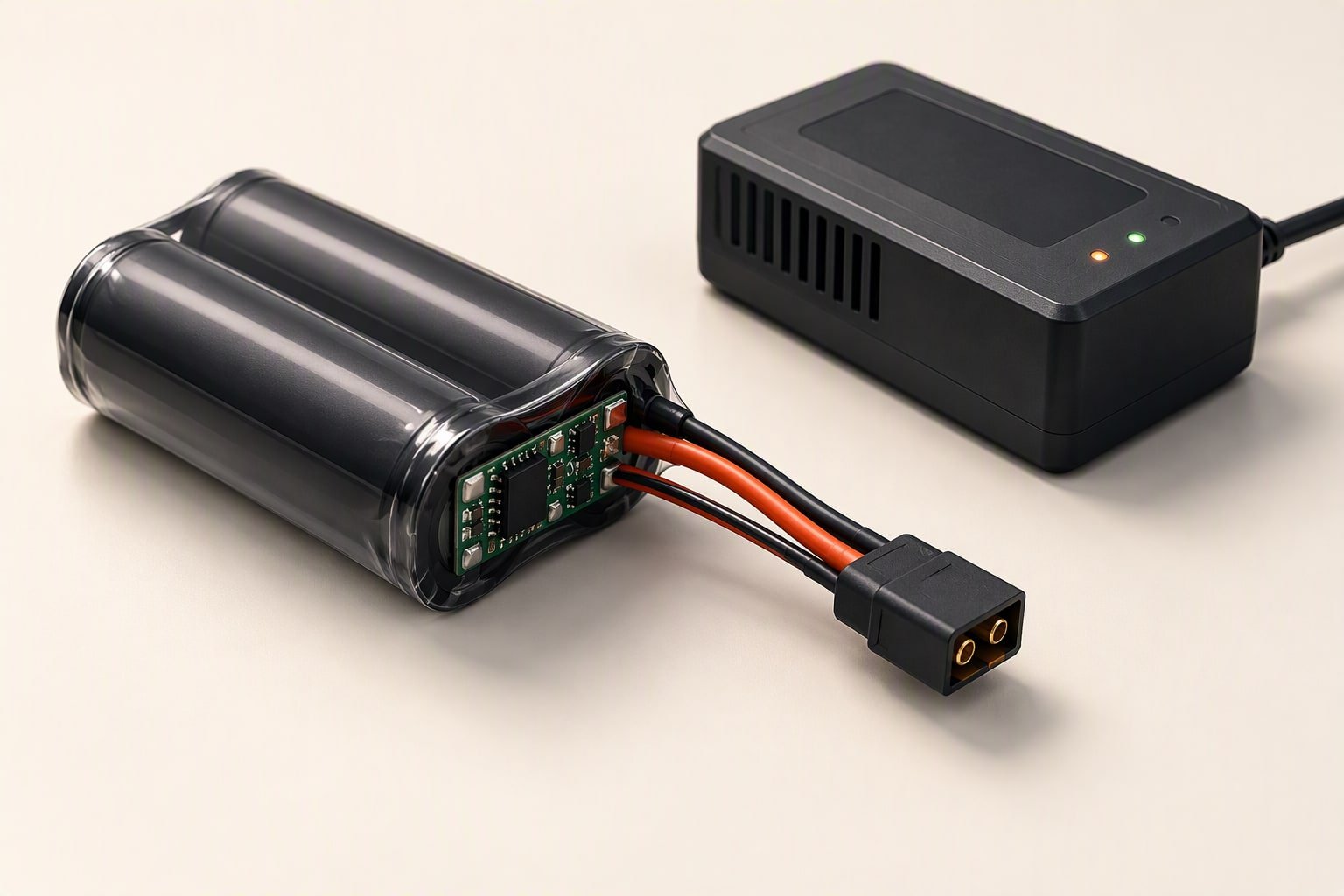
A 2S 18650 pack is a good robot battery only when it has a protection board, a proper charger and a fuse. Without those three things it is a fire risk with a connector. The cells are cheap and the energy density is excellent, but they are not AA batteries and must not be treated like them.
Key specifications
| Cell nominal voltage | 3.6–3.7 V |
|---|---|
| 2S pack voltage | 7.2–8.4 V |
| Capacity | 1,500–3,500 mAh per cell |
| Continuous current | 2–10 A depending on cell |
| Connector | usually DC barrel or XT60 |
| Protection | BMS required for bare cells |
| Charging | dedicated CC/CV charger only |
| Storage voltage | about 3.7 V per cell |
Substitute: A 6×AA NiMH pack for a safer first build, or a 2S LiPo with a balance charger for high current.
Series, parallel and what the numbers mean
A single 18650 cell is about 3.6–3.7 V nominal, 4.2 V fully charged and 2.5–3.0 V empty under load. Two cells in series (2S) give 7.2 V nominal and 8.4 V full, while the capacity in mAh stays the same as one cell. Two cells in parallel double the capacity but keep the voltage at 3.7 V. Most small robots want 2S: enough voltage for a motor driver‘s drop and a buck converter down to 5 V for logic. A 2S pack needs a BMS that balances the two cells, because they will drift apart over many cycles.
The mAh printed on a cell is not a promise. Genuine cells from known manufacturers sit around 1,500–3,500 mAh. Listings claiming 6,000 or 9,900 mAh in an 18650 are selling a number, not a cell. A capacity test with a proper charger is the only way to know what you bought.
Protection is not optional
Bare 18650 cells can deliver enormous current into a short circuit. A protected cell has a small board on the negative end; a pack has a BMS board that cuts off overcharge, over-discharge, over-current and short circuit. The BMS does not usually protect against overheating or internal failure, so it is a last line of defence, not a licence to charge unattended. Add a fuse on the main positive lead, sized above the robot’s normal current but below the wiring’s safe limit.
- Charge with a dedicated CC/CV charger set for the pack voltage — 8.4 V for 2S. A phone charger or a bench supply without a charge controller is not a charger.
- Charge at about 0.5C. For a 2,000 mAh pack, that is roughly 1 A. Faster charging shortens cell life and increases risk.
- Charge outside the robot, on a non-flammable surface, attended. Disconnect the pack from the robot first.
- Store at about 3.7 V per cell if the robot will sit for weeks. A full pack ages faster; an empty pack can be damaged by the BMS cutoff.
Using the pack in a robot
Feed the motor driver from the pack directly, and use a buck converter for the 5 V logic rail. Do not power a servo or a motor from the buck’s 5 V output unless it is rated for the stall current. Measure the pack voltage with a divider into an analog pin if you want a low-battery warning, and calibrate the divider with a multimeter. A 2S pack is empty around 6.0–6.6 V under light load; the BMS may cut off lower, but running to cutoff shortens life and can leave the robot stranded mid-run.
Wire the pack with a proper connector (XT60 or a rated barrel jack), a switch on the positive lead, and strain relief so the wires cannot pull on the cell tabs. Do not solder directly to cell terminals; use spot-welded nickel strip or buy a pack that is already assembled. Never mix old and new cells, and never parallel cells of different capacity or age without a balancing BMS designed for it.
Safer alternatives for a first build
| Option | Good for | Trade-off |
|---|---|---|
| 6×AA NiMH pack | A first robot, low current, supervised use. | Heavy, lower current, needs a NiMH charger. |
| 2S 18650 with BMS | Small robots, good runtime, rechargeable. | Needs a proper charger and protection; not a beginner’s first battery without guidance. |
| 2S LiPo with balance charger | High current, racing and high-performance builds. | More dangerous if abused; needs a LiPo bag and balance charging. |
| USB power bank | Logic-only projects and demos. | 5 V only, limited current, not suitable for motors. |
| Sealed lead acid | Heavy robots and long runtimes. | Very heavy for the energy; not for small builds. |
Buying checks
- Protected cells or a pack with a BMS — not bare cells with loose wires.
- A charger that states the chemistry and the 2S voltage, with a balance function for the pack.
- Real capacity from a seller with returns; ignore four-digit mAh claims.
- A fuse and a switch in the robot wiring, not just a connector.
- No swollen, dented or rewrapped cells. Retire them; do not “test” them in a robot.
Common questions
Can I use a 2S 18650 pack with an L298N?
Yes, 7.2–8.4 V is within the driver's range and gives the motors more voltage than a 6 V AA pack. Keep the logic ground common and check the motor rating.
Can I charge the pack while it is still connected to the robot?
No. Disconnect it and charge it on a non-flammable surface with a proper 2S charger. Charging in place risks the robot's wiring and electronics.
How long will a 2,000 mAh pack last?
Divide usable capacity by average current. A 2,000 mAh pack at 80% usable and a 600 mA average draw gives about 2 hours 40 minutes. Use the battery runtime calculator.
Do I need a BMS if the cells are protected?
Protected cells help, but a pack BMS still adds over-discharge and short-circuit protection and keeps the two cells balanced. Use one.
Related: battery runtime calculator, robot battery guide, obstacle avoiding robot, where to buy parts.
Keep reading
- How to power a robot — 2S packs, buck converters and shared grounds.
- Robot battery guide — Voltage, capacity and charging safety.
Sources and further reading
Documents used to check the numbers on this page:
- Battery University BU-205 — lithium-ion types, voltage and safety.
- Arduino Uno R3 documentation — pinout, current limits and input voltage.
Last reviewed: October 2026. Specifications checked against common 18650 cell datasheets and protection-board documentation. Prices are Indian retail ranges for protected packs and charger combinations.
Battery capacity has to match motor current; the motor selection guide covers the current estimate that sets pack size.
Where to buy in India
These open a store search. Compare seller, price and reviews before you order.