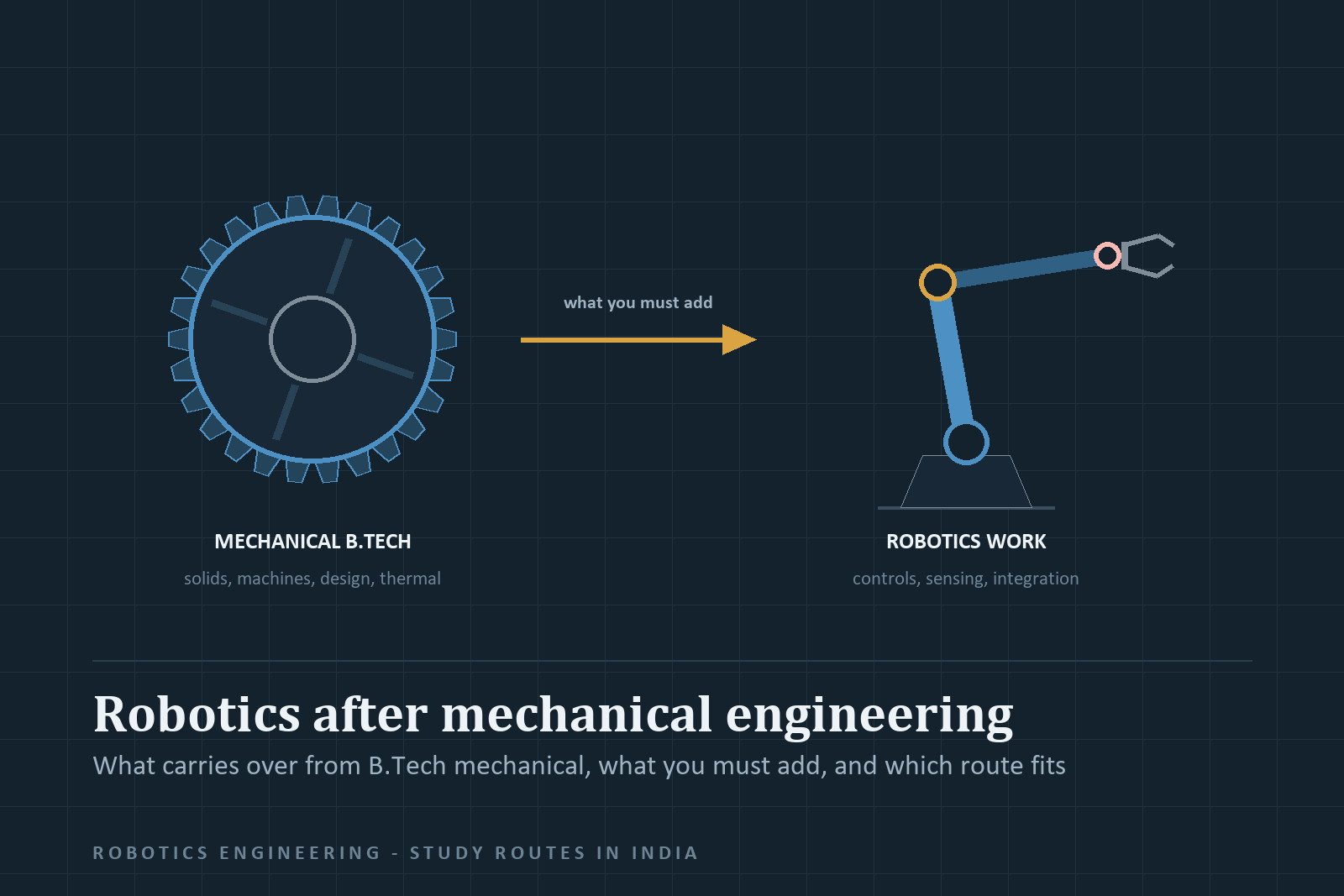
A mechanical B.Tech already contains a robotics course. AICTE’s revised model curriculum for the undergraduate Mechanical Engineering degree (2023) lists PCC-ME 302 Mechatronics, Robotics & Control as a fifth-semester core paper, 3 lecture and 2 practical hours a week for 4 credits, and its syllabus covers Denavit-Hartenberg parameters, direct and inverse kinematics, workspace estimation and path planning, robot vision, PLC principle and basic programming, P/PI/PID control, and simulation in Matlab, Scilab or ROBODK (official PDF).
That is the honest starting point for a robotics course after mechanical engineering. Eligibility is not the problem; depth is. One 4-credit paper gives you vocabulary. Hiring asks for a loop closed on a real motor, a controller fault log read at 2 am, and a safe stop wired correctly. The gap for a mechanical graduate is controls and code, not CAD.
Does a mechanical engineer fit robotics?
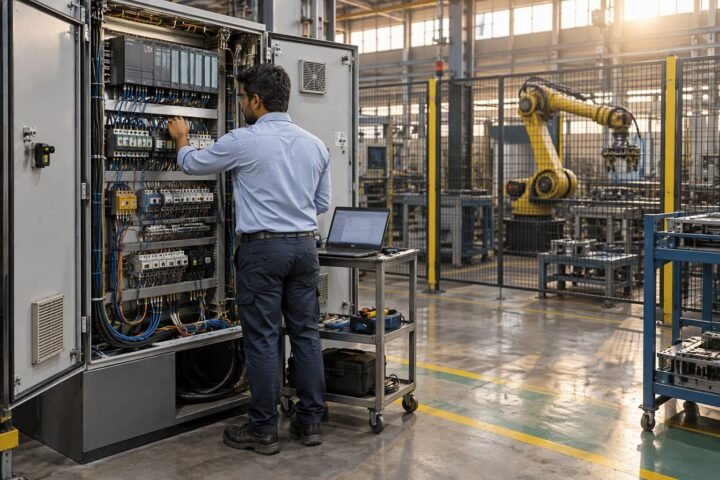
Robotics work in Indian companies splits by who owns the machine, and that split decides what an interview tests. Design, structure, application and maintenance roles take a mechanical graduate on day one. Programming and controls roles ask for proof you have not produced yet. The automation engineer career in India page maps those employer types in detail; the reading below is the mechanical one.
| Where you sit | What you bring | What is missing | Route covered here |
|---|---|---|---|
| Cell integrator | Fixture, gripper and guarding geometry | Controller operation, IO handshake, fieldbus | Robot integrator selection in India, commissioning checklist |
| Machine builder or SPM OEM | Mechanism design, tolerance chains, part selection | Cycle-time simulation, controls scoping | Mechanical design interview questions for robotics |
| In-house maintenance | Wear, lubrication, alignment, spare judgement | Controller backup, safety proof tests | Maintenance engineer robotics career in India, robot operator training in India |
| Design outside the cell | Structures, sheet metal, GD&T drawings | Drive sizing under real duty | Robot cell layout design, 3D printed robot parts design |
| R&D | Dynamics, mechanics, metrology discipline | Graduate control, estimation, software stack | Robot arm kinematics basics, embedded systems career in India |
What your mechanical degree already carries into robotics
Treat each transfer as a claim you can point at in a syllabus, not as a feeling.
| Degree content | Robotics work where it survives | Where it stops |
|---|---|---|
| Machine design and strength of machines | Bases, mounting frames, gripper jaws, welding and checking fixtures | Duty-cycle fatigue gets specified by whoever has watched a cell run |
| Power transmission and gearboxes | Axis, lift and positioner transmission choices (servo drive selection guide) | Backlash, inertia matching and tuning are control conversations |
Measurements and metrology, PCC-ME 304: limits and fits, geometric tolerances, Taylor’s principle of gauging (AICTE PDF) | Inspection cells, datum schemes, repeatability versus accuracy | It says nothing about how the controller reports error |
| Thermodynamics and heat transfer | Panel thermal load, cabinet cooling, drive derating | The fan is sized after the electrical load list exists |
| Fluid mechanics and machines | Pneumatic and hydraulic grippers, vacuum pads, cylinders | Short-stroke accuracy comes from valve logic |
| CAD, GD&T, BOMs and ECNs | Manufacturable drawings and documentation | Modelling alone is not scarce |
CNN Robotics’ Pune Senior Mechanical Design Engineer advertisement asks for a bachelor’s degree or diploma in Mechanical Engineering, GD&T and gauge design, welding fixture and positioner design, leak-test fixtures, and sizing calculations for motors, gearboxes, bearings, linear guides and couplings. Those are your subjects, written by a robotics company. The counterweight is that a portfolio of models alone reads as a designer who has never been told the part failed on site.
What the degree does not give you
Discrete control logic comes first. The PLC programming for beginners in India and PLC programmer salary in India pages exist because a mechanical curriculum rarely leaves a graduate able to sequence a conveyor, a cylinder and a sensor with alarms. CNN Robotics’ PLC/HMI Programmer posting states the entry route plainly: BE, B.Tech or diploma in Electrical, Electronics or Instrumentation, four to six years in industrial automation, hands-on Siemens S7-1200, S7-1500 and TIA Portal. Your branch is not in that line, and that is a filter to buy past rather than argue with.
Drives and power electronics are the second hole: current ripple, H-bridge behaviour, BLDC and PMSM control, braking and derating. Sensing and signal conditioning is the third: 4-20 mA loops, encoders, resolution, grounding, and telling noise from a fault. Embedded code is the fourth, and the Arduino vs ESP32 for robotics comparison is a better first decision than a robot operating system.
Then the craft nobody teaches in a degree. The CNN Robot Programmer advertisement lists TCP setup, payload configuration, mastering and user frame creation as duties, requires hands-on ABB, KUKA, FANUC and YASKAWA experience, and names Profinet, EtherNet/IP and DeviceNet. Its degree line is Electrical, Electronics, Mechatronics or Robotics. Mechanical is absent.
Which Indian robotics jobs actually name mechanical
Read the degree line and the tool line of an advertisement before you spend an hour on a cover letter.
- Design and structure roles name Mechanical. The CNN Senior Mechanical Design Engineer post asks for 15+ years in mechanical design and industrial automation.
- Application and proposal work is the strongest entry for a mechanical graduate who can talk. CNN’s Senior Application Cum Proposal Engineer accepts a bachelor’s or diploma in Mechanical Engineering, Mechatronics, Automation Engineering or Robotics Engineering, six to eight years in automation, robotics integration or SPM work, with knowledge of FANUC, ABB, YASKAWA and KUKA robots plus costing and project estimation.
- Programming and controls posts usually omit mechanical, as the two earlier advertisements show. Closing that gap is a skills purchase; the robotics skills roadmap for India is the sequence.
- Field entry is mixed by employer. Robotics jobs for freshers in India shows where openings actually appear, and how to get a robotics internship in India is the cheapest way to buy controller time on a live cell.
Decision rule: when the degree line omits your branch, the rest of that paragraph lists what compensates. Hands-on brand experience, site travel and named tools are all purchasable with time and parts. The branch line is not.
Route 1: M.Tech or M.E. in robotics after mechanical
A master’s is the only route that renames your branch on paper, so check published eligibility before shortlisting anything. If you have not yet decided that another degree is the right purchase at all, how to become a robotics engineer in India compares the same three entry routes without the mechanical filter, and its twelve-month plan is the branch-agnostic version of the build lists below.
IISc Bangalore admits to Robotics and Autonomous Systems, run by the Robert Bosch Centre for Cyber-Physical Systems, with an intake of 17 seats for 2026-27, open to a BE, B.Tech or four-year BS in any discipline holding a valid GATE score in one of AE, BM, CS, DA, EC, EE, IN or ME, selected on 70% GATE score plus 30% interview (IISc intake seat matrix). The same page lists control and optimisation, ROS and ROS 2 software stacks, sensing and actuation, control of industrial robot arms and real-time embedded systems as areas of study, which is the syllabus you are missing. IISc’s course-programme fee table gives tuition of Rs 15,000 per annum, a total of Rs 35,800 for general, OBC and EWS students, Rs 20,800 for SC, ST and PwD students, and the note that fees and charges increase uniformly at 5% annually (IISc fees and scholarships).
Anna University’s eligibility schedule accepts Mechanical Engineering into M.E. Robotics, M.E. Industrial Automation and Robotics, and M.E. Mechatronics (Anna University eligible qualifications, PDF). Dr B R Ambedkar NIT Jalandhar’s 2026-27 self-sponsored M.Tech advertisement sets a first-class bar of 60% or CGPA 6.5, 55% or 6.0 for SC, ST and PwD candidates, admits GATE-qualified candidates without any entrance test, runs an institute test on the GATE-2026 syllabus for everyone else, charges Rs 1,000 application fee and publishes a tentative fee of Rs 85,500 per semester for hostellers or Rs 77,000 for day scholars, mess charged separately (NIT Jalandhar advertisement, PDF). NITs, IIEST Shibpur, some IIITs and CFTIs fill M.Tech seats through CCMT on GATE scores from 2024, 2025 and 2026 (CCMT).
The artefact is a transcript plus a thesis, which decides nothing by itself and a great deal if the thesis contains a machine. Wrong for anyone who needs income inside 24 months, and for anyone whose target role already names mechanical. Price the two years against your own last drawn pay and the bands on the robotics engineer salary in India page, then read robotics course fees in India before you commit.
Route 2: a short structured course with a credit trail
Three products, not one category.
Free structured credit. NPTEL makes all its courses free to enrol and learn from, with an optional in-person proctored certification exam at Rs 1,000 per course, and states that certificates are envisioned for use in credit transfer to universities (about NPTEL, SWAYAM NPTEL). Its twelve-week Introduction to Robotics from IIT Madras runs from coordinate transformations, homogeneous matrices and the DH algorithm through forward and inverse kinematics, the manipulator Jacobian and statics, DC motor equations, power electronic switching, the H-bridge, brushless DC and PMSM control, encoders and stepper motors, then Bayes and Kalman filters, particle filters and localisation (course page). Half that list is your gap, at the price of one exam fee. Do it, then build what it describes.
A second degree. IIT Madras’ online Bachelor of Science in Electronic Systems admits anyone who completed class 12 with Physics and Maths irrespective of age, requires 142 credits, expects four to eight years, prices the BS level at Rs 6,000 per credit for 56 credits or Rs 3,36,000, with the entire programme at Rs 5,80,000 without any fee waiver, and mandates on-campus lab demonstration (programme, fee table, admissions and kit rules). For a graduate who already holds a degree this is the wrong instrument unless a reissued transcript is the goal.
Executive and vendor certificates. IIT Delhi’s CEP unit – the page signs its certificates “CEP, IIT Delhi” and the footer reads “Copyright CEP IITD”, while the organising department for this course is named as the Centre for Biomedical Engineering – lists an Executive Programme in Robotics (Batch 04) at five months, online, Rs 1,69,000 plus 18% GST, open to any graduate with a minimum of 50% marks, with a Rs 1,000 application fee that is non-refundable and, in the page’s words, “will not be adjusted in the total programme fee” (CEP programme page). The certificate is conditional, not automatic: at least 50% marks overall with 50% attendance earns a “Certificate of Successful Completion”, anything below earns a “Certificate of Participation”, and the page adds that “Only e-Certificates will be issued by CEP, IIT Delhi for this programme”. Two practical caveats sit on the same page: Batch 04’s application deadline was 30 October 2026, and TimesPro is named as the service provider, so a future batch rather than this one is the realistic entry. KUKA College India separately offers IHK-certified robotics courses run with IQ Bremen, hands-on, with an official IHK certificate (KUKA College). One is a line on a CV. The other is controller-specific competence a site engineer recognises, and it is the second one that changes the work you are handed.
Say the uncomfortable part plainly: a paid coaching-chain robotics certification is not equivalent to a portfolio. Certificates clear filters; interviewers decide on machines. Cost per person for OEM-format courses sits on the robot operator training in India page, which owns those bands.
Route 3: a portfolio bought with a parts budget
This route works only against a build list, because free theory is not the constraint. If hostel rules or money block parts, learn robotics without hardware covers simulation-first work, and the starter kit guide, where to buy robotics parts in India and robot under Rs 2,000 in India pages own the rupee questions. The mechanical version is not a line follower. It is one mechanism you calculated, one drive you sized, one loop you closed, one document you wrote.
| First 90 days | Build | Parts and tools | What survives an interview |
|---|---|---|---|
| Weeks 1-3 | Bench up and measure | ESP32 DevKit, breadboard, multimeter, ESP32 pinout for robotics | A table of measured voltages and currents, with one brownout explained |
| Weeks 4-6 | One axis under control | Geared DC motor or NEMA 17, TB6612FNG, encoder, stepper motor Arduino guide | A closed-loop position plot and the missed-step log |
| Weeks 7-9 | Kinematics, then code | Two-link geometry, Python, inverse kinematics for a 2-link arm in Python | A script that reaches a point and reports joint error in millimetres |
| Weeks 10-12 | One pick-and-place cell | Servo or pneumatic gripper, pick and place robot arm with Arduino, motor selection for robots | Two pages: your sizing arithmetic, then what failed and how you fixed it |
Months 4 to 12, one artefact per quarter. Quarter two is a 3-DOF arm you designed, using robot chassis design for beginners and a printed or machined joint from 3D printed robot parts design, with the tolerance stack-up stated on the drawing. Quarter three adds the software layer: task structure from ESP32 FreeRTOS robot tasks, telemetry via MQTT on ESP32 for robot telemetry, and a phone interface from Android app to control a robot with ESP32. Quarter four goes industrial: a final year robotics project documented against a robot cell layout design plan and a robot cell commissioning checklist, then the FANUC, KUKA, ABB and YASKAWA comparison so you can name a controller and a pendant honestly. Safety literacy is what makes a mechanical candidate credible on site: cobot risk assessment in India and robot safety validation in India cover the two documents a customer signs. Present the whole set using the robotics portfolio projects guide.
What a hiring integrator can verify on your CV
Site truth is narrow: which controller you have touched, what you measured, and whether you can describe a fault you fixed. Everything else is inference.
If your robotics experience is one Arduino project, write the engineering content of that project instead of the kit. “Sized a 12 V geared drive for a 0.4 kg payload, wrote the torque and inertia calculations, closed a position loop, logged 6 missed steps per reversal before adding encoder debounce” is verifiable. “Certified in robotics and IoT” is not, and the first version puts the next question somewhere you can answer. The robotics resume for freshers in India page has the format; this is the mechanical line on top of it.
Weights differ by credential type. A GATE score and a named university programme carry academic weight. IHK or OEM vendor certificates carry controller-specific weight with the people who staff cells. A generic multi-topic certificate carries filter weight only and evaporates in a technical round. Tools that recur in the advertisements quoted above are TIA Portal, S7-1200, S7-1500, Profinet, EtherNet/IP, DeviceNet and the four robot brands; naming one of each reads as someone who has stood near a machine. For expectations in a negotiation, use the bands on our automation engineer career page and check them against a current advertisement the same week.
Money and time, in the right order
| Route | Cash you can check on an official page | Time | End artefact | Wrong for |
|---|---|---|---|---|
| M.E. or M.Tech | Rs 15,000 per year tuition at IISc; Rs 85,500 per semester tentative at NIT Jalandhar | 2 years plus GATE preparation | Transcript and thesis | Anyone needing income now |
| NPTEL or SWAYAM course | Free to learn, Rs 1,000 per optional proctored exam | 4, 8 or 12 weeks per course | Exam certificate plus the build it describes | Anyone who enrols and does not finish |
| Executive or vendor programme | Rs 1,69,000 plus GST for the IIT Delhi CEP robotics executive programme | 5 months, or a short hands-on block | E-certificate, or controller-specific skill | Anyone expecting paper to do the work of a machine |
| Parts and self-build | Kit bands on the starter kit and course fees pages | 90 days to one artefact, 12 months to a profile | Machines, drawings, logs, write-ups | Anyone who will not write anything down |
Every figure above was read from the institution’s own page on 2026-11-01, and all of them move. IISc states a uniform 5% annual increase on tuition and charges; the Jalandhar table is labelled tentative with dates the institute may change. Read the fee notification for the year you are joining, and read four fields specifically: tuition per semester, hostel and mess, examination and admission fees, and the refund clause with its window. Where a programme publishes no fee openly, ask before payment, not after.
Opportunity cost belongs in the same arithmetic. Two years out of a salary line usually exceeds the published tuition, and the honest way to price it is your actual last drawn pay against what a current advertisement for the target role offers, not against the top package in a brochure.
Who this page is for, and who publishes it
Robotics Engineering is published by Jaadu Digital, an industrial automation practice, which is why this reads as a curriculum audit rather than a course directory. The editing and sourcing method, including where AI assistance is used and how claims get checked, is on the editorial standard page. For the design and calculation subjects this page assumes you already have, our sister reference run by practising mechanical engineers, EngiTech, covers them.
No degree, certificate or kit list replaces the one thing employers test: a machine you built, sized, debugged and wrote down.
Frequently asked questions
Does a mechanical engineer fit robotics?
Yes for design, structure, application and maintenance work, which is most of the Indian market. Automation advertisements for senior mechanical design and application roles accept a bachelor's or diploma in Mechanical Engineering outright. Robot programming and PLC roles list Electrical, Electronics, Instrumentation, Mechatronics or Robotics instead, so a mechanical graduate bridges that gap with named tools and hands-on controller time rather than with a second degree.
Is there a robotics course after mechanical engineering that I actually need?
No course is required. AICTE's mechanical model curriculum already mandates a fifth-semester Mechatronics, Robotics and Control paper covering DH parameters, forward and inverse kinematics, PLC programming and PID control, so the shortfall is depth in drives, sensing, embedded code and controller operation. That is cheaper as a free NPTEL or SWAYAM course plus the Rs 1,000 optional exam than as an expensive generic certificate.
Which is better, M.Tech robotics after mechanical or a portfolio?
A master's renames your branch and suits research, R&D and teaching entry, with published eligibility such as Anna University accepting Mechanical into M.E. Robotics and IISc admitting any discipline holding a valid GATE paper in ME among others. A portfolio is faster, cheaper and decisive for integration and design jobs. If you need income within two years, build first and defer the degree.
What robotics skills for mechanical engineers matter most?
Discrete control logic on one PLC platform, drive and power electronics fundamentals, sensing and signal conditioning, C on a microcontroller, and one robot controller's operating craft such as TCP setup, mastering, payload configuration and user frames. The tools repeating in India postings are TIA Portal, S7-1200, S7-1500, Profinet, EtherNet/IP, DeviceNet and ABB, KUKA, FANUC or YASKAWA robots.
How long does the transition from mechanical to robotics take?
Ninety days to a first verifiable artefact at eight to ten hours a week with a small parts budget, and about twelve months to a profile that clears an integrator's technical round. A master's is two years plus GATE preparation, and the online B.Sc. route at IIT Madras is officially four to eight years with in-person lab demonstration on campus.
Will a coaching centre robotics certification get me hired?
It can pass an initial filter and nothing more. Interviewers decide on evidence: which controller you touched, what you measured, what failed. IHK or OEM vendor courses such as KUKA College India carry real weight because they are specific to a controller, while a generic multi-topic certificate rarely survives a question about a fault you fixed.