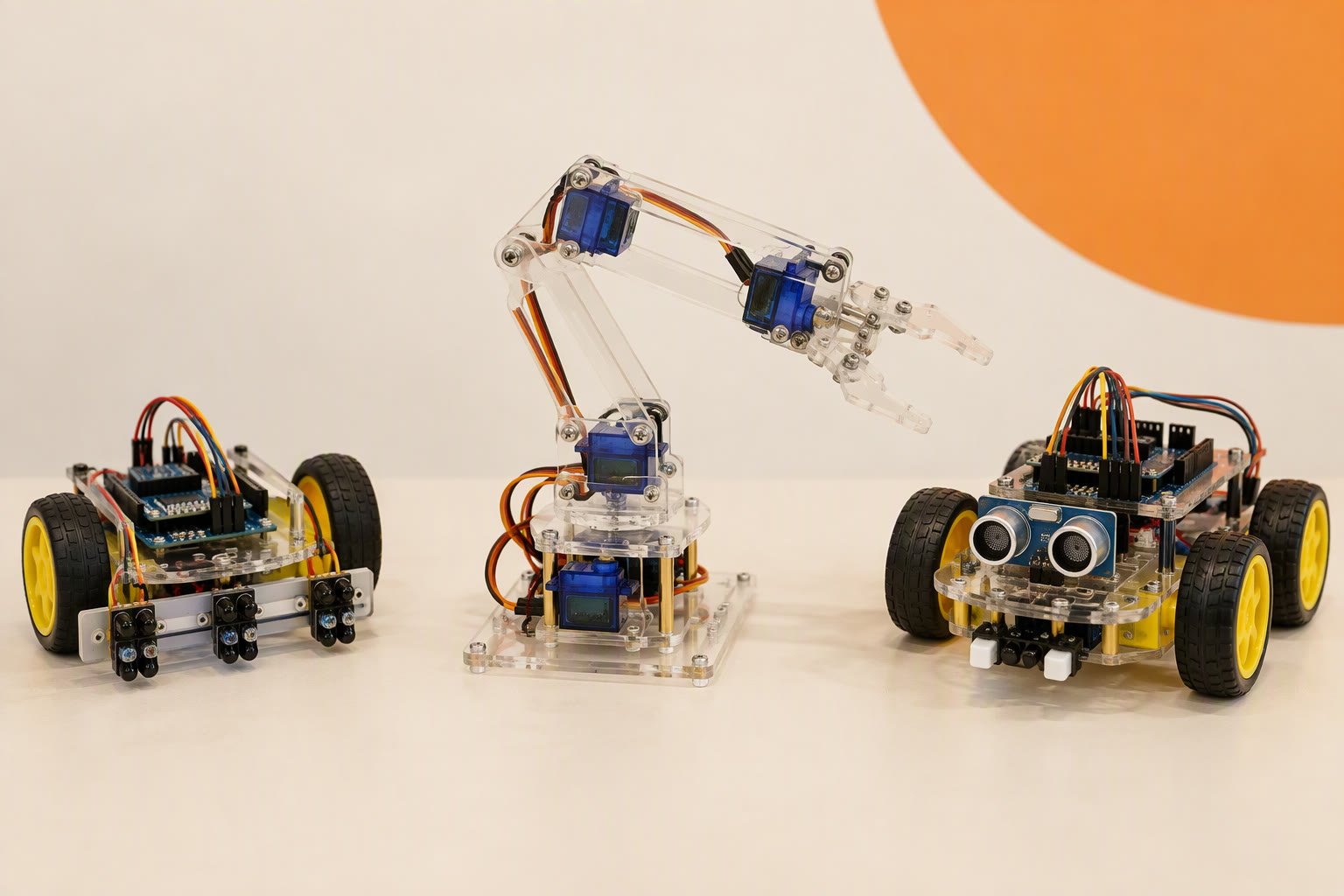
A diploma robotics project should be finished, tested and explainable in one semester, which usually means one mechanism, one sensor story and a parts budget of ₹10,000 or less — not a scaled-down B.Tech thesis. The eight ideas below are chosen for what a polytechnic student can actually complete between lab slots, with honest notes on where each one goes wrong. Good diploma robotics projects are finished, tested and explainable within one semester on a modest parts budget.
Budgets are parts only, at typical Indian retail prices in October 2026. Build weeks assume you work in the lab two or three afternoons a week and have the parts in hand by week two.
What the examiners are actually marking
A diploma project is not judged on novelty. It is judged on whether the machine works on demand, whether you understand every block in it, whether you measured anything, and whether the wiring is safe. A modest build with a test log beats an ambitious one that worked once, in front of one person, on one battery.
Most polytechnic semesters run about 15–16 weeks alongside other subjects, so the build window is smaller than it looks. Choose a project whose hardest part you can test at least ten times before the viva. That single constraint removes half the ideas on most student lists, including anything that depends on a camera working in a corridor with changing light.
Eight diploma robotics projects with honest budgets
| # | Project | Budget | Build weeks | Main risk |
|---|---|---|---|---|
| 1 | PID line follower with a lap counter | ₹3,000–5,000 | 6–8 | Tuning on the actual track |
| 2 | Obstacle-avoiding rover with edge detection | ₹2,500–4,000 | 4–6 | Sensor noise and a weak 5 V rail |
| 3 | 3-DOF arm with record and playback | ₹6,000–10,000 | 8–10 | Gripper design and repeatability |
| 4 | Smart dustbin with fill-level alert | ₹2,000–3,500 | 3–4 | False triggers from people walking past |
| 5 | Wi-Fi car with phone telemetry | ₹2,500–4,500 | 4–6 | Latency and a missing failsafe |
| 6 | Solar soil-moisture watering node | ₹3,500–6,000 | 6–8 | Waterproofing and the energy budget |
| 7 | Tape-guided AGV with station stops | ₹5,000–8,000 | 10–12 | Stopping accuracy and marker recovery |
| 8 | Gesture-controlled hand | ₹4,500–8,000 | 8–10 | Calibration across users and mechanical fit |
Ideas that finish within eight weeks
1. PID line follower with a lap counter. A five-channel IR array, a driver and two geared motors. The lap counter can be a second sensor at the start line or a beam break. You need a fixed track, ten clean runs and a table of lap times. Start from the line follower build, then add the control loop from PID control explained. This is the safest strong project on the list.
2. Obstacle-avoiding rover with edge detection. An ultrasonic sensor looks forward; two IR reflectance sensors look down for a table edge. The demonstration is a rover that stops at a wall and refuses to drive off a table. It is honest, visible and cheap. The risk is electrical: sensor chatter and a 5 V rail that dips when the motors start look like software bugs.
4. Smart dustbin with fill-level alert. A servo opens the lid, an ultrasonic sensor measures how full the bin is, and an ESP32 or a small OLED shows or sends the level. Be precise in the report: this is a sensor-triggered lid with a fill estimate, not artificial intelligence. It finishes quickly, which leaves time for proper testing and a tidy enclosure.
5. Wi-Fi car with phone telemetry. An ESP32 serves a small web page with direction buttons and shows battery voltage and commanded speed. The engineering is in the failsafe: if commands stop arriving, the car stops within a defined time. Test with the phone in airplane mode and with the router switched off, and report both.
6. Solar soil-moisture watering node. A small panel, a charge controller, a 3.7 V cell, a soil-moisture sensor and a pump that waters one pot. Do not call it a rover, and do not claim crop-yield improvement. The valuable result is an energy budget: what the panel delivers on a cloudy day against what the pump and electronics consume. Water and mains electricity need supervision.
Ideas that need most of the semester
3. 3-DOF arm with record and playback. Three servos, a laser-cut or 3D-printed frame and a gripper. Record joint angles from three potentiometers, store a sequence, then replay it. That is teach-pendant behaviour without inverse kinematics, and it is a legitimate diploma scope. The gripper is the project: if it cannot hold the object through a move, nothing else matters. Budget for MG90S-class servos and a separate 5–6 V supply.
7. Tape-guided AGV with station stops. A line follower that counts station markers and stops at each one, then resumes. Add a simple error message when a marker is missed. This is not SLAM and should not be described as autonomous navigation. The measurable claim is stopping repeatability over ten runs at each station, which is exactly what an examiner can check.
8. Gesture-controlled hand. Three to five servos, flex sensors or an MPU6050, and a frame that fits a hand without pinching. The demo is a glove that opens and closes the fingers. Budget for a second set of sensors, because calibration differs between users, and plan a mechanical prototype before the final frame. Medical or prosthetic claims are out of scope.
What examiners actually ask
Examiners judge diploma robotics projects on whether you can explain what you built.
- Draw the block diagram and trace the power. Where does each voltage come from, and what happens at stall current?
- Why this sensor? What are its range, its blind spots and its failure mode?
- How many trials, and how many failed? “It worked” is not a result. Ten runs with a completion count is.
- What happens when the battery drops? Does the robot behave predictably, or does the controller reset?
- What runs every loop, and how long does it take? A delay in the loop is a design decision you should be able to defend.
- What did you change after testing? The best answers describe a fault, a measurement and a fix.
- What is yours? Name the reference design, then name what you added, changed or tested.
- What would you cut with half the budget? This separates students who understand the build from those who copied a bill of materials.
Buy it, borrow it, or use lab stock
| Item | Decision | Why |
|---|---|---|
| Arduino Uno or Nano | Buy | You need it outside lab hours; a clone costs ₹450–800 or ₹280–450. |
| Multimeter | Buy | ₹250–400, used every session, and it answers most reset mysteries. |
| Bench power supply | Borrow | Lab equipment; a battery pack is enough for the demo. |
| Oscilloscope or logic analyser | Borrow | Useful for PWM and serial faults; a ₹400–800 USB analyser is optional. |
| Soldering iron and drill | Borrow | Lab tools, unless you will keep building after the diploma. |
| 3D printer | Borrow | College or maker space; make a cardboard or acrylic prototype first. |
| Battery pack and charger | Buy | Safety and availability; do not rely on a shared pack for demos. |
| Critical sensor | Buy two | The spare is cheaper than a delayed submission. |
| Servos and driver | Check lab stock first | Departments often have these; buy only the size you need. |
Diploma scope versus degree scope
| Dimension | Diploma project | Degree project |
|---|---|---|
| Question being answered | Does it work reliably? | Why does it work, and is it better than an alternative? |
| Typical budget | ₹2,000–10,000 | ₹4,000–30,000 |
| Build window | 4–12 working weeks | 12–16 weeks plus iteration |
| Maths | Thresholds, geometry, simple control | Control theory, kinematics, probability |
| Testing | Ten runs, completion and repeatability | Baselines and designed trials |
| Software | One sketch or one small program | ROS 2, vision or multiple nodes |
| Report | Build, test log, results | Literature review, method, analysis |
| Defensible claim | “It completes this track at this rate.” | “It improves this metric against a baseline.” |
If you later move to a degree, the final-year project guide covers the larger budgets and the ROS 2 and vision work that a diploma project usually avoids. The report format guide applies to both, and the cost calculator adds shipping and contingency before you order.
A sixteen-week plan that leaves time for the report
- Weeks 1–2: choose the project, order the risky part, and write the block diagram and budget.
- Weeks 3–4: test every module alone on the bench and record voltages.
- Weeks 5–7: integrate mechanics, power and code; get one full demo working badly.
- Weeks 8–10: tune, fix failures and keep a dated test log.
- Weeks 11–12: run the formal trials and build the results table and figures.
- Weeks 13–14: write the report, then revise it against the format guide.
- Week 15: rehearse the demo and the viva questions with a classmate.
- Week 16: buffer. Something will arrive late or fail on the day.
A diploma in robotics or electronics does not end at the viva. The build log, the report and the demo video are the portfolio that gets you an interview; the fresher jobs guide explains what employers ask for at that level.
Two project briefs with real commercial demand: a pipe inspection robot for drains and an agricultural row-following robot for polyhouses.
If the project involves a moving arm or a cobot, the robot safety standards guide covers the stop-distance and guarding basics examiners ask about.
If you are comparing qualifications, robotics course fees in India sets out diploma, degree and online options side by side.
See also: robotics competitions in India for a deadline that makes a project real.
Most diploma projects start with a base plate, and this chassis guide covers the maths before you drill.
Sources and further reading
Pin limits and board behaviour are documented by Arduino in the Uno Rev3 documentation and the language reference. For battery safety in the watering and rover projects, read Battery University on lithium-ion types before you build a pack.
Last reviewed: October 2026. Prices are parts-only Indian retail ranges and vary with seller, clone quality and stock. Check your department’s scope, safety rules and lab stock before ordering.