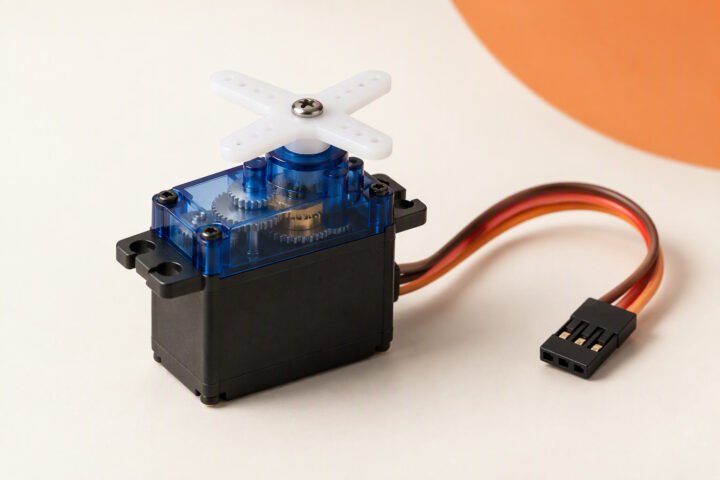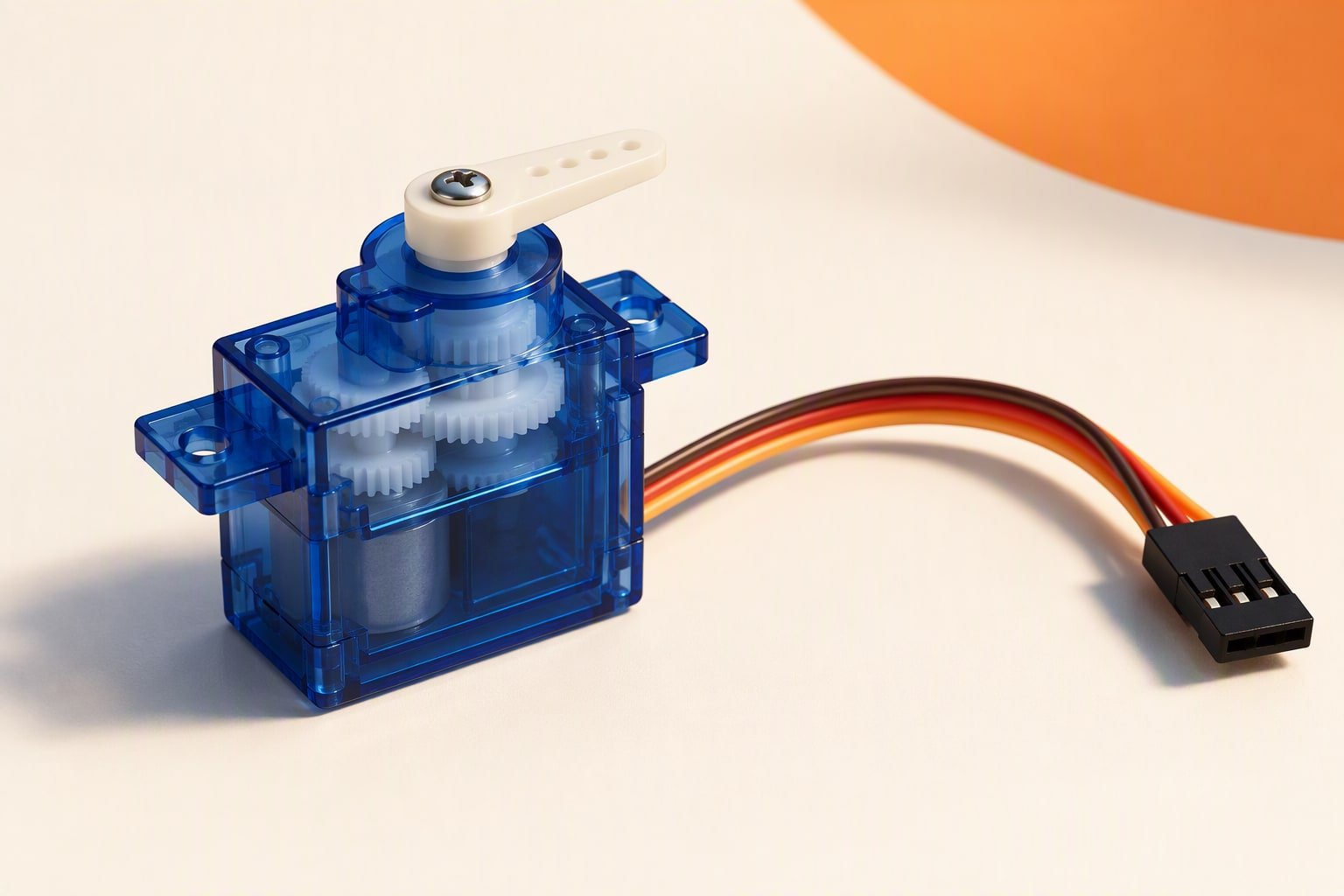
The SG90 is a ₹120–₹250 plastic-gear servo that is perfect for a demo and wrong for a joint that carries load. Its 1.8 kg·cm torque is measured at the horn, not at the end of an arm, and its stall current can reset an Arduino that is trying to power it. Use it for light grippers and sensor pans; use a metal-gear servo for anything that has to survive a semester.
Key specifications
| Weight | 9 g |
|---|---|
| Torque | 1.8 kg·cm at 4.8 V |
| Speed | 0.1 s per 60 degrees at 4.8 V |
| Operating voltage | 4.8–6 V |
| Idle current | about 5 mA |
| Moving current | 100–250 mA |
| Stall current | up to 650 mA |
| Gears | plastic |
| Rotation | 0–180 degrees |
Substitute: MG90S for metal gears, or MG996R for a standard-size joint.
What the numbers mean
Torque in kg·cm tells you how much weight the servo can hold at a 1 cm arm. At 10 cm, the same servo holds roughly one-tenth of that, and that is before friction, linkage losses and acceleration. An SG90 rated at 1.8 kg·cm is therefore a 180 g load at 1 cm or an 18 g load at 10 cm in the ideal case. In practice, plan for half the rated figure and add margin for shock. Plastic gears strip when a horn is forced or when the joint hits a stop under power.
The speed figure — about 0.1 s per 60 degrees at 4.8 V — is more honest for small builds. It is fast enough for a pan-and-tilt sensor, a gripper and a walking-demo leg. It is not fast enough for a balancing robot, and it is not precise enough for a camera gimbal that has to hold an angle against vibration.
Power it separately, every time
The signal wire draws almost nothing; the motor inside does not. An SG90 can pull 100–250 mA while moving and up to 650 mA when stalled. The Arduino’s 5 V pin is not a servo supply, and a USB port is worse. Use a 5–6 V supply rated for at least 1 A per two or three servos, connect all grounds together, and put a 470–1000 µF capacitor across the servo supply near the first servo. Long, thin jumper wires add resistance and cause the jitter that people blame on the code.
- Brown-out resets: the board restarts when a servo moves. The supply is sagging or the ground path is shared with motor current.
- Twitching at rest: supply noise, a weak BEC, or a signal wire picking up motor noise. Twist the signal and ground leads, and keep them away from motor wires.
- One servo works, three do not: the supply cannot deliver the combined stall current. Size for the worst case, not the idle case.
Control and mechanical limits
The servo expects a 50 Hz PWM signal with a 1–2 ms pulse: about 1 ms for 0 degrees, 1.5 ms for 90 degrees and 2 ms for 180 degrees. The Arduino Servo library generates this for you. Do not send pulses outside the mechanical range to “get a little more travel”; the servo will hit its internal stop and buzz, which draws stall current and wears the gears. The 180-degree rating is typical, but clones vary by a few degrees, so calibrate the endpoints on the actual unit.
Mount the servo so the load is carried by the case, not by the output shaft. Use the supplied grommets and screws, avoid tightening the horn screw against a binding joint, and add a servo saver or a slip clutch if the joint can be back-driven. A 3D-printed bracket that flexes will make a good servo look bad.
SG90 or something stronger?
| Servo | Use it for | Watch out for |
|---|---|---|
| SG90 | Sensor pan, light gripper, demo arm with no load. | Plastic gears, low torque, stall current near 650 mA. |
| MG90S | The same jobs with metal gears and a little more torque. | Still a micro servo; do not expect it to lift a heavy arm. |
| MG996R | Robot arm joints, heavier grippers, standard-size mounts. | Higher current, needs a strong 5–6 V supply and a proper bracket. |
| DS3218 | High-torque joints where holding force matters. | Much higher current; plan the supply and wiring first. |
Buying checks
“SG90” is used loosely. Check whether the listing is a 180-degree servo or a continuous-rotation servo, whether the gears are plastic or metal, and whether the quoted torque is at 4.8 V or 6 V. A genuine TowerPro unit and a no-name clone can differ in centering accuracy and gear play. For a project that will be graded, buy one extra and test it on arrival: sweep it slowly through its full range and listen for grinding before it goes into the build.
Common questions
How many SG90 servos can an Arduino power?
None directly from the 5 V pin if they move under load. Use a separate 5–6 V supply with a common ground. The Arduino only sends the signal.
Why does my servo jitter?
Usually supply noise or a weak supply. Add a capacitor, shorten the power leads, use a dedicated 5–6 V regulator, and keep signal wires away from motor wires.
Can the SG90 rotate continuously?
Only the continuous-rotation variant, which is sold as a different product. A standard SG90 is limited to about 180 degrees and will hit a mechanical stop.
Why does the servo buzz when it is not moving?
It is holding against a load or fighting a binding linkage. Reduce the load, centre the horn mechanically, or use a stronger servo.
Related: 3-DOF robot arm build, servo torque calculator, obstacle avoiding robot, where to buy parts.
Keep reading
- Servo buying guide — SG90 versus MG90S and MG996R on real torque.
- Servo vs DC motor vs stepper — When a DC motor plus encoder wins.
- Pick and place robot arm — Where an SG90 is enough and where it strips.
- Servo motor with Arduino — Pulse timing, current draw and wiring that stops brownouts.
Sources and further reading
Documents used to check the numbers on this page:
- Arduino servo motor guide — wiring and power notes.
- Arduino Servo library — pulse timing and attach() behaviour.
Last reviewed: October 2026. Specifications checked against common SG90 datasheets; clone specifications vary. Prices are Indian retail ranges.
The SG90 is enough for a small parallel jaw; the gripper design guide covers sizing and pad friction.
Where to buy in India
These open a store search. Compare seller, price and reviews before you order.