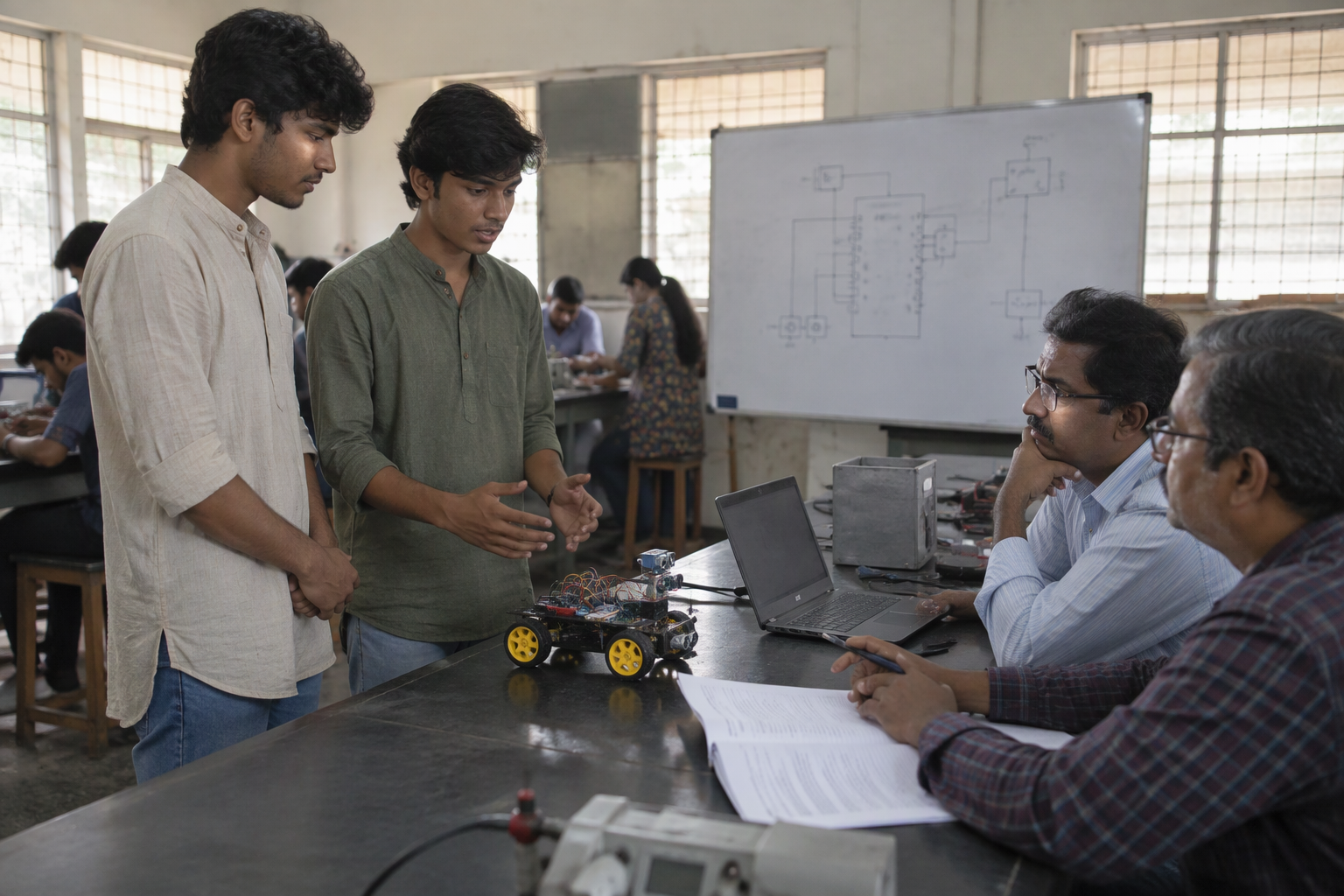
Most robotics project vivas are lost on the second question, not the first. The first answer is rehearsed; the second one — why the driver is an L298N, why the encoder sits on the left wheel, what happens to the controller when the battery sags under load — is where the marks actually are. This page lists the 40 questions Indian examiners ask most often, in the order a viva normally moves, with the answer that scores and the follow-up that usually comes next.
Answers are deliberately short. A viva is spoken, and two sentences you can defend beat a paragraph you cannot. Where a question has a trap built into it, the trap is named.
How examiners actually grade a project viva
A project viva is not a memory test. The panel already has your report; what they cannot get from paper is whether you understand the decisions behind the build. Four things carry almost all the weight, and only one of them is technical recall.
| What is being scored | What full marks looks like | How students lose it |
|---|---|---|
| Working demonstration | The robot does its stated job once, without excuses | Demo depends on a laptop tether or a fresh battery |
| Design justification | Every major part has a reason and a rejected alternative | “Sir, it was in the kit” |
| Debugging account | One real fault, described symptom to fix | “It worked in the lab yesterday” |
| Depth in one area | You can go three questions deep somewhere | Shallow answers everywhere |
The fourth row matters more than students expect. A panel will forgive a simple robot. It will not forgive a student who cannot explain anything on it beyond the title page.
1. Fundamentals
What is a robot, and what separates it from an automated machine?
A robot senses, decides and acts in a closed loop, so its behaviour depends on what is happening around it at run time. An automated machine runs a fixed sequence regardless of conditions. A washing machine is automated. A line follower is a robot because its steering comes from sensor input, not from a stored script.
What are degrees of freedom, and how many does your robot have?
Degrees of freedom are the independent coordinates needed to describe the robot’s configuration. Be precise here, because examiners test it: a differential-drive robot on a floor has three configuration variables — x, y and heading — but only two controllable degrees of freedom, because it cannot slide sideways. That gap is what makes it nonholonomic, and saying so earns the mark.
What is the difference between open-loop and closed-loop control?
Open loop commands an actuator and assumes it obeyed. Closed loop measures the result and corrects. Your robot almost certainly uses both: the drive motors may run open loop on PWM, while the speed controller that keeps it straight uses encoder feedback.
What is a workspace?
The set of points the end effector can physically reach. For an arm it is a volume; for a mobile robot it is the floor area it can occupy. It is a geometry answer, not a control answer — do not drift into accuracy.
What is the difference between accuracy and repeatability?
Accuracy is how close the robot gets to the point you commanded. Repeatability is how tightly it returns to the same point on repeated attempts. A robot can be very repeatable and still inaccurate, and for most pick-and-place work repeatability is the number that matters. The site covers this in more depth in the repeatability versus accuracy guide.
2. Kinematics and mechanism
Explain forward and inverse kinematics in one sentence each.
Forward kinematics takes joint angles and returns the position of the end effector. Inverse kinematics takes a desired position and returns the joint angles that reach it. Forward always has one answer; inverse often has several, and sometimes none.
Why does a two-link arm have two inverse-kinematics solutions?
Elbow up and elbow down. Both reach the same point, and the choice is made by the mechanical limit or by the workspace you need to clear. If your project uses an arm, know which one your code picks and why — see the kinematics basics guide.
What is a singularity?
A configuration where the robot loses a degree of freedom, so a small motion at the end effector needs an impossible joint speed. A fully stretched arm is the classic case. In practice you avoid commanding motion straight through one.
Why use a gearbox if it costs you speed?
Because a small motor makes its torque at high speed, and the load needs torque at low speed. A gearbox trades speed for torque and improves resolution. The cost is backlash and friction, which is the honest second half of the answer.
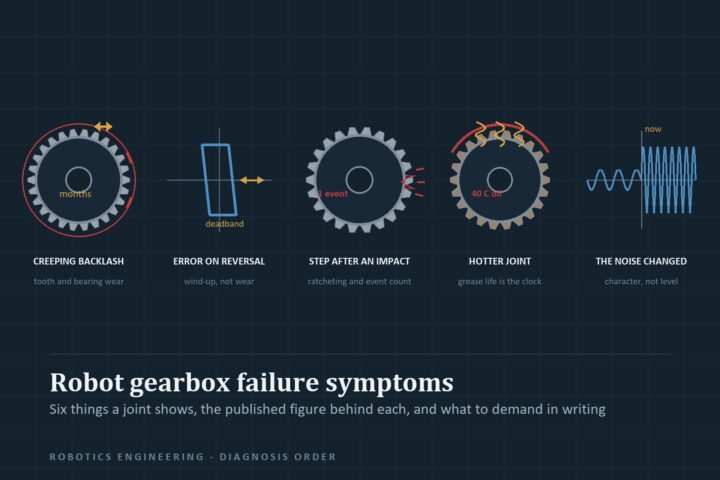
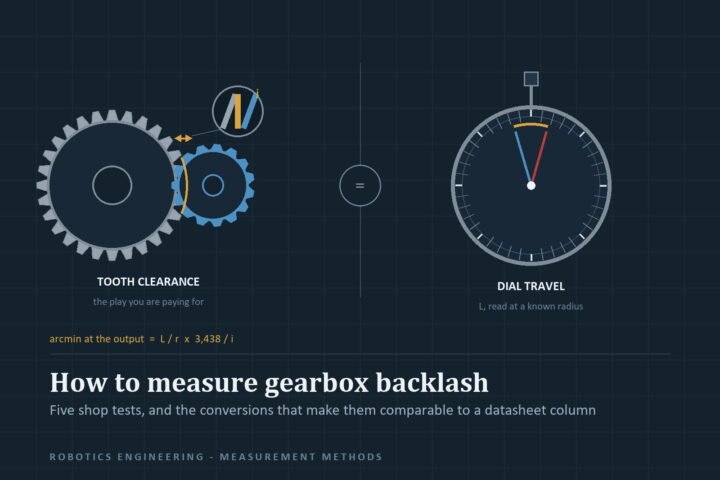
What is backlash, and where did it appear in your build?
Lost motion when the drive reverses direction — the motor turns a little before the output moves. It shows up as a dead zone when the robot changes direction, and it is worst in cheap plastic gearboxes. Say where you saw it, even if you did not fix it.
3. Actuators and motors
DC motor, servo or stepper — when do you choose each?
DC with a driver and encoder for continuous drive where you control speed. Servo for a known angle you need held against load. Stepper for repeatable open-loop positioning at low speed. Most student robots use all three, and being able to say which wheel uses what and why is the real answer. The comparison guide has the trade-off table.
What does the kg-cm rating on your servo mean?
Torque expressed as force times radius. A 10 kg-cm servo can hold 10 kg at a 1 cm arm or 1 kg at 10 cm. The rating is at a stated voltage, usually 4.8 V or 6 V, and it drops if you run it below that.
Why does a stepper motor lose steps?
The load demands more torque than the motor can deliver at that speed. Common causes are accelerating too fast, a current limit set too low on the driver, and mechanical binding. When it happens the position is silently wrong, which is why steppers are usually paired with a home switch.
What is PWM, and why can’t you use it to set a servo angle directly?
Pulse-width modulation varies the fraction of time a signal is high, which averages into variable power for a motor. A hobby servo does not read the average — it reads the width of a single pulse, typically 1 to 2 milliseconds, repeated every 20 milliseconds. Feeding it a motor-style duty cycle gives nonsense.
Why does the motor driver get hot?
Because it drops voltage across its output transistors while carrying motor current, and that lost power becomes heat. Stall current makes it worse, a missing heatsink makes it worse again. A driver that is hot but working is normal; one that shuts down mid-run is undersized.
4. Sensors
How does an ultrasonic sensor measure distance?
It fires a burst of sound, times the echo, and converts time to distance using the speed of sound. Because the sound travels out and back, the distance is roughly the echo time divided by 58 in centimetres. Saying the 58 explains that you understand the round trip.
Why does the HC-SR04 reading jump around?
Missed echoes, angled or soft surfaces, and interference from a second sensor firing at the same time. The fix is usually a timeout on the echo read, a median of several readings, and staggering when multiple sensors fire. The jumping-readings fix walks through it.
What is the difference between an IR reflective sensor and LiDAR?
An IR sensor judges reflected intensity from one spot, so it is cheap, short range and confused by surface colour and sunlight. LiDAR measures time of flight across a scan and returns distance and angle, at a much higher cost and power draw.
How does a wheel encoder work, and how do you convert counts to distance?
A slotted disc or magnetic ring produces pulses as the wheel turns. Convert with counts divided by counts-per-revolution, divided by the gear ratio, multiplied by wheel circumference. If you cannot state your counts per revolution, the encoder is decoration rather than feedback.
What is sensor fusion, and did your project need it?
Combining two noisy sources so the result is better than either. Encoder plus IMU for heading is the standard student example. A robot that only follows a line does not need it; a robot that must know where it is does.
5. Control
Explain PID in terms of what each term does to the error.
The proportional term reacts to the error now, the integral term reacts to error accumulated over time, and the derivative term reacts to how fast the error is changing. P gets you close, I removes the remaining offset, D damps the overshoot.
How did you tune your PID?
Start with P alone until the robot responds but oscillates, add D until the oscillation damps, then add a small I only if a steady offset remains. Say what you observed at each step — the panel is testing method, not the final numbers.
What happens if the integral term is too large?
The accumulated error winds up and the output overshoots badly, then takes a long time to settle. On a robot that starts against a wall or is held by hand, the integral keeps growing while the error cannot be corrected. The fix is clamping the integral, which is worth naming.
Why does a line follower oscillate?
Usually too much gain, too few sensor samples per second, or a sensor array spaced wider than the line. The correction arrives late and too large, so the robot overshoots the line in both directions. Slowing down often fixes what tuning cannot.
What is deadband, and why does it matter at low PWM?
Below a minimum duty cycle the motor does not turn at all — friction wins. If your controller outputs a small correction that falls in the deadband, the robot simply does not respond, and the controller integrates until it finally jumps. Mapping small outputs to zero, or to the minimum that turns the wheel, removes the stutter.
6. Electronics and power
Why does the Arduino reset when the motors start?
The motor inrush current pulls the supply voltage down below the microcontroller’s brownout threshold. The causes are a shared supply, thin wires, or a battery that cannot deliver the peak. The fixes are a separate motor supply, a bulk capacitor at the driver, and a battery rated for the stall current.
Why do the grounds have to be common?
Voltage is a difference between two points. If the motor supply and the logic supply do not share a ground reference, the control signals have no defined level and the driver behaves unpredictably. Connecting only the positive rails is the single most common wiring mistake in student robots.
How did you size the battery?
Add the average current of every load, divide the battery capacity by it for run time, then check the peak current against the battery’s discharge rating. A pack that meets the average but not the stall current will sag exactly when the robot needs torque.
Why is a linear regulator a bad choice for a motor supply?
It burns the voltage difference as heat, so dropping 12 V to 5 V at 1 A means roughly 7 W of heat in a small package. A buck converter switches instead and loses far less. Use a linear regulator for quiet logic, a buck for anything drawing real current.
What is back-EMF, and how did you protect against it?
A spinning motor is also a generator, and switching it off makes its inductance produce a voltage spike. Motor driver modules include flyback diodes for this. If you drove a motor with a bare transistor and no diode, say how it failed — that is a good answer, not a bad one.
7. Microcontroller and code
Arduino or Raspberry Pi — which one, and why?
Arduino for deterministic timing and direct hardware control; Raspberry Pi for vision or networking where a full operating system helps. A Pi’s GPIO timing is not reliable under load, which is a poor fit for motor control loops. The Arduino versus Raspberry Pi comparison covers where each one breaks.
Why is delay() a problem in a robot loop?
It blocks everything, so sensors stop being read and the robot keeps moving on stale information. Replace it with millis() comparisons so the loop keeps running and actions happen on a schedule. If your code still uses delay() in the main loop, expect this question.
What does an interrupt do, and what did you use it for?
It runs a short handler the moment a hardware event occurs, regardless of what the main loop is doing. Encoder counting is the standard use, because pulses arrive faster than a polling loop can catch. Keep the handler short — it blocks everything else while it runs.
How do you debug a robot that does nothing?
In order: is it powered, does the code upload, does the onboard LED blink, does the serial monitor print, does one subsystem work alone. Changing code before checking power is the most common wasted hour in a lab.
What is the difference between a library and a driver?
A library is a package of code you include. A driver is the specific layer that talks to one piece of hardware and translates your commands into its protocol. A library often contains a driver, but the words are not interchangeable.
8. Project-specific and safety
Why did you choose this project?
Give a reason grounded in a real constraint — cost, a local problem, a skill you wanted. “It was available” is honest but scores nothing. The strongest answer connects the project to something you would build again.
What was the hardest bug?
Have one ready, with symptom, hypothesis, test and fix. Panels remember a well-told debugging story far longer than a list of features, and it is the cheapest way to demonstrate that you did the work yourself.
What would you change with another five thousand rupees?
Name the weakest link, not the flashiest upgrade. Usually that is the power system or the sensor that made the demo unreliable. If you are rebuilding on a budget, the robot under ₹2,000 guide shows where the money actually goes.
What happens if a sensor fails mid-run?
Describe the failure mode and the safe state. A robot that keeps driving on a stale distance reading is a design flaw; one that stops when readings time out is defensible. This question is checking whether you thought about failure at all.
Where would this design be unsafe on a real shop floor?
Be specific: no e-stop, no guard, exposed drive, no risk assessment. Industrial cells are built to standards such as ISO 10218-2 precisely because a working prototype is not a safe machine. Saying that unprompted reads as maturity, not criticism of your own project.
How to answer when you do not know
Every viva contains a question you cannot answer. What matters is how you handle it, because the panel is watching for honesty and reasoning, not perfection.
- Do not invent a number. A confident wrong value is worse than “I would need to check that”.
- Say what you do know. “I did not measure that, but the driver is rated for 2 A per channel and the motors stall near 1.5 A” shows the reasoning still works.
- Offer the method. Explain how you would find out — measure, read the datasheet, run the test.
- Do not argue. If the panel corrects you, take the correction and build on it.
Five follow-ups that catch most students
These are the second questions. Prepare them and the viva stops being unpredictable.
- “Why that value?” — asked about every resistor, capacitor and gain. Know at least the reasoning, even if the value came from a tutorial.
- “What if it were twice as heavy?” — tests whether you understand torque and current, not just the build.
- “Show me the code path.” — you should be able to point to the exact function that reads the sensor and the one that sets the motor.
- “What did you measure?” — a project with no measurement reads as copied. Even one logged cycle time or distance test helps.
- “What is the failure mode?” — asked about the whole system. Answer with the safe state, not with “it stops”.
Frequently asked questions
How long does a robotics project viva last?
Typically 10 to 20 minutes per team, with the demonstration taking a third of it. Prepare a 90-second demo script and a three-question-deep explanation of one subsystem; most panels spend the rest of the time on whatever you mention.
Can I keep the robot running during the viva?
Usually yes, and you should. A robot that is visibly powered and idle invites questions about whether it works. Keep the battery charged, keep a spare set of batteries, and rehearse the demo on the actual floor rather than a lab bench.
Do examiners ask for maths derivations?
Rarely in full, often in reasoning. You may be asked to write the PID equation, explain a Jacobian qualitatively, or derive torque from a gear ratio. Know the shape of the maths and what each symbol means; memorised derivations are less important than being able to reason with the equation.
What if my robot fails during the demonstration?
Say what failed, run the first diagnostic step out loud, and if it cannot be fixed in a minute, explain what the robot does when working and what the failure implies. Panels mark the debugging, and a calm diagnosis often scores better than a flawless demo.
Should I carry the report and code printout?
Carry both, plus the wiring diagram on one page. The wiring diagram is the document panels ask for most often, and having it ready signals that you understand your own build rather than having assembled it from a video.
Sources
- Arduino, Language Reference — analogWrite, attachInterrupt and millis behaviour used above.
- ROS 2 Documentation, ROS 2 Docs — kinematics and controller terminology as used in robotics courses.
- ISO, ISO 10218-2 — robot system and integration safety requirements referenced in the safety question.
Related reading: project report format · final year robotics projects · diploma project ideas · robotics interview questions · portfolio projects guide · Arduino projects for beginners.