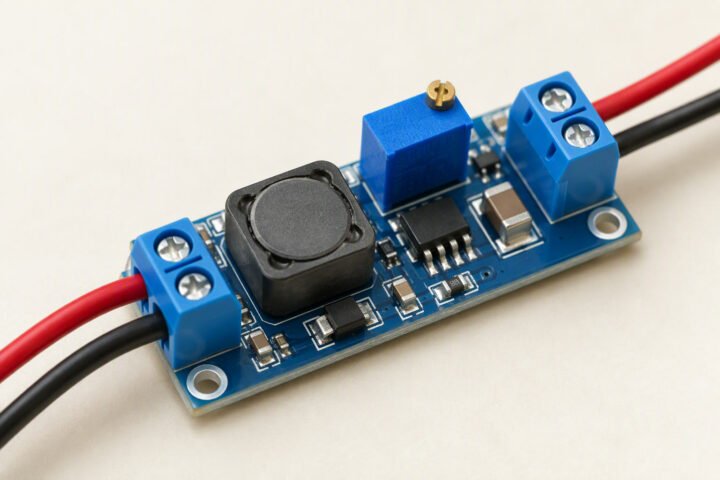
LoRa is a long-range, low-data-rate radio that suits sending small sensor and status messages across a field, not video or live control. Before you buy a lora module farm robot setup, check the frequency band allowed in India, the antenna and whether you need a gateway.
Key takeaways
- LoRa trades data rate for range, so it carries short messages rather than streams.
- Modules are sold for different frequency bands, and you must use one legal where you operate.
- A simple point-to-point link needs no gateway, but a LoRaWAN network does.
- A walking test in your own field tells you more than any listed range.
LoRa module for a farm robot: frequency band rules
The frequency band is the range of radio frequencies a module transmits on. LoRa modules are sold for several bands, for example 433 MHz, 868 MHz and 915 MHz, and the legal choice depends on the country.
In India, the 865 to 867 MHz range is commonly cited as licence-exempt for low-power devices, but rules and limits are set by the telecom authorities and can change, so read the current notification before you buy or sell anything. Do not assume that a module labelled for another region is legal here. Buy a variant that lists support for the band you intend to use, and ask the seller. This is general guidance, not legal advice.
Range and antenna
Range is how far a message arrives reliably, and for LoRa it depends heavily on the antenna, height and obstacles. Open fields with a clear line of sight give the strongest results, while crops, trees, walls and metal frames reduce them.
Use an antenna made for your band and attach it before powering the module, since transmitting without one can damage the radio. Mount it high and vertical, away from the robot’s metal body and batteries. Quoted ranges in listings are typically best-case figures, so treat them as upper limits. Our overview of agricultural robots in India shows the field conditions you should plan for.
Data rate limits
LoRa settings such as spreading factor and bandwidth set a trade-off: higher spreading factors reach further but send data much more slowly. Effective rates can be a few hundred bits to a few thousand bits per second, so check the settings you plan to use.
Work an example with assumptions. If the effective rate is 1,000 bits per second and a message is 20 bytes, that is 20 x 8 = 160 bits, so sending it takes 160 / 1000 = 0.16 seconds. Real air time also includes headers, so it will be longer. Duty cycle rules, where they apply, limit how often you may transmit. Send short numeric readings, not text-heavy or image data. If you need bigger messages or faster links, a Wi-Fi or mobile network may suit better; see our guide to MQTT telemetry for an ESP32 robot.
Gateway needs
A gateway is a device that receives LoRa packets and forwards them to the internet or a server. Simple point-to-point use, with one module sending to another, needs no gateway at all.
LoRaWAN is a network standard that does use gateways and a network server. That adds cost, setup and a dependency on internet access in the field. For a single farm robot reporting to a base station, point-to-point is often enough. If you want to see readings on a web page, the ESP32 DHT22 web dashboard shows a way to display data once it reaches a board that has Wi-Fi.
Power use
LoRa modules draw most current while transmitting and very little while asleep, so the pattern of use sets battery life. Check the datasheet for transmit current, receive current and sleep current.
On a farm robot with a large battery, the radio is a small load next to the motors. On a sensor node that runs for weeks, sleep current and sending interval matter most. Estimate a budget with our robot battery runtime calculator and read the robot battery guide for pack basics. Handle lithium cells carefully; this is general guidance and not a substitute for the cell maker’s instructions.
Field test plan
A field test plan is a written routine for measuring your link before you rely on it. Test in the real field, at crop height, with the robot’s motors running.
For the controller, a board such as the ESP32 DevKit V1 is common in hobby projects, and the ESP32 WiFi robot car with web control shows how it handles wireless control over a short range. Pair a LoRa module with a controller you already know how to program. For more project ideas, browse the build hub.
| Check | What to look for |
|---|---|
| Band | Variant matching the band legal in India |
| Antenna | Correct band, attached before power-up |
| Data rate | Settings suited to short messages |
| Gateway | Point-to-point or LoRaWAN, decided early |
| Power | Transmit and sleep current from datasheet |
How to check this yourself
- Read the current Indian notification for the licence-exempt band and match it to the module’s listing.
- Send a numbered message once a second from a fixed spot and confirm the receiver logs every number.
- Walk away in fixed steps, noting the distance where messages begin to go missing.
- Repeat with the robot’s motors running and compare the missing count.
- Change one setting at a time, such as spreading factor, and repeat.
Common mistakes
- Buying a module for a band that is not allowed for your use.
- Transmitting with no antenna connected.
- Expecting video or high-rate control over LoRa.
- Trusting a listed range without a field walk test.
Quick checklist
- The module variant matches the legal band.
- The antenna fits the band and is mounted high.
- My messages are short and my rate is calculated.
- I decided between point-to-point and gateway.
- I have a written walk test plan.
Frequently asked questions
Which LoRa frequency can I use in India?
The 865 to 867 MHz range is commonly cited as licence-exempt for low-power devices, but rules and limits are set by the telecom authorities and can change. Check the current official notification before buying or selling, and choose a module variant that states support for that band.
How far can a LoRa module send data on a farm?
It depends on antenna, height, settings and obstacles. Listings give best-case figures from open space, while crops and trees reduce them. The only reliable answer is your own walk test: send numbered messages, walk away in fixed steps, and count the missed messages at each distance in your own field, with the robot’s motors running.
Do I need a gateway for a LoRa farm robot?
Not for simple point-to-point links, where one LoRa module sends straight to another module. You need a gateway only if you use a LoRaWAN network that forwards messages to the internet. Decide this early, since it changes cost, setup and what the robot can report to you.
Related reading
- Learn hub for wireless and sensing basics.
- Wiring checker for SPI pin planning on ESP32.
- Robotics project report template to record your field test.
- Voice Recognition Modules for Robots: Offline or Cloud
- LiPo Charger Module: What to Check Before Buying
- Desktop Robot Arm Kits: What to Check Before Buying
About the author and how this is kept accurate
Written, checked and maintained by Jignesh Panchal of Jaadu Digital. Figures in worked examples come from the stated assumptions, not from a bench test of our own. Read the editorial standard, follow the author on LinkedIn, or send a correction. Last reviewed: November 2026.