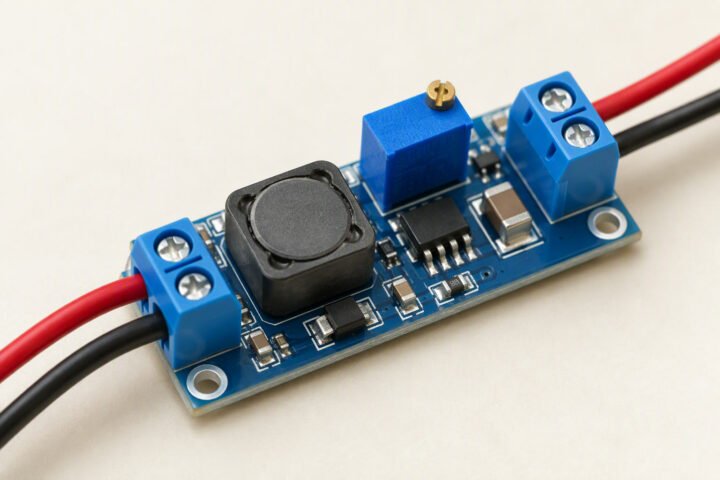
Before buying a LiPo charger module, check that it supports your cell count, lets you set a charge current at or below your battery’s rating, and has the protection and input range you need. A LiPo charger module that charges the wrong voltage or at too high a current can damage a battery or start a fire.
Key takeaways
- A single lithium polymer (LiPo) cell is typically charged to 4.2 V, using constant current first and then constant voltage as the current tapers.
- Charge current is usually set by a resistor or a setting on the module, and it must not exceed the limit on your cell datasheet.
- Packs with two or more cells in series need a charger that supports that cell count, and usually one that balances the cells.
- A module that has no battery protection circuit relies on you to avoid over-discharge, short circuits and wrong polarity.
Charge current setting
Charge current is the current the module pushes into the battery during the constant-current phase. It is often described as a C-rate, where 1C means a current in amperes equal to the capacity in ampere-hours.
Work out your own number from stated assumptions. Take a 1000 mAh cell, which is 1 Ah. A 0.5C charge is 0.5 times 1000 mA, which is 500 mA. A 1C charge is 1000 mA. For a 2000 mAh cell, 0.5C is 1000 mA. Check the cell datasheet for the maximum charge rate, since many small cells are only rated for around 1C or less, and some cells are rated lower. When in doubt, charge more slowly.
On many popular single-cell modules the charge current is set by a programming resistor, and the formula comes from the chip datasheet. Check your chip datasheet and compare it against the resistor on the board, because some boards ship with a default current that is too high for a small cell. A sticker on the board does not replace reading the resistor value. Our LiPo battery safety and charging guide explains why a slow charge is gentler on the cell.
Cell count support
Cell count is how many cells are in series in the pack, written as 1S, 2S, 3S and so on. Each cell charges to about 4.2 V, so a 2S pack charges to about 8.4 V and a 3S pack to about 12.6 V.
A module made for 1S must never be used on a 2S pack, because it would try to charge to 4.2 V and mismatch the cells. Check the listing for the exact cell counts it supports and whether it balances each cell. Balancing means the charger watches each cell separately and prevents one cell from running high while another is low. For packs with more than one cell, use a charger that balances through the balance lead, and read how battery management systems for robotics handle protection and balance.
Use the battery pack series and parallel calculator to check voltage and capacity for your intended pack before you pick a charger. Note that cells in parallel share the same voltage rating, but you still need to charge them as one group.
Protection circuit
A protection circuit is a small board or chip that cuts the battery off when it is over-charged, over-discharged, over-current or short-circuited. A charger module and a protection board do different jobs, and some modules include both while others include only the charger.
Check the listing for protection on over-discharge, over-current and short circuit, and check whether it is on the charger board or on the battery. If it is missing, you need a separate protection board or a pack with one built in. Bare cells often have no protection. For a robot that can stall a motor, a short or a heavy current spike is a real risk, so make sure the protection limit is above your normal running current.
Look at the pin labels and polarity markings on the board. Wrong polarity on a LiPo can destroy the cell, so check twice before you connect. The BQ2407x LiPo charger component page shows what a charger IC with defined charge stages looks like on a module.
| Check | What to look for | If missing |
|---|---|---|
| Cell count | Matches your pack, 1S or more | Do not use it |
| Charge current | Adjustable and below the cell limit | Add a lower-current charger |
| Over-discharge cut-off | On module or battery | Add a protection board |
| Short-circuit protection | On module or battery | Add a fuse or protection board |
| Status LEDs | Charging and done indications | Use a meter while charging |
| Input voltage range | Matches your supply | Use a suitable supply |
Input supply range
The input supply range is the voltage the module accepts on its input. Many single-cell modules use a 5 V USB supply, while multi-cell chargers need a higher voltage than the pack voltage.
The charger must be able to drive the pack to its full voltage, so the supply voltage must be higher than the pack charge voltage. A 5 V USB input is fine for a single cell at 4.2 V, but it cannot charge a 2S pack at 8.4 V unless the module has a boost stage. Check the listing for the minimum and maximum input and the current the supply must provide. A weak phone charger can sag and make the module behave oddly.
Use a quality supply with a current rating above the charge current you set, and avoid unbranded adapters with no markings. Do not open or modify mains-powered adapters. If you are unsure about the supply, use a ready-made DC adapter or USB supply from a reputable seller and a qualified person to advise on anything involving mains wiring.
Heat and layout
Heat is the energy lost in the charger chip and traces. Linear chargers drop the extra voltage as heat, so a higher input voltage and a higher current make the chip hotter.
Check whether the board has a thermal pad, a heatsink or a thermal regulation feature, and place it away from the battery. A hot charger next to a cell is a poor design. Look for clear traces, enough solder on the power pins and strong connectors. Thin wires and cheap connectors can heat and loosen, so choose a connector rated above your current. On a robot, mount the charger where air can move, and not wrapped in foam or tape.
In the ESP32 robot car and the obstacle avoiding robot, the battery and charger placement affects wiring length and heat, so check both before you route cables.
Charging habits
Charging habits are what you do around the charge, and they matter as much as the module. Good habits prevent most incidents.
- Charge on a non-flammable surface, in view, and not overnight or unattended.
- Stop at once if the battery swells, smells, gets hot or the module behaves oddly.
- Do not charge a cell that is damaged, puffy or deeply over-discharged.
- Keep a fire-safe container and sand or a suitable extinguisher nearby, as the battery guidance recommends.
- Disconnect the battery when you have finished.
For a broader view of battery choices, read the robot battery guide listed under related reading, and compare it with your own runtime needs before you pick a pack.
How to check this yourself
- Read the charger chip datasheet and note the full-charge voltage, charge current formula and termination current.
- Calculate the charge current you want from the cell capacity, for example 0.5C, and compare it with the resistor or setting on the module.
- With a meter on the output and no battery connected, check that the output voltage matches the expected full-charge value for your cell count.
- Charge a healthy cell while watching it and a thermometer or fingertip check on the chip, and stop if anything gets hot.
- Log the voltage and current at intervals and compare the pattern with the constant-current and constant-voltage description in the datasheet.
Common mistakes
- Using a single-cell module on a multi-cell pack.
- Leaving the charge current at the factory default for a small cell.
- Charging unattended or overnight.
- Assuming a module has protection without checking.
- Using the wrong polarity on the battery connector.
Frequently asked questions
What charge current should I use for my LiPo battery?
Check the cell datasheet for the maximum charge rate, then choose a lower value for a gentler charge. As a worked example, a 1000 mAh cell at 0.5C is 500 mA. If you cannot find a rating, charge slowly and watch the cell throughout.
Can I charge a 2S LiPo with a single-cell charger?
No. A single-cell charger targets about 4.2 V, which would leave a 2S pack undercharged and unbalanced, and a wrong connection could damage it. Use a charger that lists support for your exact cell count and balances each cell through the balance lead.
Do I need a protection board on my LiPo battery?
Yes, unless the pack already has one. A protection circuit cuts off the battery on over-discharge, over-current or a short circuit. Bare cells often have none. Check the listing, and add a suitable board or a fuse if protection is missing. This is general guidance, so follow the cell maker’s advice.
Related reading
- Robot battery guide, to choose the pack that the charger will serve.
- Learn hub, for battery and power basics.
- Build hub, for projects that use rechargeable packs.
- Voice Recognition Modules for Robots: Offline or Cloud
About the author and how this is kept accurate
Written, checked and maintained by Jignesh Panchal of Jaadu Digital. Figures in worked examples come from the stated assumptions, not from a bench test of our own. Read the editorial standard, follow the author on LinkedIn, or send a correction. Last reviewed: November 2026.